Every stone
We left Toruń after breakfast, with Przedecz to reach by lunchtime and Łódź by the evening. Przedecz is the town my grandfather came from.
My father was born in Lippe, and that is the recent part of this. His people were German in Poland long before any of them lived in Germany. They came into the marshes of Kujawy from the 1700s, German-speaking Lutheran farmers on long leases, invited in by Polish landlords to drain and work ground nobody else wanted, and they came before Poland was partitioned at all. The empire came to them; they did not come to the empire, and the farm never moved. What moved was everything above it: Poland, then Prussia, then Russia, then Poland again, then Germany for six years, then Poland.
What actually happened is that we drove into a town I had not meant to stop in, I saw the name on the sign, and I pulled over.
Chodecz. I knew the name and could not produce a reason for knowing it, which is a particularly annoying condition to be in at forty miles an hour. The answer took most of the morning to surface. My uncle had sent me a research report some years ago, in German, and at the end of it there is a list of what remains unresolved. One item is a birthplace. It appears in the records as Glocken, a real village with real people in it, two farmers named on wartime papers as farming there, and no modern Polish name that anybody has yet been able to match it to. The report’s recommendation was to search the church books of the Evangelical parish at Chodecz or Przedecz, to establish where Glocken was and what it is now called.
So the name on that sign was never mine. It was somebody else’s instruction, long since filed below the level I could reach.
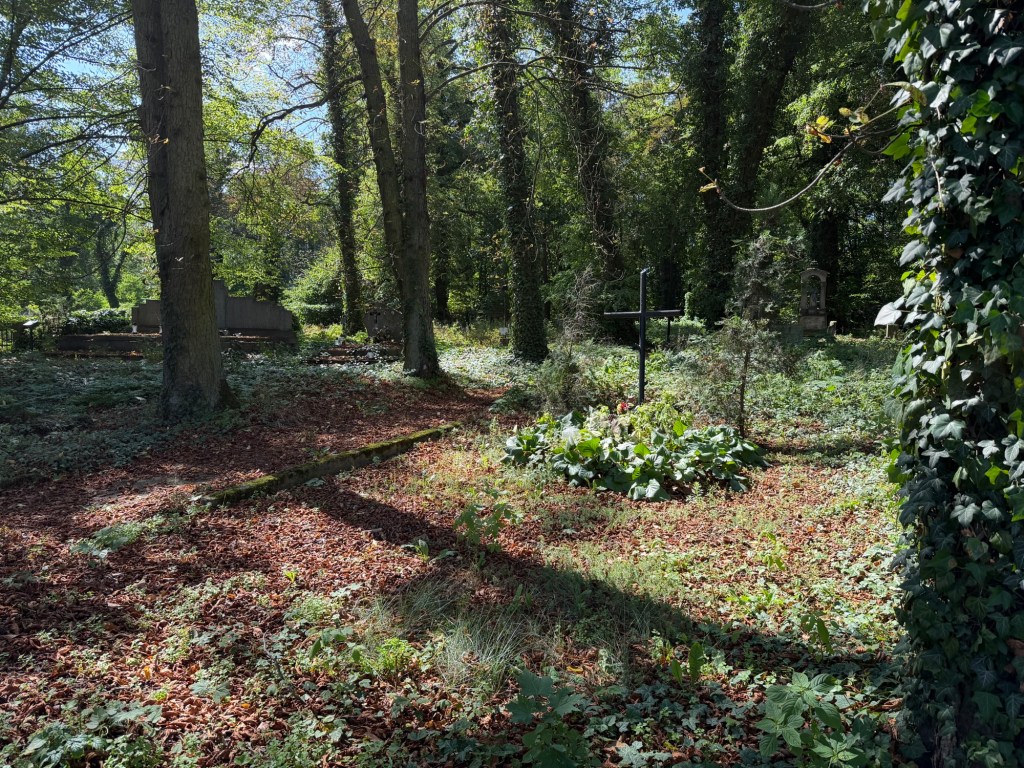
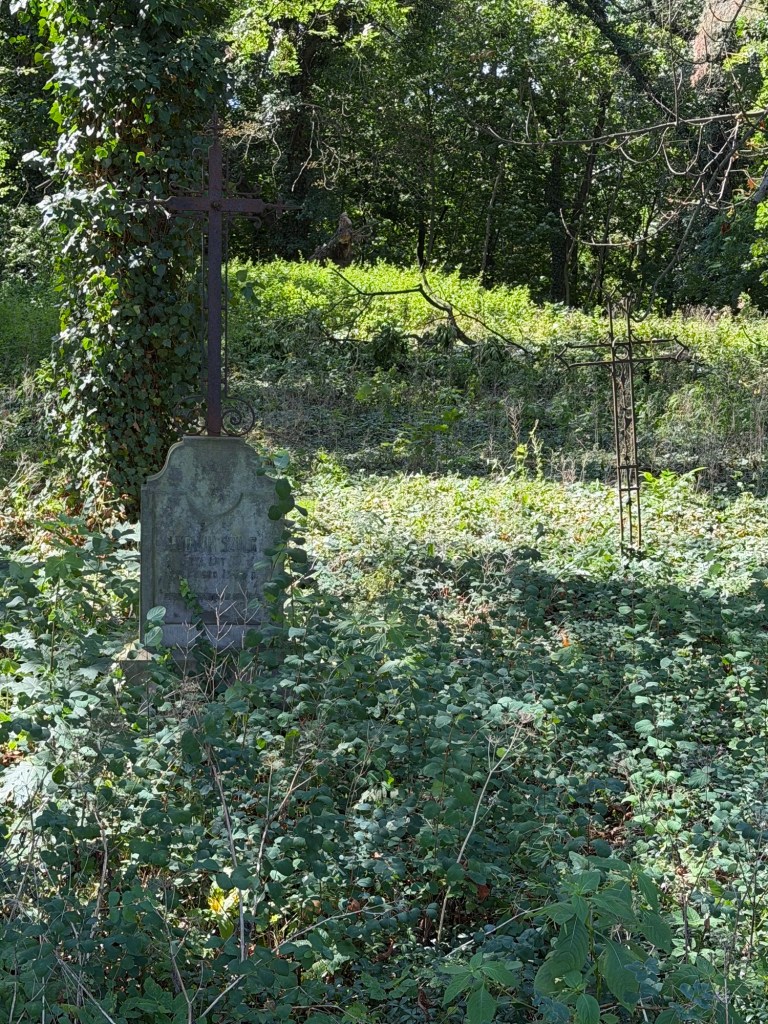
We found the Evangelical cemetery on the edge of the town. It is in woodland, it has a black iron cross standing in the middle of it, and nobody is looking after it. Ivy has come up over the stones the way water comes up over a slipway. We gave it an hour and read every stone we could get at, and there was not one Krentz.
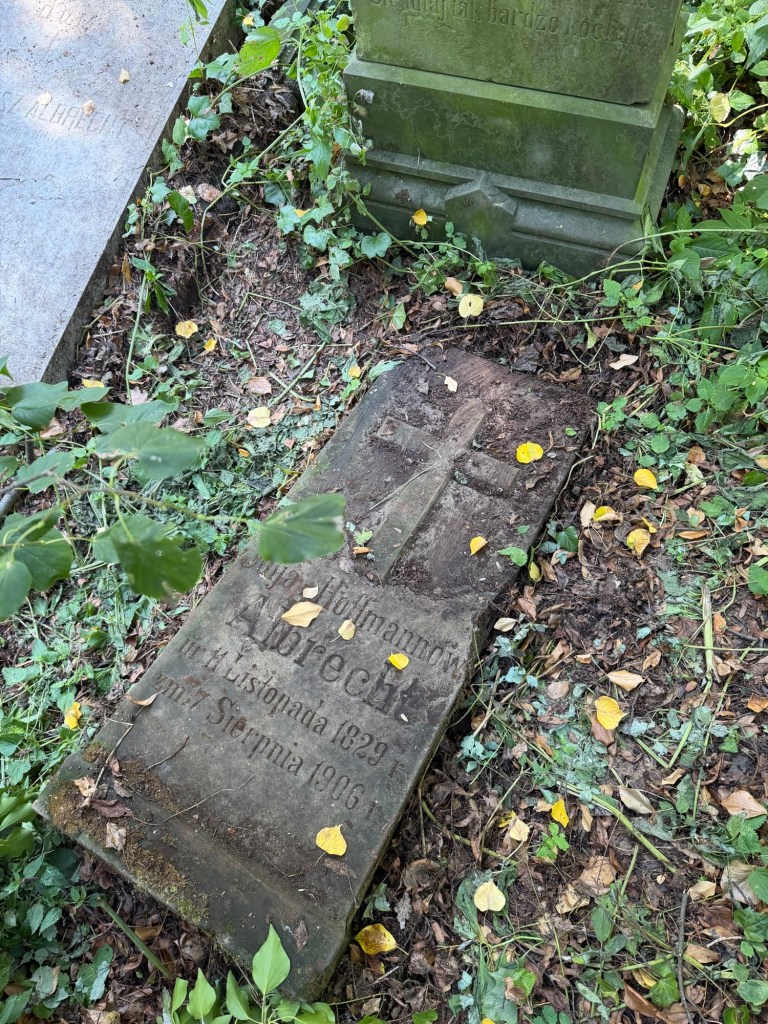
Most of them cannot be read at all. Some have come off their bases and lie face down. This one had gone over backwards and kept its lettering, which makes it the exception: a Hoffmann married into an Albrecht, born on the eleventh of November 1829 and dead on the seventh of August 1906.
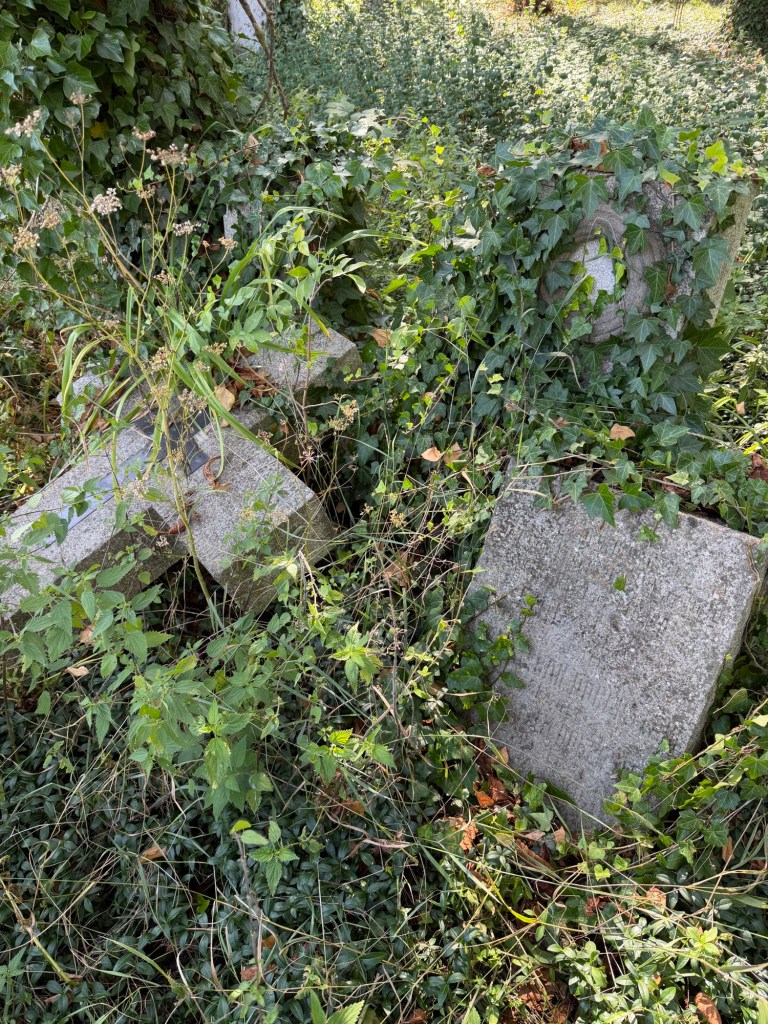
Alongside it, three more, and nothing to be got from any of them without shears and a free afternoon.
The other one I could read was Ludwik Szulc, or Szulg. We could not agree on the last letter, a c or a g, and it is the letter that decides what the name is. Szulc is what becomes of Schulz once a Polish clerk has written it down. Szulg is not much of anything. He lived seventy-four years and was buried here in 1936, when there was still an Evangelical congregation in the district to bury him.
We got back in the car and drove on to Przedecz, and it was only afterwards that the shape of that hour became clear to me. The recommendation had been to look in the church books. I had gone and searched the graveyard instead. Those books have since given up a marriage act of 1827 that answered a question I had been carrying for a year, and I had stood in the right town and not gone into the building.
Glocken has been found since, and it is Kłokoczyn, a village of the Przedecz commune four and a half kilometres up the road from where I stood reading gravestones that morning. Glocken was never really its name. It is a wartime calque, a German word chosen to chime with the sound of the Polish one and imposed from 1939, and it lasted six years, which is exactly the trick that was played on Przedecz itself. Kłokoczyn is on the list of villages belonging to the Przedecz starostwo in 1489. My uncle put that question years ago and has his answer now, from the one member of the family who had driven to the right town and searched the wrong site.
Moosburg
Przedecz has a church on a mound at the top of the town and the church is not a church. It was a castle first. The Teutonic Order took the earlier earthwork here in 1329 and held this corner of Kujawy for about a dozen years, and it was the Order that renamed the place Mosburg. Read plainly that is the moss castle, and Moos does mean moss, but in older and southern German it also means bog or marsh, which is why the Polish accounts render it as the boggy castle and why anybody who has walked this ground in October would accept either. The Polish name is far older than the German one. Przedecz is in a papal bull of 1136.
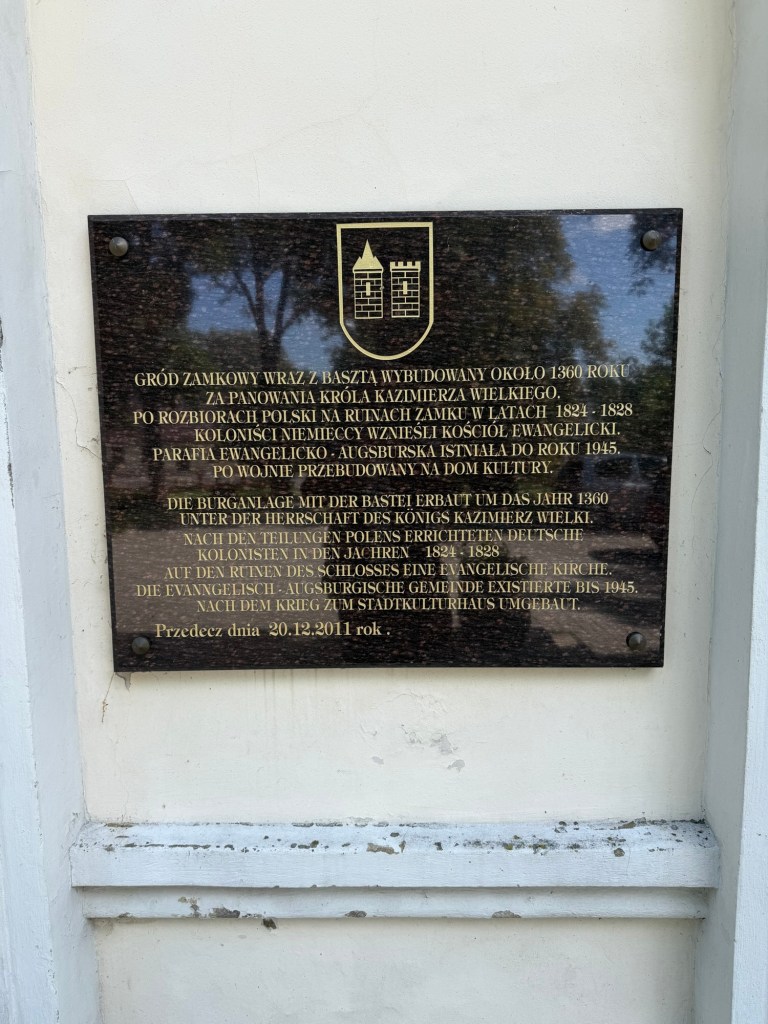
Casimir the Great got Kujawy back at the Peace of Kalisz in 1343, took Przedecz by exchange four years later, and built a stone castle, finished about 1360. What survives of it is a tower and some footings, and around them German colonists put up an Evangelical church between 1824 and 1828. That parish lasted until 1945. The building is now the culture centre and the public library.
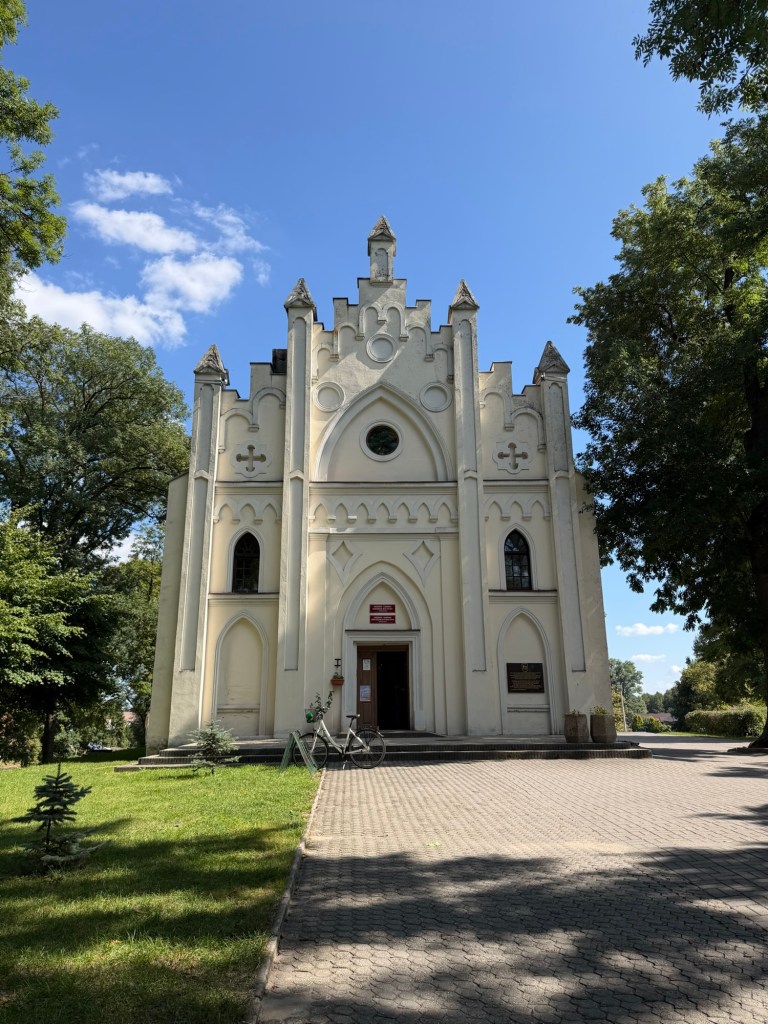
All of that is on a plaque by the door in Polish and German, and I would have liked longer with it than I got.
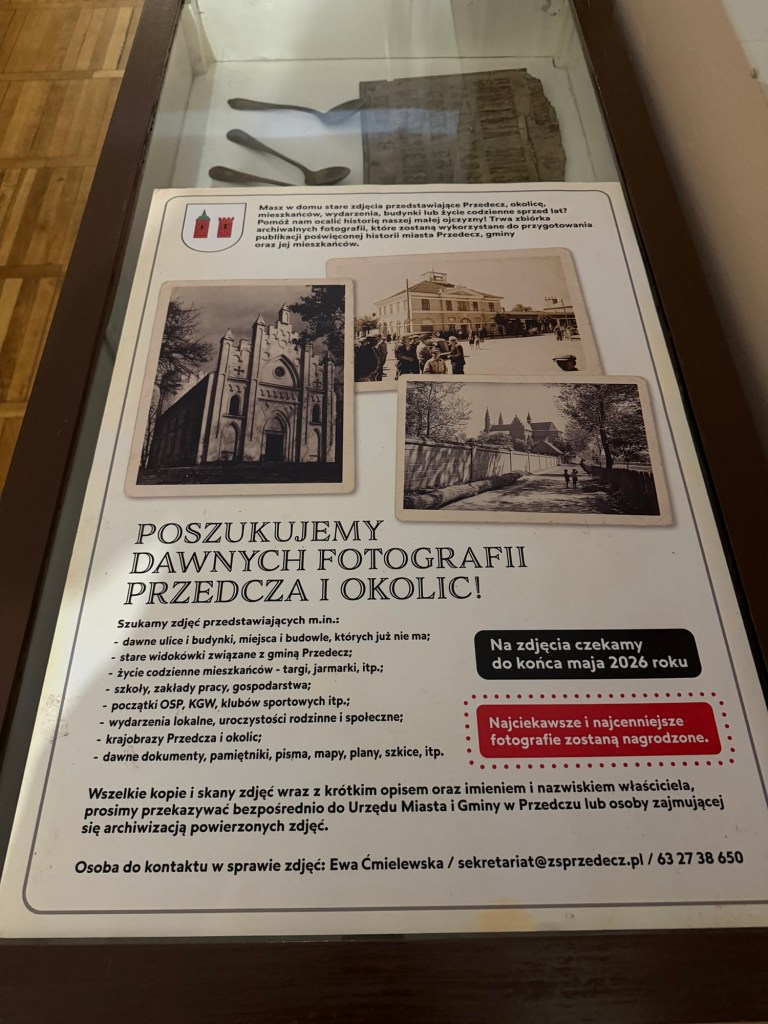
Inside there is a case of things dug up or handed in: spoons, flasks, a couple of rusted guns, a broken sign. Propped in with them is a poster asking anyone in the town who has old photographs of Przedecz to bring them in, so they can be copied before they go. They want streets that no longer exist, market days, workshops, farms, family occasions. There is a closing date on it. I read the list twice, because the family album did not survive 1945 and there is almost nothing on my side from the years before the war.
There was a lady working inside. My girlfriend spoke to her in Polish and she said the town hall holds the records, and that we should go there.
A museum that is not open yet
On the way down to the cemetery we passed a sign for the museum of local history. The door was standing open, so we went in. We were most of the way to the stairs before it became apparent, in the way these things become apparent all at once, that we were standing in somebody’s house.
We got out fast. A man outside stopped us, laughing, and explained that the sign had gone up early and the museum is not ready. It is clearly a work in progress and the town is clearly proud of it, which is the same instinct as the poster in the display case, and I would rather a place put its sign up too soon than never get round to it.
The flower shop
The Lutheran cemetery is on the far side of the town and we walked to it. It was locked. It looked worse from the gate than Chodecz had from the inside, everything above waist height under green.
A woman came out of one of the houses beside it while we were standing there. My girlfriend asked her how you get in. The flower shop, she said. They look after it and they hold the key. She also explained, without being asked, why it had got away from them this year, which was that the people who normally cut it had been taken up with a local festival. She was not making excuses. She just did not want two strangers to draw the obvious conclusion.
The town hall shut at half past three, so the key would have to wait.
The books
I expected nothing. Walking into a municipal office in a small town, unannounced, in August, to ask a stranger about a family that stopped being local in 1945, is not a promising line of enquiry, and I was ready to be told to write in.
My girlfriend spoke to the clerk on duty. She said she was very busy, and that she would have a look.
She then spent an hour with us. She had the books out on the counter, deaths and marriages, going back well past the First World War, and she went through them page by page. We found Walter-Willy, my grandfather’s older brother. Born at Jasieniec on the twentieth of September 1919 at ten in the morning, and registered on the fifth of October by his father, who is down as August Krentz, farmer, aged twenty-seven. The mother is Ida née Kaus, aged nineteen. The witnesses are Marcin Krentz, twenty-nine, and another August Krentz, sixty-two.
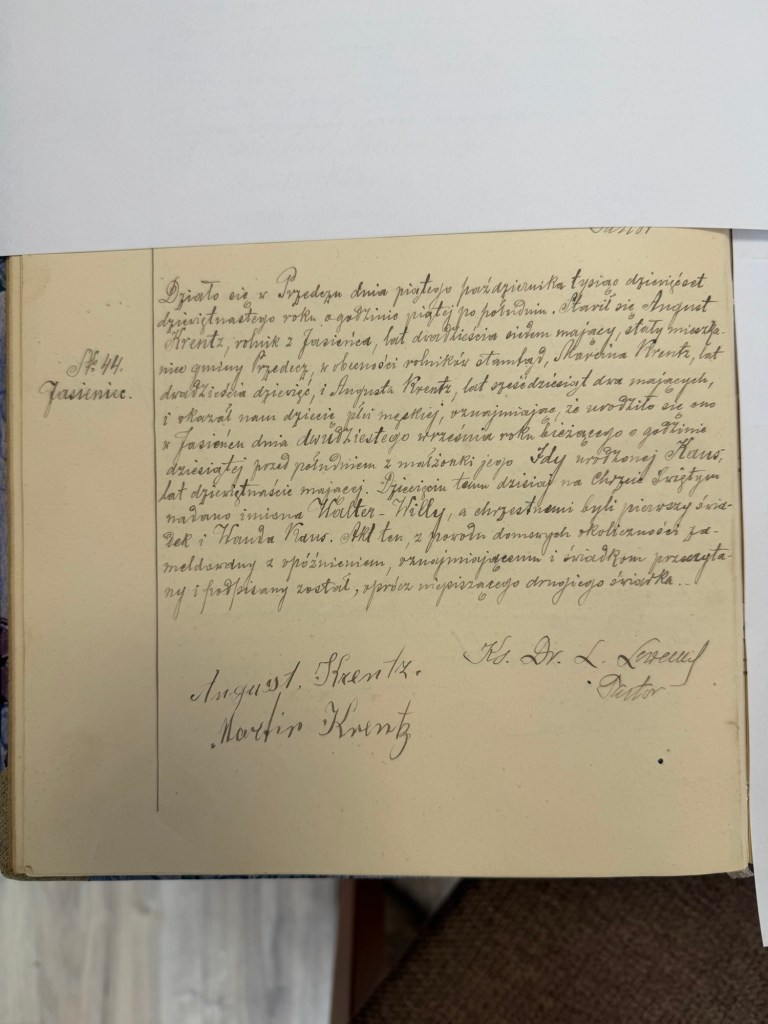
Two things sit at the foot of that page. The christening was late, and the act says so and blames domestic circumstances. And the closing clause records that everything was read out and signed by all present except the second witness, who does not write. The second witness is the August who is sixty-two, which by his age and his village makes him my great-great-grandfather. He could not sign his own name.
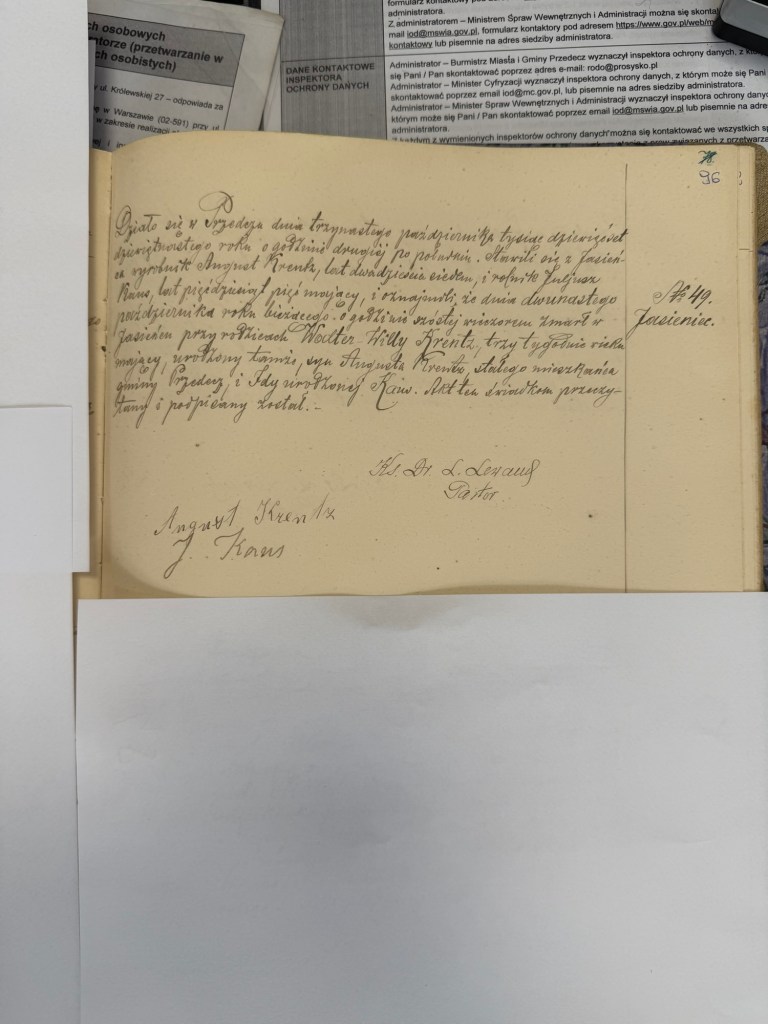
Walter-Willy died on the twelfth of October at six in the evening, at his parents’ house, three weeks old. His father registered that too, and this time the clerk has written him down as a labourer rather than a farmer. The second witness is Juliusz Kaus, fifty-five, the child’s other grandfather.
The same hour gave us the old man’s own death, thirteen years and two months after he had stood in that same office at Przedecz and been unable to sign his name.
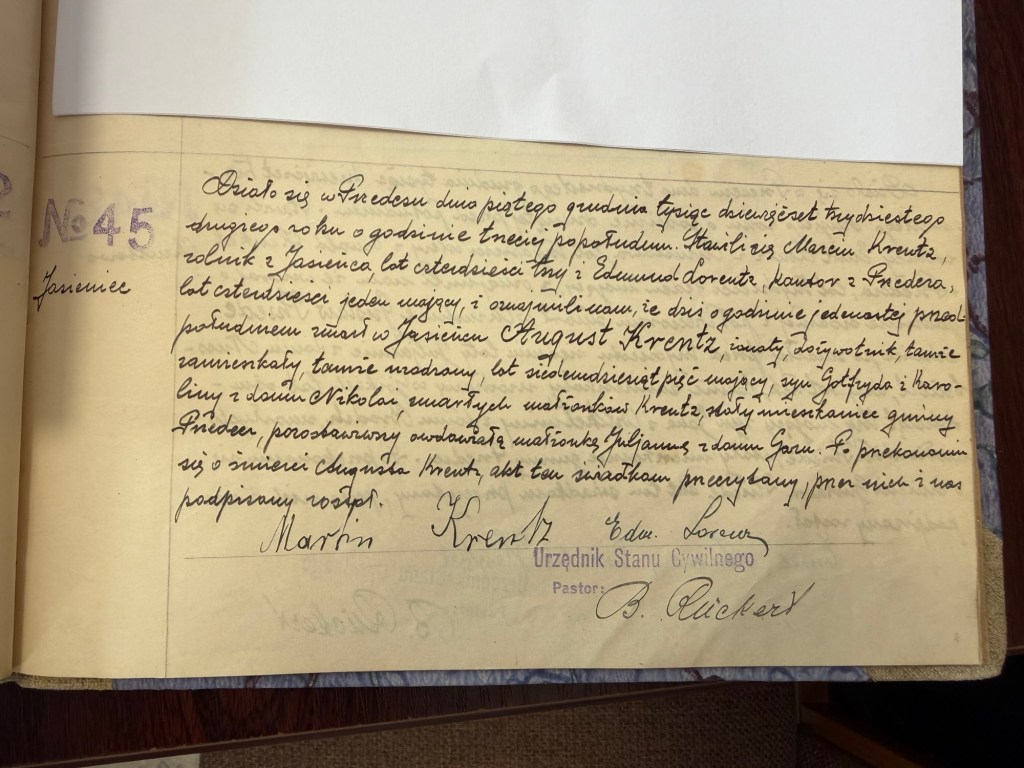
The act itself is a dense paragraph of close Polish cursive and it gives you everything. August died at eleven in the morning and the act was drawn at three in the afternoon. He was seventy-five, married, a dożywotnik, which is the retired farmer living on the holding he has signed over. Born there, lived there, died there. Two men came in to report it: Martin Krentz, a farmer of Jasieniec, aged forty-three, who was August’s own son and so my great-great-uncle, and Edmund Lorentz, the cantor, aged forty-one. Then the line I had come several hundred miles for without knowing it, which names August as the son of Gotfryd and Karolina née Nikolai, both by then dead, and records that he left a widow, Julianna née Garn.
Until that afternoon I had my great-great-grandparents’ names only as my grandfather had recited them. Here was the generation above, written down by people who had no notion that anyone would ever come looking.
Martin signed his own name at the foot of it, and the hand is his. The clerk who drew the act had written him into the body of the text as Marcin, which is the Polish form, and he then signed himself Martin. The same thing is happening on that page as on the stone at Chodecz, except that here the man got the last word. And something like it happens twice on the same page. The clerk wrote the cantor in as Edmund Lorentz, and the name under it looks to me like Lorenz, without the t.
The act is signed twice at the foot and stamped once. The stamp says Registrar of Civil Status. Under it, in the same purple ink, it says Pastor, and B. Rückert has signed. One man, two offices, one book. That is how these parishes worked, and it is why the record of a German Lutheran farming family in central Poland sits on a shelf in a Polish town hall rather than in any church archive.
The clerk, it emerged, had done her academic research on the history of this district and the families in it. She was certain there were no Krentz graves in the town, because she had studied that cemetery in detail, and she named several others out in the country that might repay a look. The nearest was an hour away in the wrong direction and we were expected in Łódź. They will keep.
My grandfather was wrong about something too, and it turns on the two old men in those October pages. Both of his grandfathers are in that book, eight days apart: August Krentz on the birth act, Juliusz Kaus on the death. When he came to dictate his own account he gave four grandparents’ names, and two of them were right but on the wrong side. He had taken his mother’s people, the Kaus family, and set them down on his father’s line. He was eighty-eight when he did it. I am not going to hold that against him.
One more thing about that page, which I only worked out afterwards. Edmund Lorentz, the cantor who signed as a witness in 1932, is the same Edmund Lorenz who wrote the account of what happened to this community in September 1939, naming the dead one by one. I had photographed his signature without knowing whose it was.
Waldstraße 1
The farm was in the town itself. Waldstraße 1, in my grandfather’s telling, and the street carries the same name today in Polish. The number is still 1, on a black plate on a brick gatepost, and there is a Polish flag flying over it.
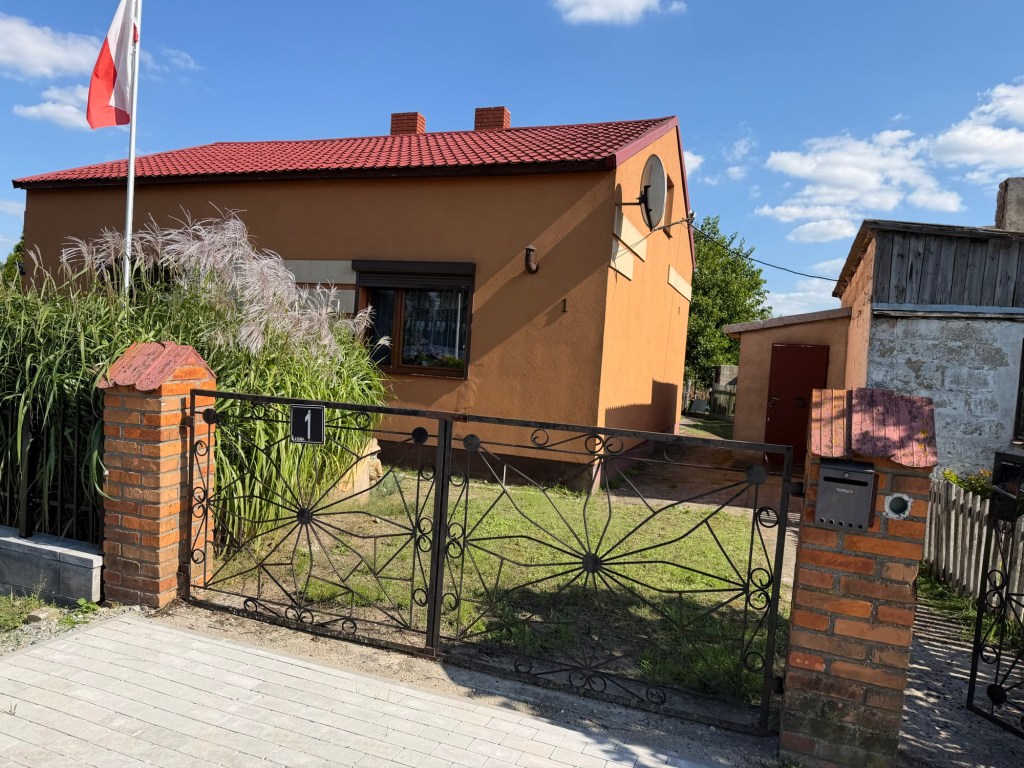
There is a house on it now, part of a small modern estate, ornamental grasses along the fence and a satellite dish on the gable. I had not expected anything else and I would not have wanted the alternative, which is a ruin. Somebody lives there and keeps the grass down.
Gathered
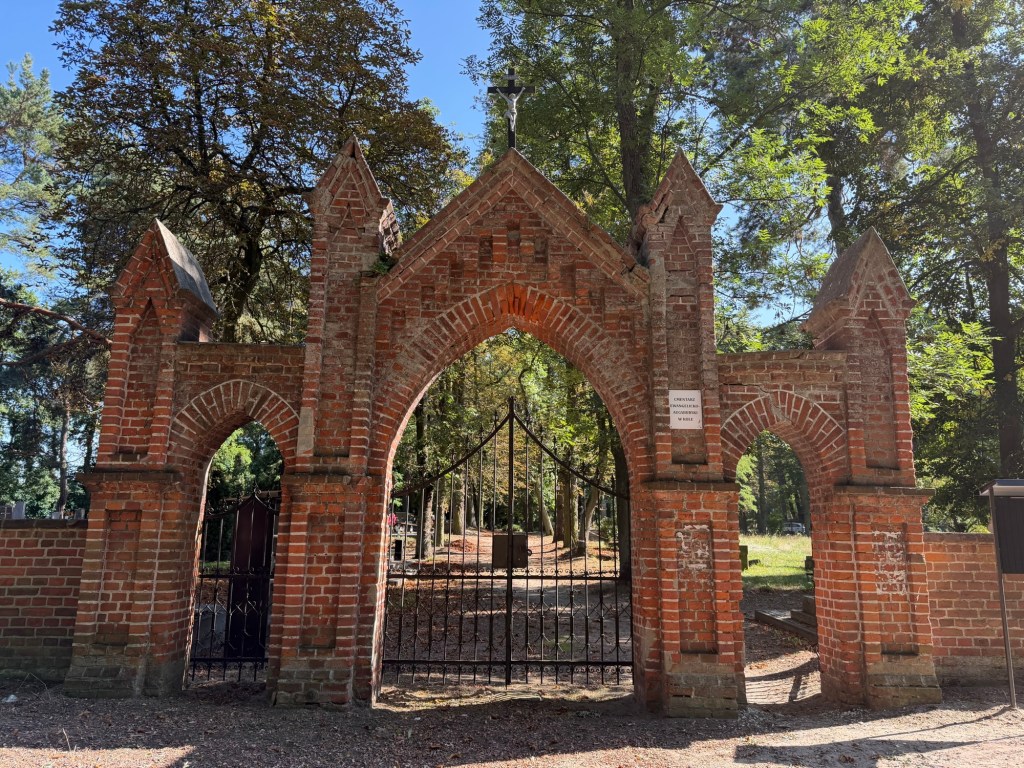
Koło was the last stop and the only one where we knew what we were looking for, because my girlfriend had already turned up stones with the name on them. The Evangelical cemetery there is nineteenth century, on the Kaliskie Przedmieście side of the town, and it is looked after. Brick gate, trees, gravel, a crucifix over the arch.
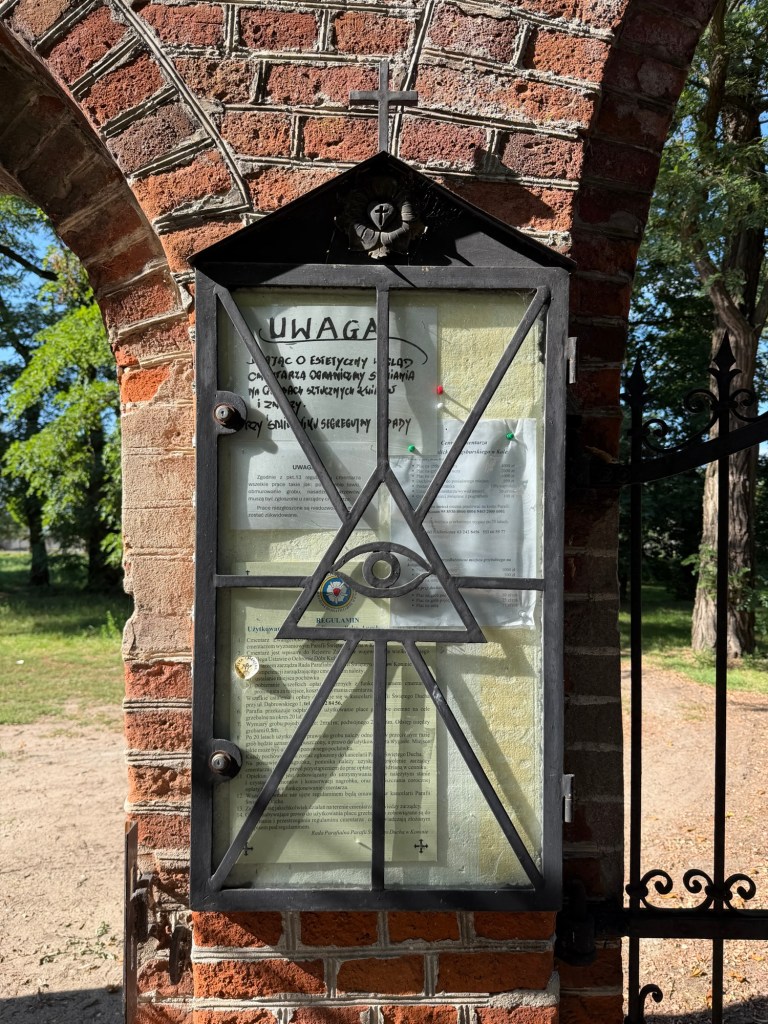
Set into the pier there is a glazed case of parish notices, and the ironwork over the glass is a triangle with an eye in it, rays coming off the point, a Luther rose above. It is the Eye of Providence and it belongs on a Lutheran gate as much as anywhere. There is another body of men who use the same figure, and I have a certain familiarity with them, so I took a photograph.
We had braced ourselves for a long walk round the place. In the end we did not get twenty yards. Immediately inside the gate, on the right, against the wall, there is a cluster of Krentz.
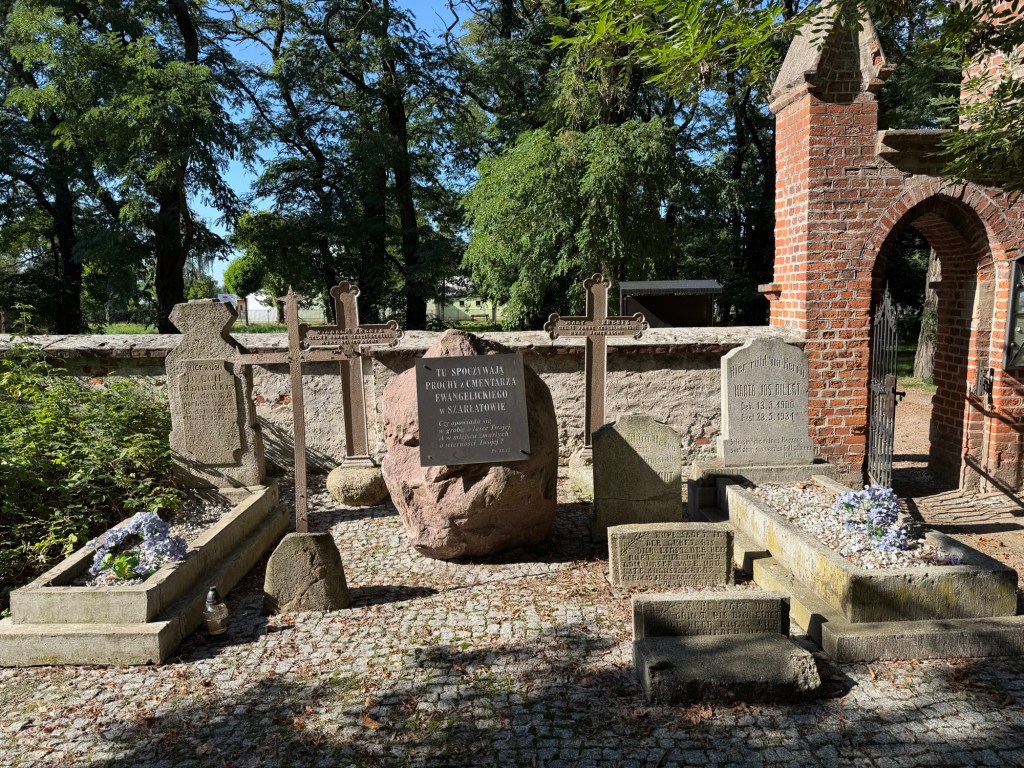
Two cast iron crosses stand at the front of it, both with the raised lettering still sharp enough to read at arm’s length. Wilhelm Krentz, in his seventies, died the fifteenth of December 1905, rest to his ashes. Beside him a Mary Krentz, seventy-five, died the thirtieth of November 1906, rest to her ashes, with a gap in the casting between her forename and her surname where letters have gone, so Mary may be what is left of something longer.
Then a low stone, worked flat and set almost at ground level, carrying a verse about resting softly in the vault until the Lord calls, and under it here rests in God our father and husband August Krenz. Perhaps dated 1889.
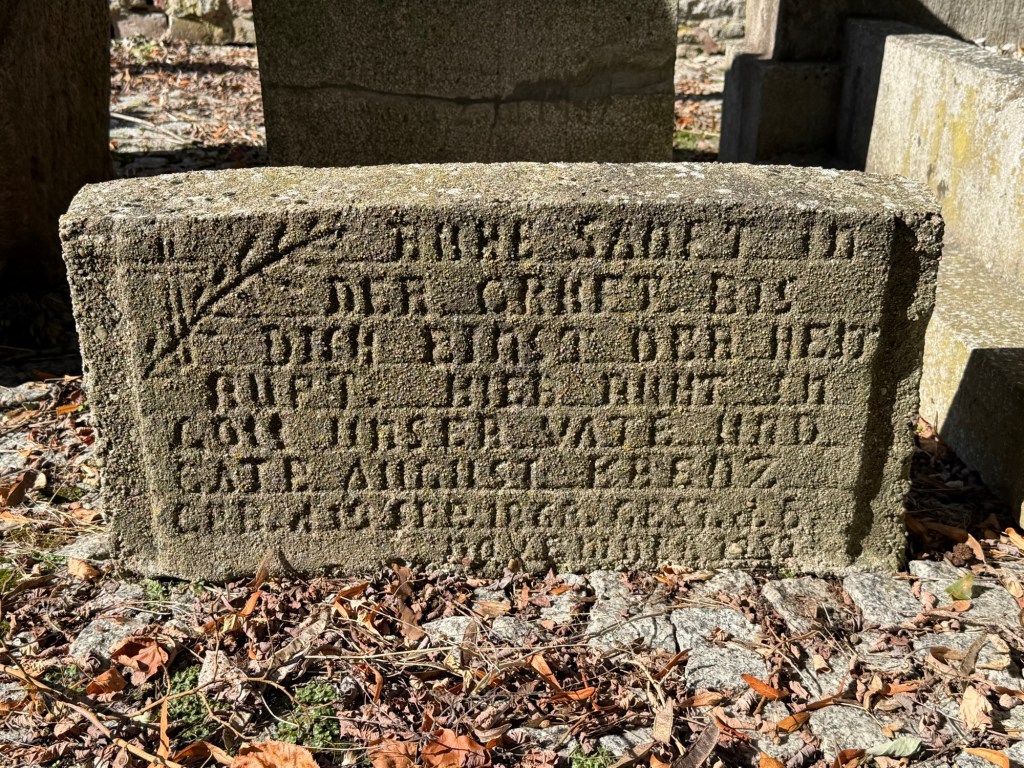
Look at the spelling. Krentz on the two crosses a yard away, Krenz on this one, and it is not a different family. Think back to that clause at the foot of the 1919 birth act. A man who cannot write cannot correct a clerk, and his name goes into the book the way the man holding the pen happened to hear it. My great-great-grandfather was one of those men, and this was a district that had been administered in Russian for a century, which gave everyone involved several more ways to hear it. My own surname is one version that survived rather than the version that was right.
Behind the flat stone, a headstone for an Edmund, which stopped me, because that was my grandfather’s name. The surname runs into the damaged edge and gives up after the first two letters. He died before the First World War.
None of them was buried here. The boulder in the middle of the group carries a plate explaining it: here rest the remains from the Evangelical cemetery at Szarłatów. That cemetery had been going since about the middle of the nineteenth century and its last recorded burial was in 1937. The ground it stood on has since been taken by the Drzewce opencast lignite pit, so in September 2016 the remains were lifted and brought here and the stones were set against this wall. Under the explanation the plate carries a verse: Is your mercy declared in the grave, or your faithfulness in the place of the dead? The reference given is Psalm 88.
Two cemeteries in one day, then. At Chodecz the stones are standing where they were put and cannot be read. At Koło they have been carried off a cemetery that no longer exists and propped against a wall, and they can, just about.
Mirrors
We got into Łódź in the early evening, which is my girlfriend’s city, and this time I was the one being shown round.
She took me to a courtyard off Piotrkowska where every wall is covered in broken mirror. Not decorated with it. Covered, eight hundred square metres of it, the back of the building and both outhouses, in cut and shattered pieces set close.
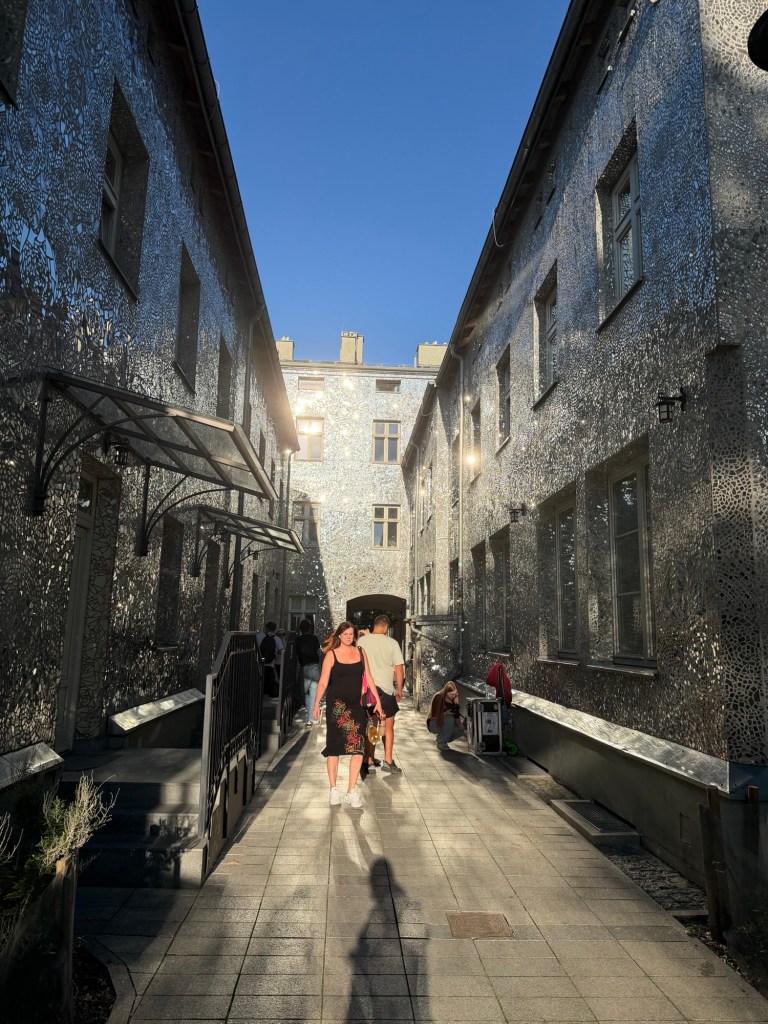
The work is by Joanna Rajkowska and it is called Pasaż Róży after her daughter Rosa, who was diagnosed as a small child with retinoblastoma, a cancer of the eye. The artist’s own account is that the passage is the path her daughter travelled from not seeing to seeing. The broken pieces stand for a damaged retina. Late sun comes over the roofline and the whole yard goes off like a chandelier, and the reflections never resolve into anything, and that is the point.
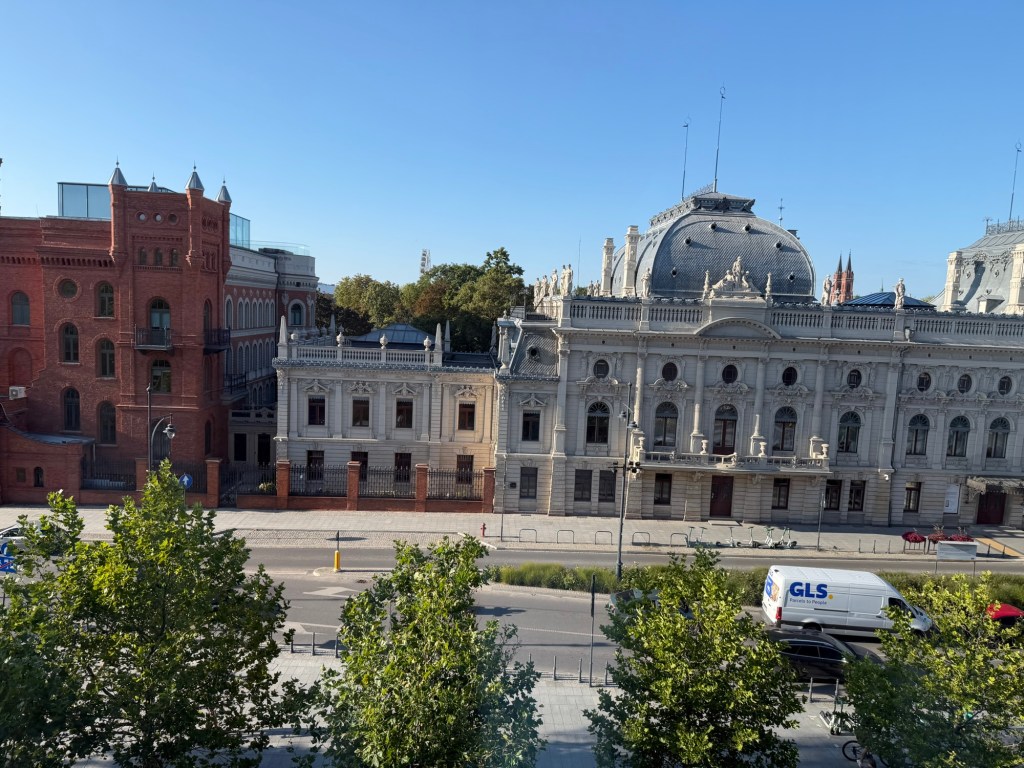
Two minutes away there are courtyards with the render off and weeds coming out of the brick. There is a great deal to say about this part of the city and I did not know most of it yet.
The same week
I found two plaques near the top of Piotrkowska. The first of them I have been turning over ever since.
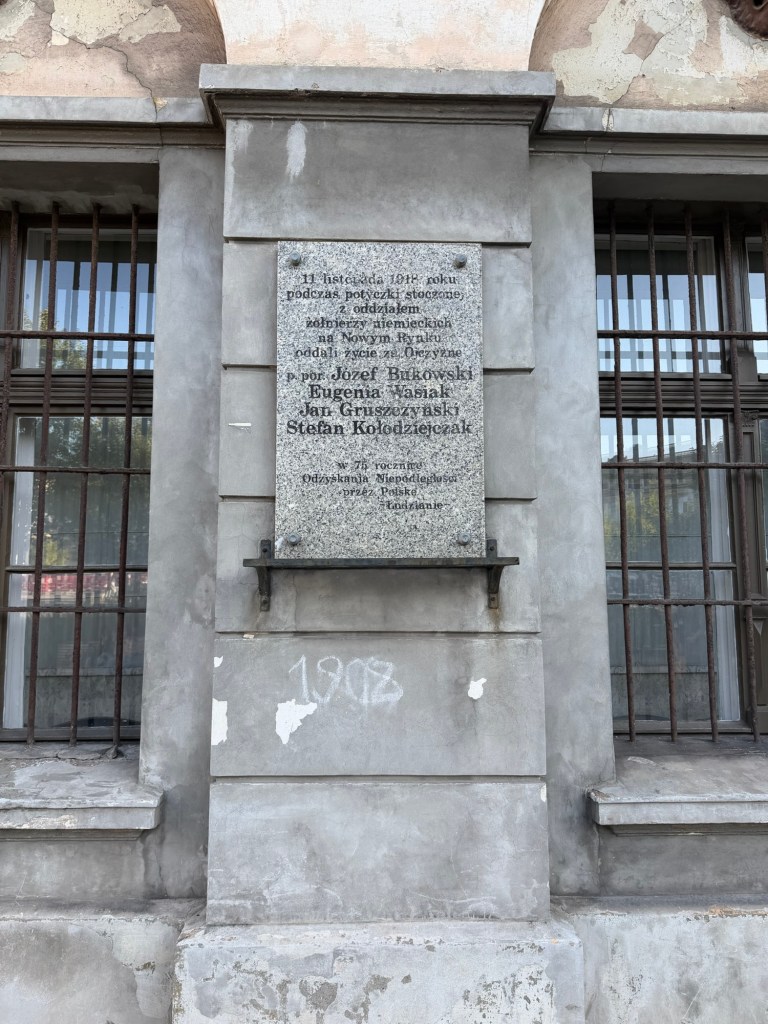
It records four people killed on the eleventh of November 1918 in a fight with a party of German soldiers on the Nowy Rynek, which is now plac Wolności. Second Lieutenant Józef Bukowski, a former officer of the First Polish Corps in Russia. Eugenia Wasiak, who was twenty. Jan Gruszczyński, who was seventeen. Stefan Kołodziejczak, a printer, twenty-nine. The disarming of the German garrison went on across the city that night and cost eight Polish lives, and by the following morning Łódź was free. The plaque was put up by the people of Łódź on the seventy-fifth anniversary and signs itself simply as theirs.
That same November, a hundred miles up the road, my great-grandparents were married in the church at Przedecz. Same country, same fortnight, opposite ends of the same event.
The other plaque is the city motto, and it is the sort of thing I cannot walk past.
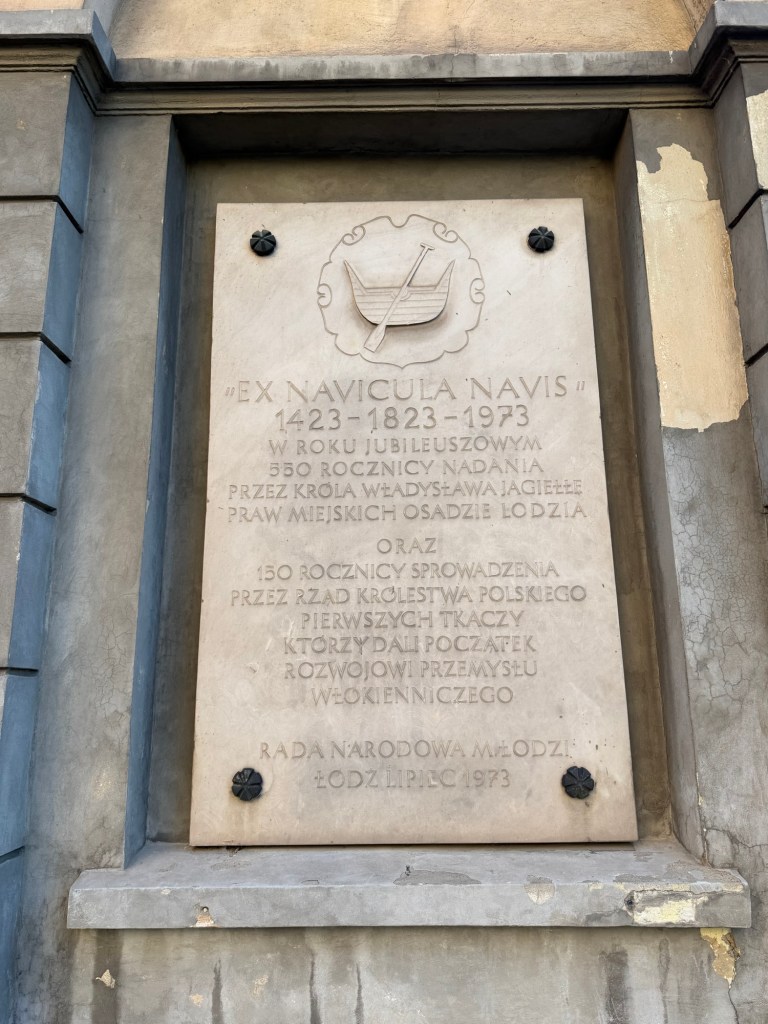
Ex navicula navis. From a little boat, a ship. The arms of Łódź are a boat, because the name is the word for one, and the motto turns that into the town’s own account of itself: a village that got its charter from Władysław Jagiełło in 1423 and then did very little for four hundred years, until weavers were brought in from 1823 and it became the second city in Poland. What I did not know until I looked it up is that the motto is not medieval at all. It was proposed in 1903, during a newspaper competition to settle the city’s arms, by the historian and heraldist Jan Karol Kochanowski. The city has carried it ever since.
A Polish curry
She showed me Manufaktura and then went off to stay with her mother and grandmother, and I was left to my own devices in what used to be Izrael Poznański’s cotton empire. He started buying the land in 1871 and had the first weaving shed running the year after, and by the 1890s the place was turning out cloth at a rate nothing in Europe could match. The mills closed, the site rotted through the nineties, and it reopened in 2006 as shops, museums, a cinema and a very large square with a carousel in it.
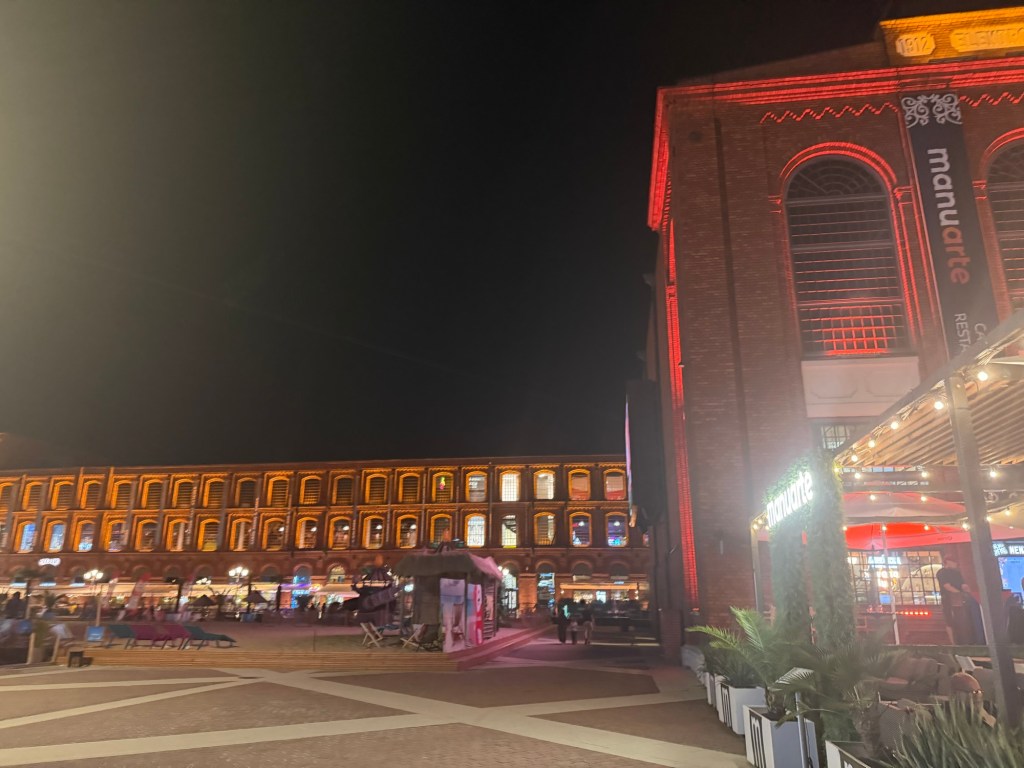
My father had asked me to report back on what a Polish Indian curry is like, so I found one and ate it under a heater on the square.
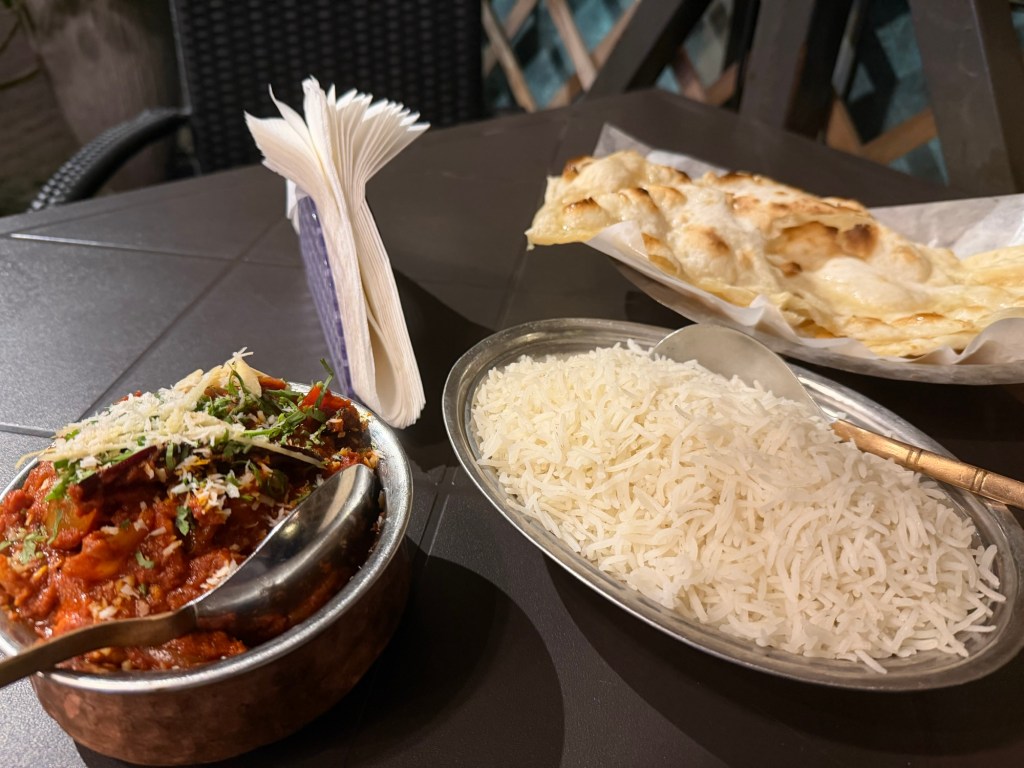
It was good. Generous with the vegetables, gentler than it would have been at home, plainly adjusted for the local palate, and none the worse for it. I sent him a photograph and a verdict.

