The washing floors
The Great Laxey Duck Races are one of those fixtures the Island puts on every year without feeling any need to explain itself. We went up early, before much had started, and had a potter round the stalls.
The setting is the Valley Gardens, which are the old washing floors of the Great Laxey Mine, where the ore was crushed and dressed before it went down to the harbour. The terracing that did the work then makes an accidental amphitheatre now, and people sit on it. Standing over the whole thing is the Lady Evelyn, a fifty foot wheel built in 1865 for the Snaefell mine at the head of the valley, sold to Cornwall around 1910 to pump slurry off a china clay pit, worked there until the 1950s, and eventually left in component parts on a Welsh hillside. It came back to the Island in 2003 and was rebuilt here by volunteers over three years, on the washing floors rather than at the mine, which by then was too remote to reach. It is named for Evelyn Jones of the Laxey Mines Research Group.
The site is held on a lease from the Village Commissioners at a peppercorn rent. When the wheel had been standing five years, the Trust marked it by commissioning a wooden plaque carrying five wheels, with a peppercorn dipped in gold paint set at the middle of each one.
The bin race
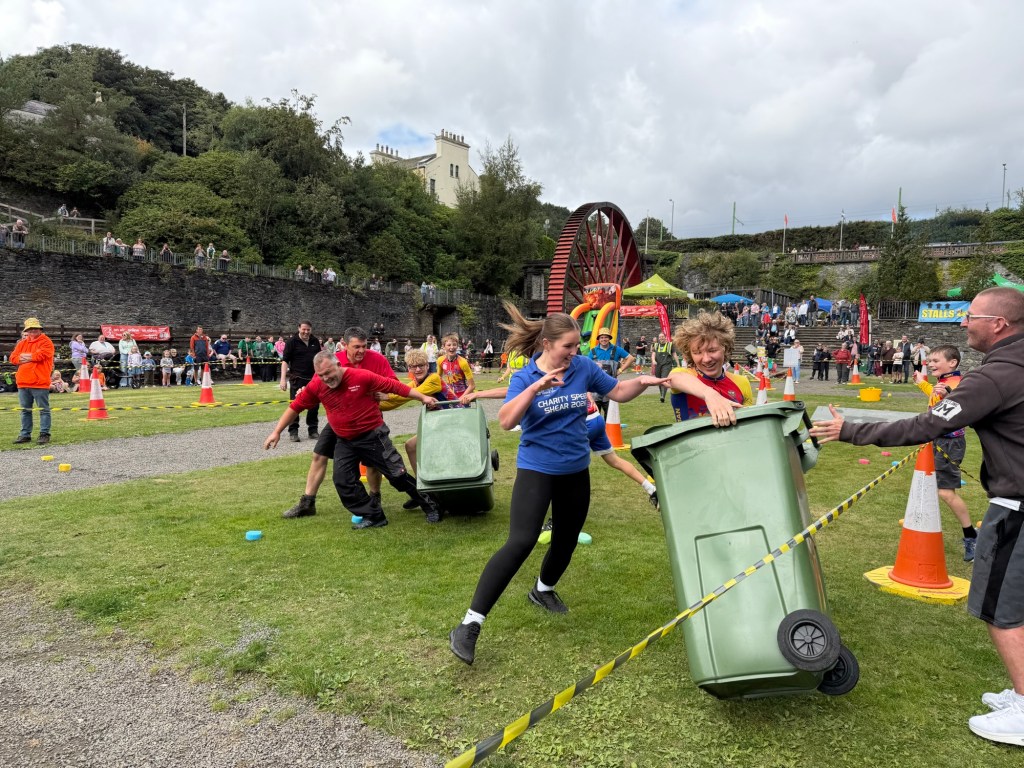
Then the bin race, which was pure violence and carnage.
Teams drag a wheelie bin round a course laid out in cones, in relay, and that is as much of the format as I was able to establish from the outside. Whatever rules exist are not enforced in any way a spectator could detect. Adults ran against children and neither side gave anything away. Bins went over on their sides and were dragged anyway. It reminded me of the cammag at St John’s after Christmas, which is billed quite openly as a game of three halves and no rules: same energy, same absence of anything resembling a referee. Very Celtic, very Manx.
The organisers announced in August that this year’s would be the last one, which I did not know while watching it and which puts the afternoon in a slightly different light now. Nothing about it looked finished.
The mine railway
Between the bin race and the ducks we took the train up the valley.
The Great Laxey Mine Railway runs a quarter of a mile from the Valley Gardens to the Mines Yard, and it does so on a nineteen inch gauge, which is believed to be the only one of its kind in the British Isles. The original engines, Ant and Bee, came from Stephen Lewin of Poole in Dorset in 1877 and were built deliberately narrow so they would fit inside the adit. The mine closed in 1929 and in 1935 everything above ground, engines included, was scrapped. The two that run now are replicas, built in 2004 by Great Northern Steam of Darlington.
We went behind Ant. Bee was sitting ready in the yard, brass polished, with a works plate reading Lewin Engine Co, No 685, Poole, Dorset.
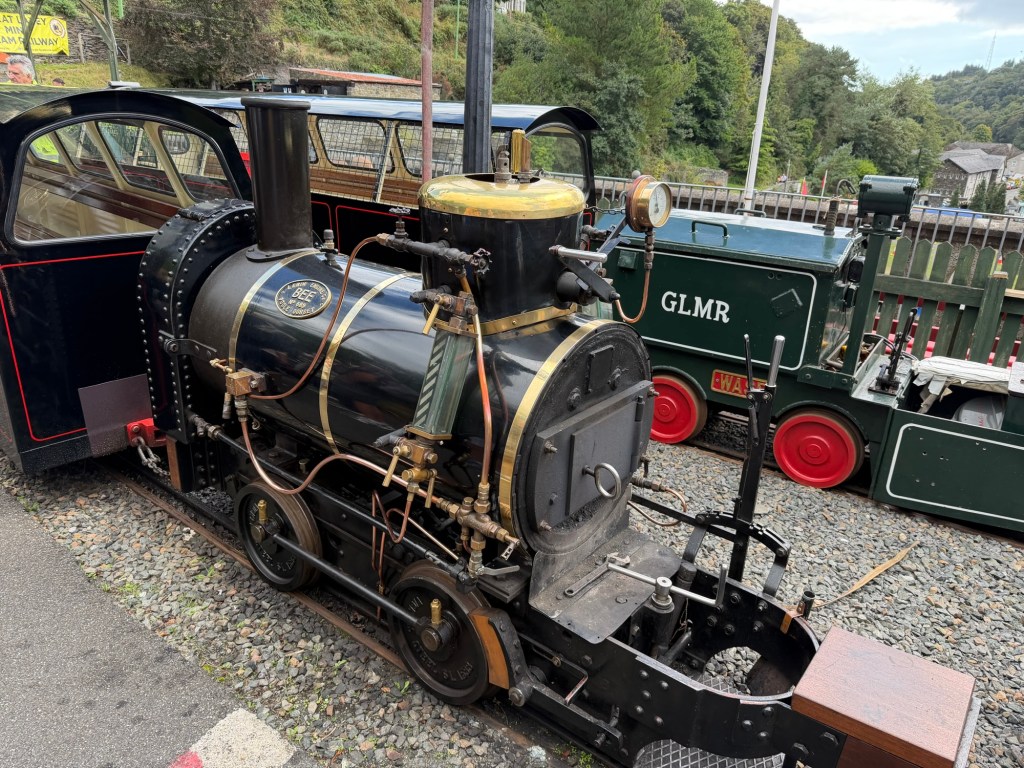
The carriages are long and narrow because they have to be, with benches down one side, so passengers travel sideways at right angles to the direction of travel. It is a slightly comic way to ride a railway and entirely the correct one.
The tunnel
Part way along, the line drops into a tunnel and goes under the Manx Electric Railway and the main coast road. It is about seventy metres long and it is the only railway tunnel left on the Island. The roof comes down close, the noise doubles, and for a few seconds there is nothing ahead but a small bright hole.
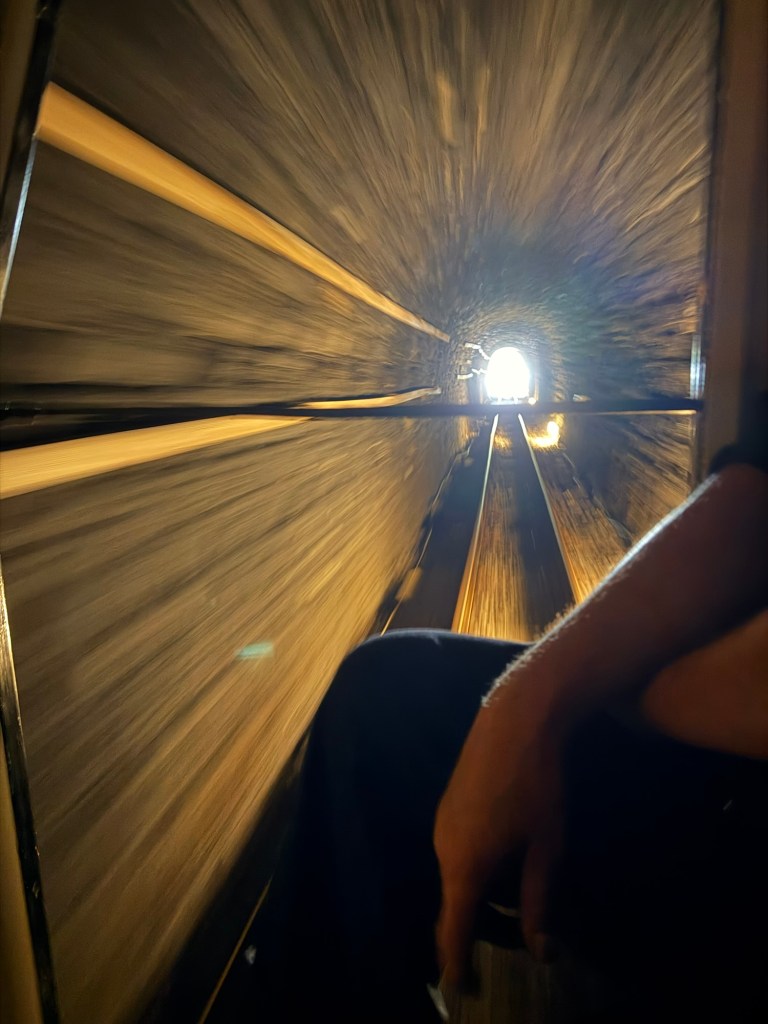
It gave me some feeling for what the men underground here had, though I should be honest that seventy metres with daylight at the far end is not the same article at all. The adit ran a mile and a half into the hill and the workings went down more than two thousand feet below it. Up at the top of this same valley, at Snaefell, twenty men died in 1897 when they went down a shaft into carbon monoxide they could not smell. That is the Island’s worst mining disaster and it happened four kilometres from where the bins were being dragged about.
The ducks
Then the ducks, which are utterly daft and all the better for it.
Several thousand of them go into the river up at the fire station and are left to find their own way down to the finish below the washing floors. Half the village leans over the railings on Glen Road to watch them come, and there are people in waders in the water to move on any duck that has found a rock it likes. From the bridge the river is more yellow than water. Ours did not win, and neither did anyone else’s that I could see from where I was standing.
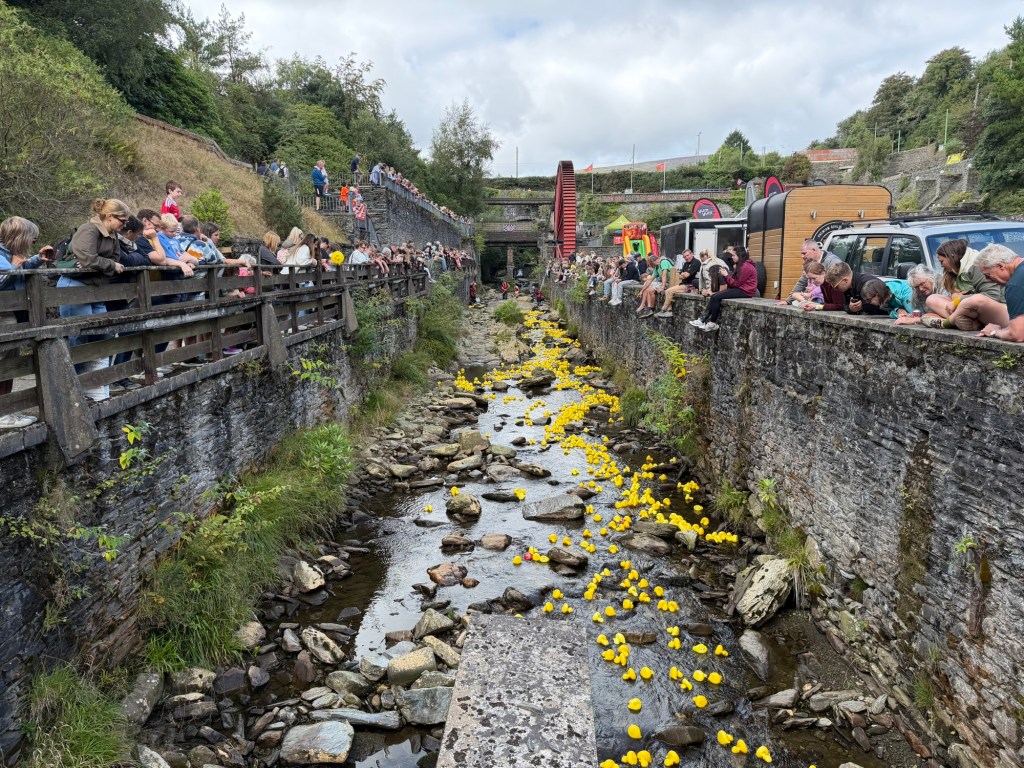
All of it goes to the Laxey and Lonan Heritage Trust, who are the same people who put the Lady Evelyn back up.
No marks
We had a look round Laxey afterwards for Ordnance Survey bench marks and found precisely none. There is a first duty in this hobby, which is to look pleased with yourself in front of somebody else’s gatepost, and I discharged it several times to no purpose whatsoever.
The ship
We finished in Douglas, where the Nao Santa María is berthed in the marina.
She is a full size replica of Columbus’s flagship, built in 2018 at Punta Umbría in Huelva for the Nao Victoria Foundation, in iroko and pine, to mark five hundred and twenty five years since 1492. She weighs about two hundred tonnes and is one of some thirty ports on this year’s European tour, and this is her first visit to Douglas. Demand was such that her stay has been extended to the thirteenth.
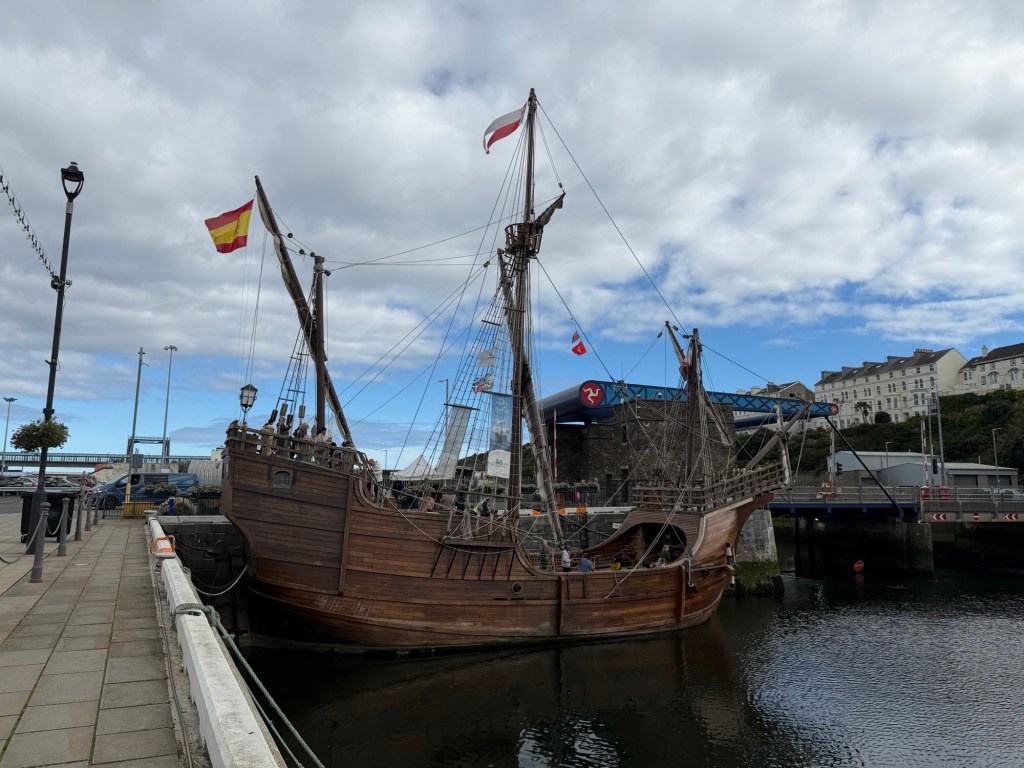
She is more museum than faithful reproduction, and she arrives under engine. She does carry a full sail plan, five sails and something like three kilometres of rope in the rigging, along with an engine room, radar and GPS below, and I understand she has sailed properly in her time. Standing on her deck and looking at the size of the thing, and then thinking about the width of the Atlantic in 1492, none of that mattered very much.
A bin race, a steam engine, a river full of rubber ducks and a Spanish carrack, in one Saturday, on an island thirty miles long.

