
I have been going through my grandfather’s war for a while now. Some of it he dictated late in his life, and a good deal more has had to be reconstructed out of archives and photographs because there were things he chose not to talk about.
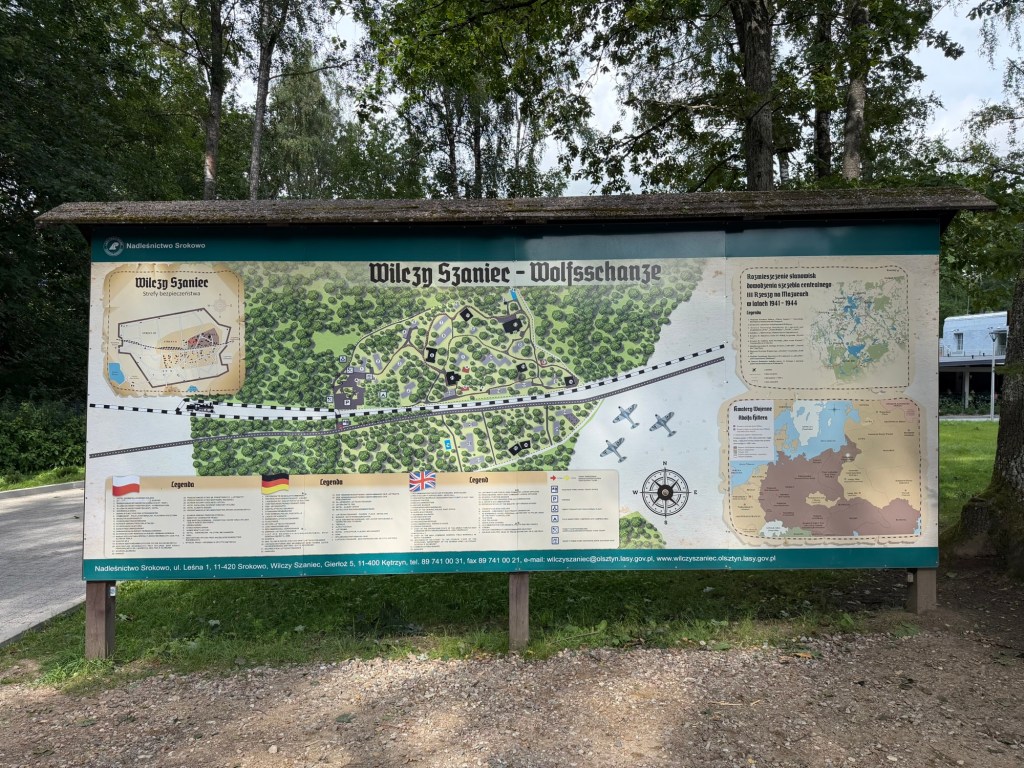
The short version is this. He was twenty-one, a farmer’s son from a German family settled in what is now central Poland, twice wounded on the Eastern Front. In October 1942 he was put on a train under escort without being told where he was going, driven to a gate in a forest in East Prussia and told to walk. What he walked into was the Führerhauptquartier Wolfsschanze. He was assigned to the innermost security zone as an orderly in the guest barracks, making up rooms and taking coats, and he stayed there for very nearly two years. He left on 25 July 1944.
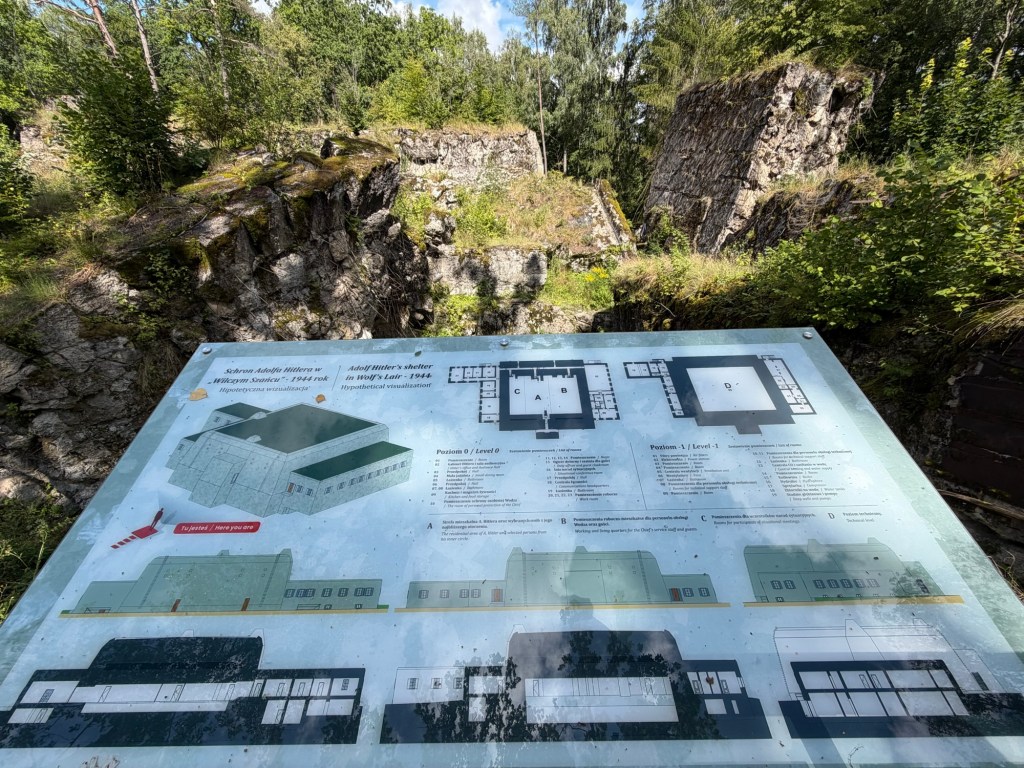
I have a number of his photographs from 1942, when a good deal of the compound was still timber. That did not last. The second building stage began in the summer of 1942 and some of the wooden barracks were strengthened with reinforced concrete against the risk of air raids. Then in 1944, with Hitler telling his staff that the Allies knew exactly where he was and would flatten the place any day, Organisation Todt replaced the earlier modest bunkers with colossal ones and clad a great deal of what was left. Speer put the bill for concrete at Rastenburg at thirty-six million marks. By the summer of 1944 a fair number of the barracks had brick and concrete around them and were no longer quite the buildings he had photographed.
In one of the pictures my grandfather is sitting on a set of brick steps in front of a low building, entirely at ease. On the morning we set off I decided we were going to find those steps. I could not tell you why. I knew the site had been demolished and half swallowed by forest, and I knew the building had been rebuilt around itself while he was still living there. I simply had it in my head that brick steps were the sort of thing that survives.
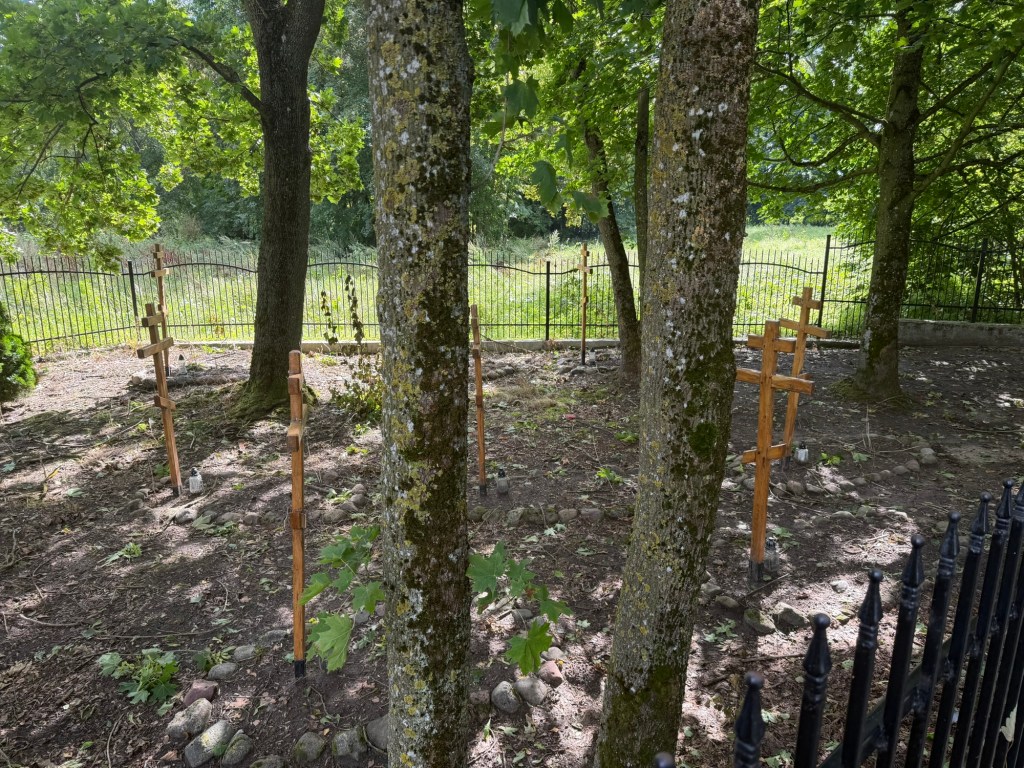
We stopped on the way at a small enclosure of graves under maples, Russian soldiers from the first war, wooden Orthodox crosses, a lantern at each one and the ground swept. Masuria was fought over again and again in that war, and there are cemeteries like this scattered all through the region. Somebody is still looking after this one.
The drive took an hour. What is open today is essentially Sperrkreis 1, the inner zone where my grandfather worked, with a little of Sperrkreis 2 attached. We walked it for five hours and did not see all of it, which tells you something about a place that was supposed to be invisible from the air.
The bunkers are difficult to describe. They are the size of small blocks of flats, walls and roofs of several metres of reinforced concrete, and they are now furred over with moss and sprouting birch. They are also all broken. Slabs lie where they came down, sections of ceiling stand on end, and rusted reinforcing bar comes out of the fractures like wire.
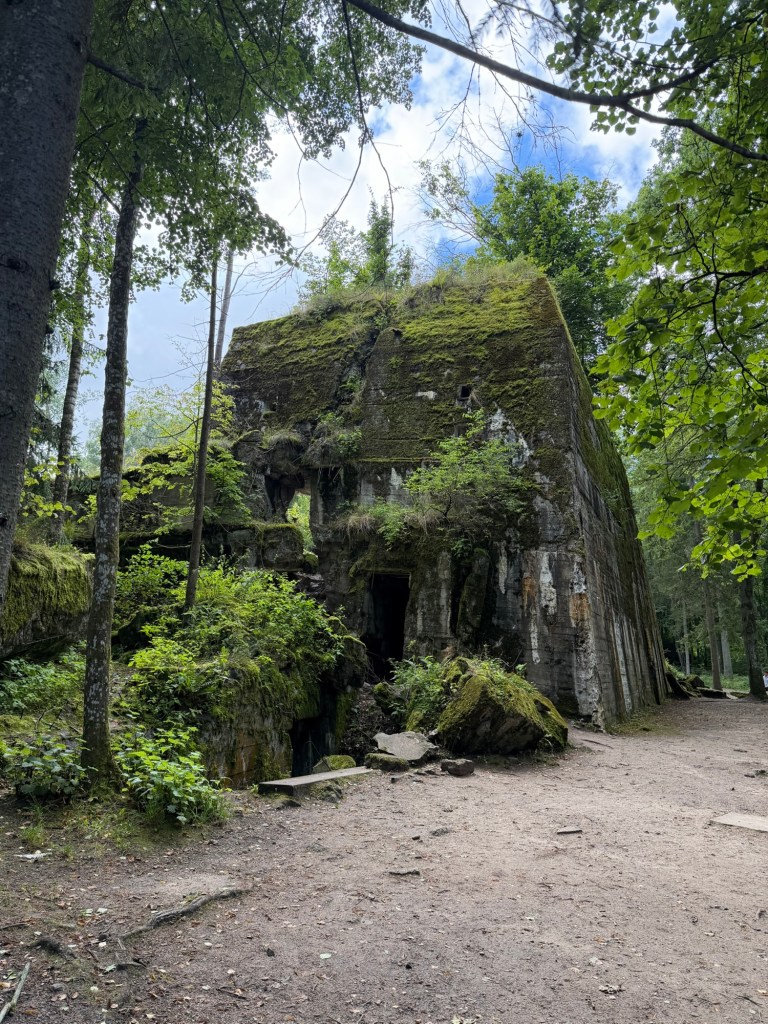
Keitel gave the order and the retreating Germans did it themselves on the night of 24 to 25 January 1945, something in the region of eight tonnes of explosive for a single bunker, concrete thrown twenty or thirty metres into the air and the ice cracking on the lakes nearby. It very largely failed. The lighter buildings went, the great bunkers cracked and settled and stayed where they were, and the Red Army walked in three days later without firing a shot. What followed took much longer than the demolition did: Polish sappers clearing the ground of more than fifty-four thousand mines, some in glass casings so the detectors could not find them, a job that was not signed off until 1955.
Object 3 on the plan at the gate is a low brick footing in a clearing with a bronze laid on it, split down the middle, Polish on one side and German on the other. It records that the barrack in which Stauffenberg made his attempt on 20 July 1944 stood here, and that he and many others who set themselves against the dictatorship paid for it with their lives.
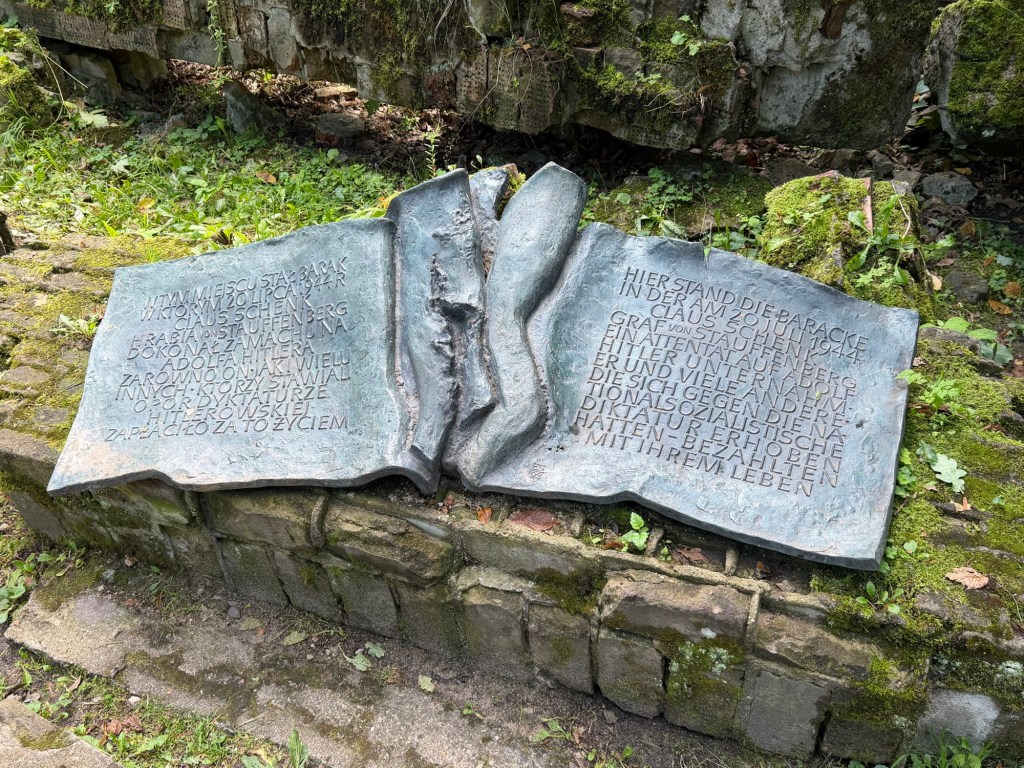
The daily situation conference was always held in Hitler’s bunker. It was not held there that day because the bunker walls were being thickened and the room was unavailable, so it happened in a barrack above ground instead, where the blast had somewhere to go. That is a large part of the reason the attempt failed, and the whole of the reason my grandfather was standing where he was.
He took the colonel’s coat on the way in, because a man with one hand and three fingers cannot manage a coat alone. The colonel was the last to arrive and the first to leave, and when he came back out my grandfather helped him into it again, fastened his belt for him, and watched him walk off across the compound. Then the bomb went off, about thirty metres from where he was standing. He had no idea who the man was. Five days later he was told to pack his bag, and that was the end of his war in the forest.
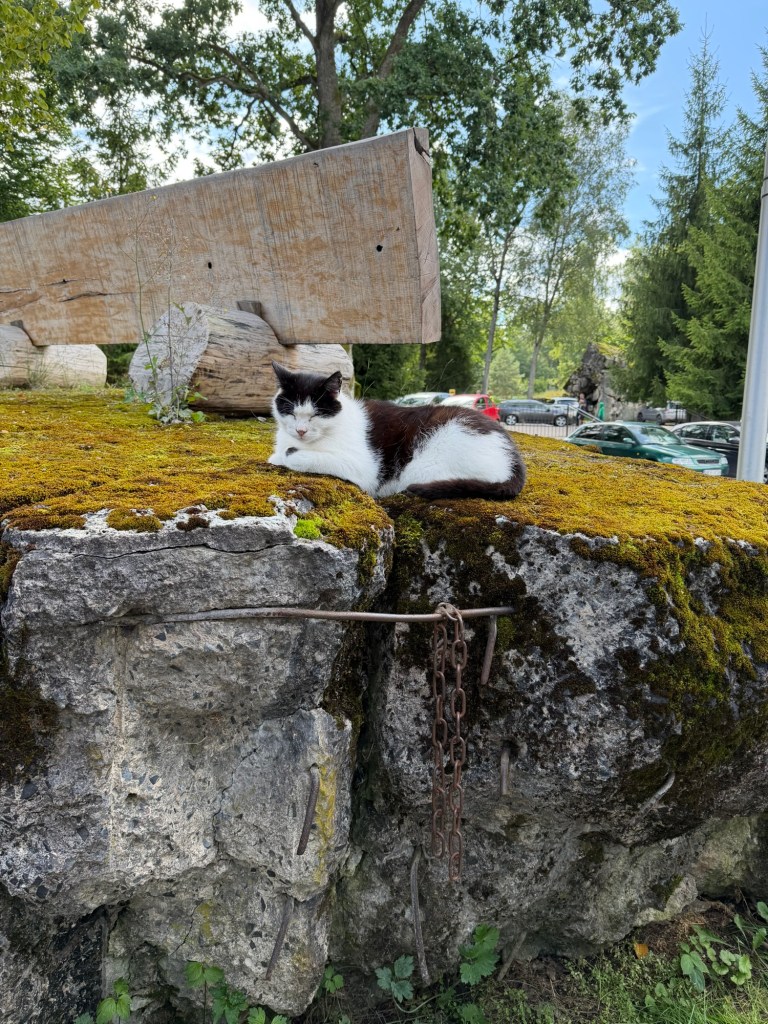
The site has a cat, who has clearly worked out that a car park full of people eating sandwiches is a better proposition than a forest, and who let us photograph her without opening her eyes.
My girlfriend applied mosquito spray before we set off. I declined, on the grounds that I know better. By the end of it I had been eaten alive and she had not been touched, and I would like the record to show that she did not say anything about it, which was worse.
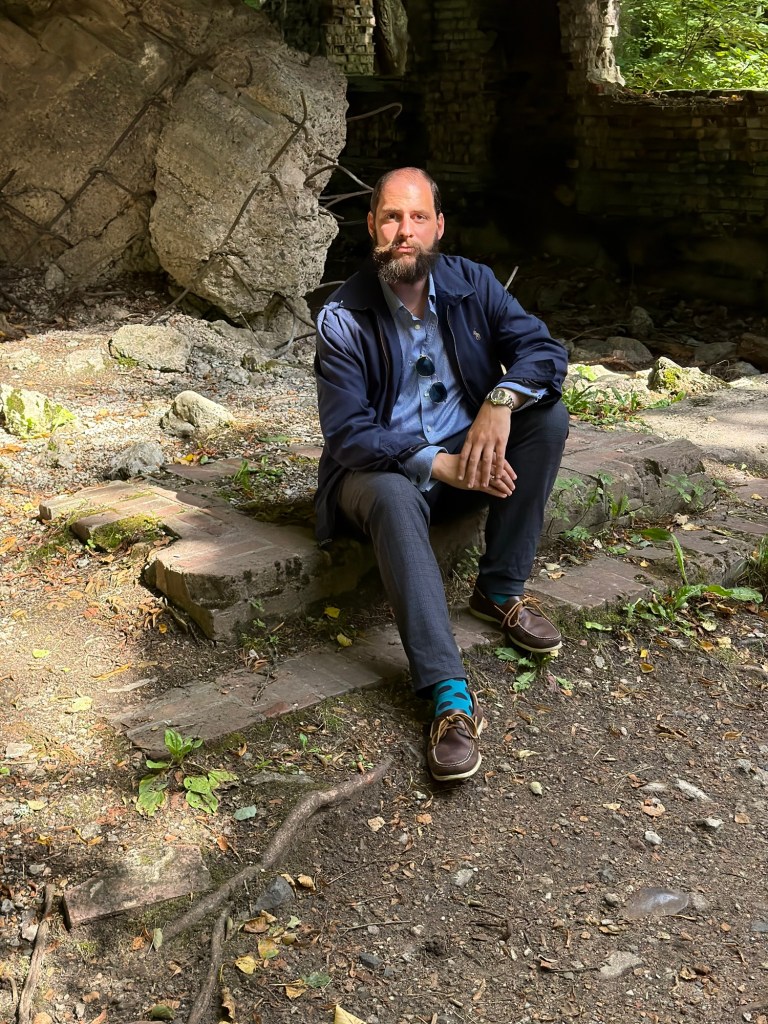
We looked for the steps the whole time. We found a set that stopped me: brick, the same shallow rise, the same construction, in front of what had been the Reichssicherheitsdienst building. It was into that building that my grandfather walked in the spring of 1944 to ask for leave, and got told that leave was impossible but a service trip was not, and went home for a fortnight on a technicality. It was the right architecture. It was not wide enough. I sat down on it anyway and had my picture taken, on the reasonable basis that I had found something.
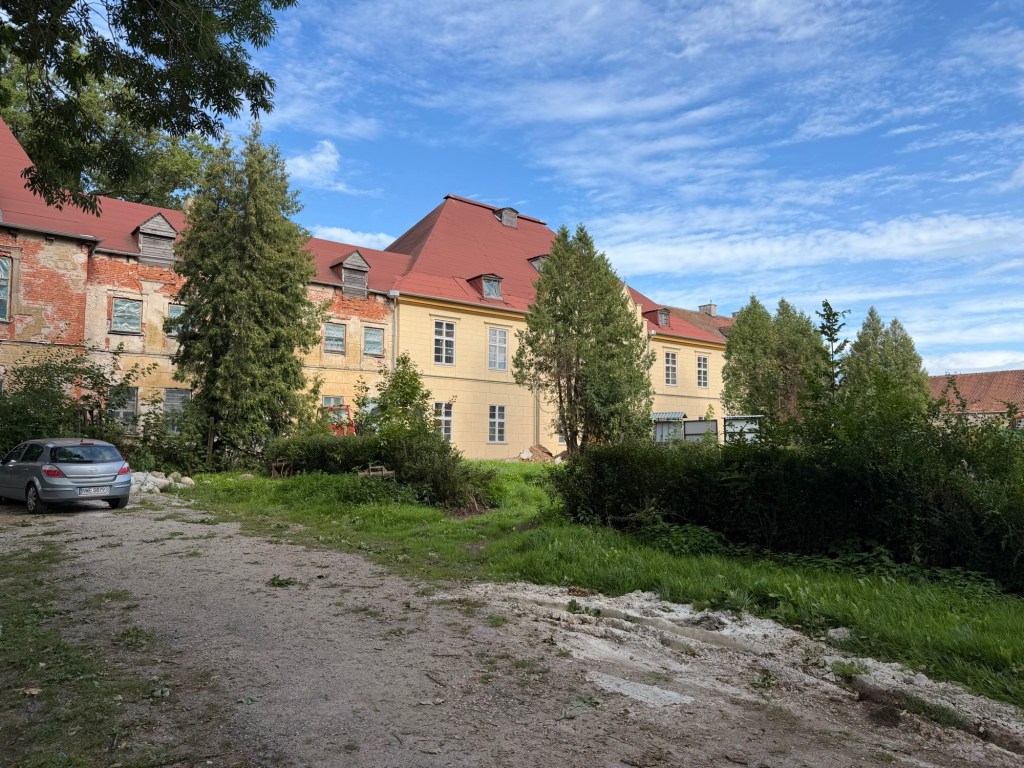
On the way back we stopped at Sztynort, a baroque house that belonged to the Lehndorff family for three hundred years. From 1941 the last of the counts, Heinrich, was living in one wing while Ribbentrop occupied the other. He was in the plot. He was hanged at Plötzensee that September. The house is under renovation and closed, which is the best news it has had in eighty years, having been in turn a Soviet collecting point for looted goods, a farm cooperative and an empty shell.
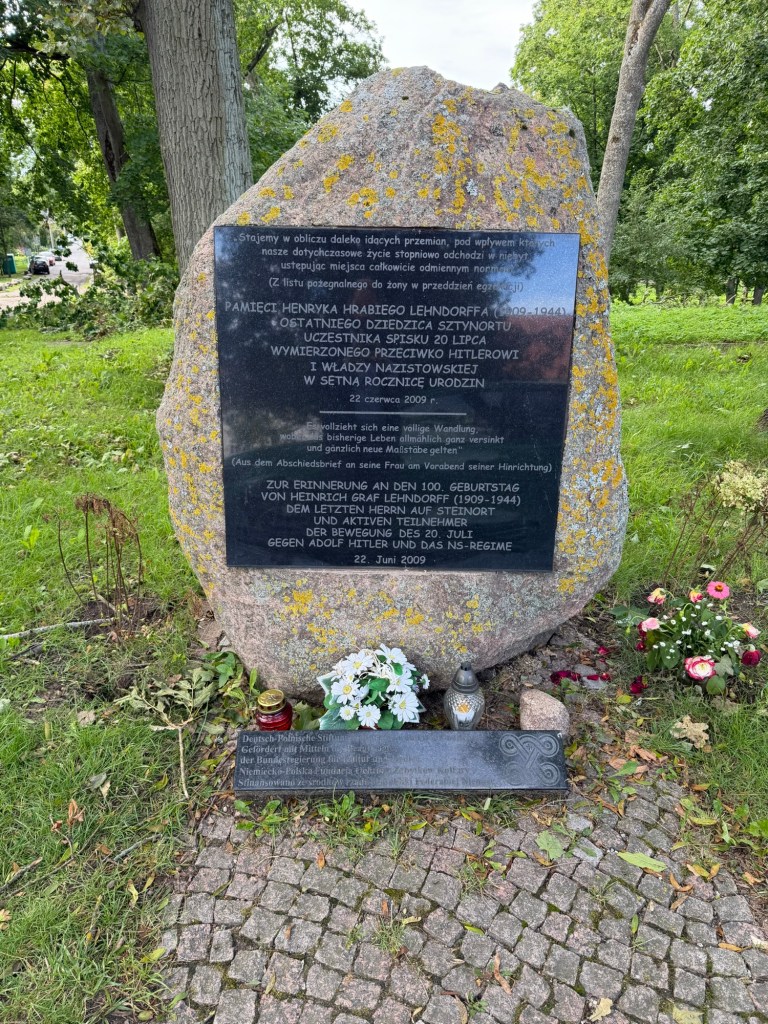
In the park there is a boulder with a plaque put up on what would have been his hundredth birthday. It quotes the letter he wrote to his wife the night before his execution: life as it was is sinking away entirely, and wholly new measures apply. There were fresh flowers at the foot of it.
We got back to the hotel at six, thoroughly finished. My girlfriend lay down on the bed and started going through her phone. After about fifteen minutes she turned it round and held it up to me.
It was a photograph from somebody else’s travel blog. In it were the steps.
I got my grandfather’s picture out and put the two side by side. The same shallow brick rise, the same courses, the same number of bricks across.
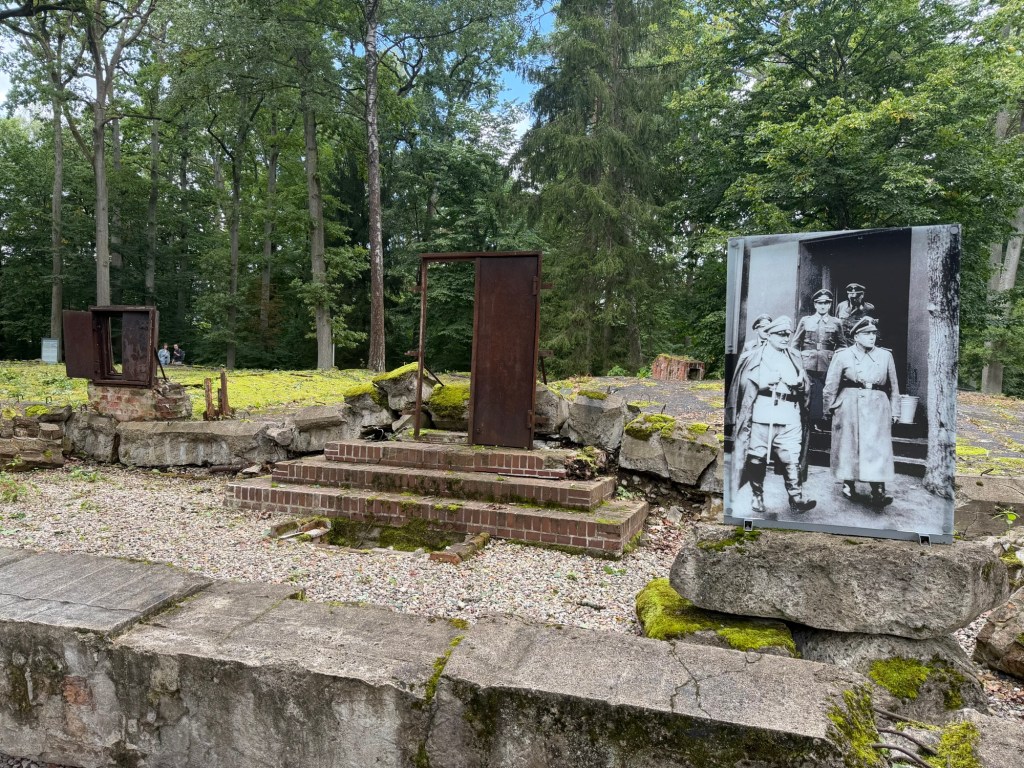
Beside the steps in her photograph is a display board carrying a wartime picture of Göring coming down them, and in that picture a tree stands hard against the right-hand corner. The same tree is in another of my grandfather’s photographs of that doorway.
What settled it was on the back of his picture. There is writing there, in the old German hand, that I have looked at many times over the years without ever getting anywhere with it. I sat with it for an hour that evening and it came apart. Treppen. Speer Baracke. Steps, Speer barrack. That is what the historians call the building the bomb went off in.
Those are the steps of Object 3. He had sat on them for a photograph in 1942. He was standing at that door on the morning of 20 July 1944. And in between he had gone in and out of it for the better part of two years with no idea whatsoever what the building was going to become.
It was gone seven by then and the site closes at eight, and neither of us could have walked another step regardless. We had dumplings in town and went to bed.
The next morning we drove back out and went to the one part of the site we had not covered, which turned out to be the far side of a building we had walked straight past the day before.
They are still there.
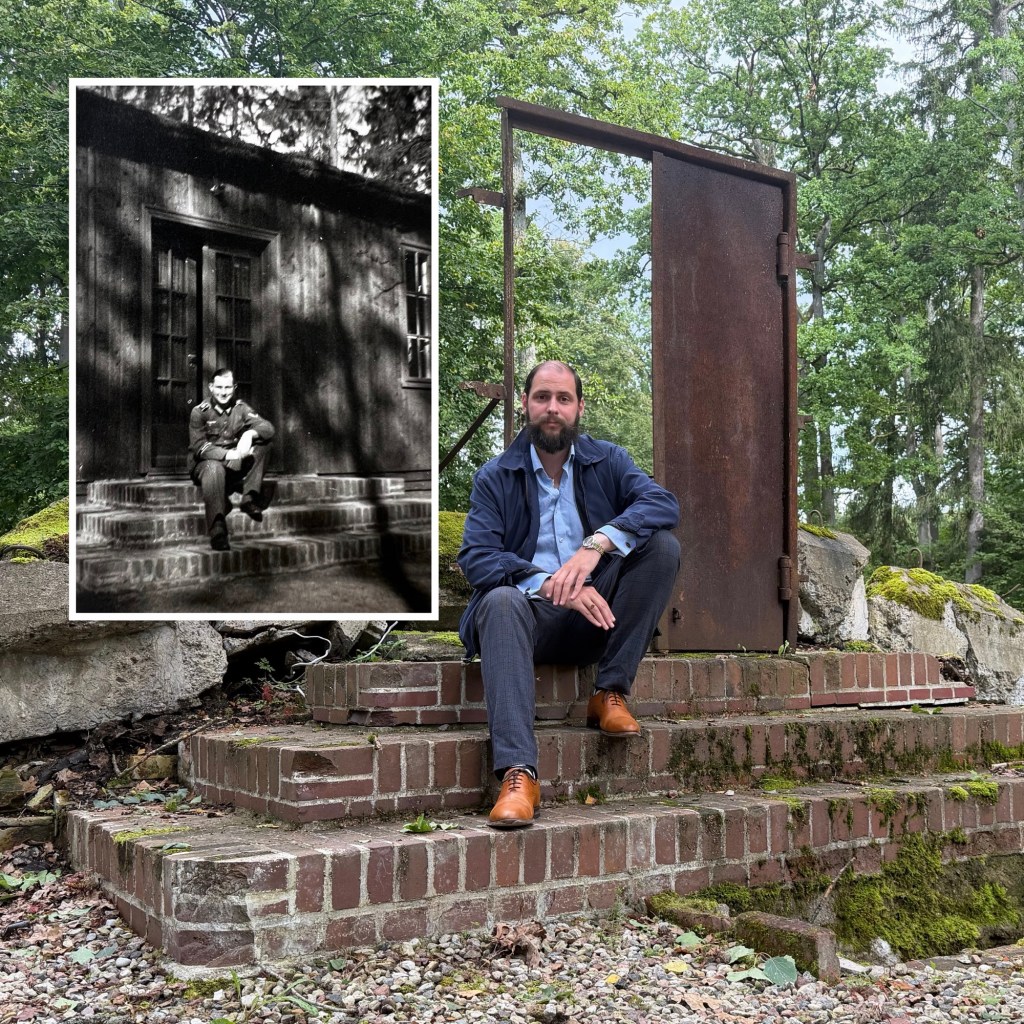
I sat down where he sat and my girlfriend took the photograph. I am not going to be able to do that moment justice here, so I will not try. What I will say is that I would have regretted not going back for the rest of my life, and that going back was not my idea. I had given up. She lay down on a bed after many hours on her feet and went looking anyway, and found in fifteen minutes what I had failed to find in five hours, and then got up the next morning and drove out there again with me.
That is the whole of it, really. The steps were always going to be where they were.
 Charlton Krentz