Fruit
I do not eat breakfast. Not as a discipline, and not out of any theory about it, simply because the first meal of my day has for years been whatever turns up at lunchtime. Hotels charge for the privilege of proving otherwise and I usually leave the money on the table.
This morning I went down anyway. What was waiting was a fruit table of a seriousness I had not expected: not the customary bowl of hard apples and a melon cut some time the previous week, but bowl after bowl of it. Green apples, russet ones, oranges, mandarins, grapefruit, kiwis, apricots, plums, cherries, nectarines, and two sorts of peach including the flat ones, which taste of considerably more than their shape suggests they should. Somebody in that kitchen takes fruit seriously.
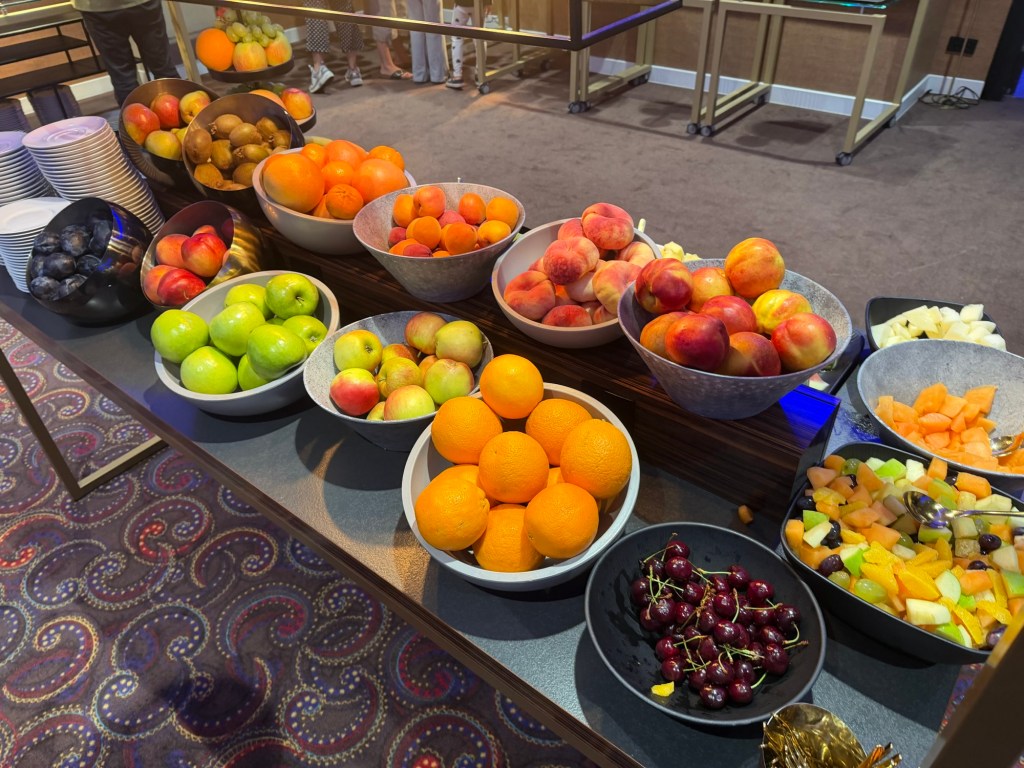
I took a plum, a few cherries and one of the flat peaches. Then, because a plate of fruit on its own looks like a statement about oneself, I went back for sausages, bacon and a poached egg under hollandaise, and carried the two plates to a table by the glass.

A bench in the park
She was due back around midday, so I had a morning to fill and no intention of starting the Old Town without her. I liberated a few plums from the fruit table on her behalf and left them in the room, on the theory that a person returning from dental surgery wants something soft and cold and does not want to be asked how it went. Then I went out for a short walk with no destination, and found myself pulled back towards the Palace of Culture and Science, which is not difficult, since it is visible from most of the middle of the city and has the gravitational pull to match.
Looking for somewhere to sit, I turned into the small park along its northern side. There was a statue. Grey, monumental, a group of figures under a dead stone tree, and unremarkable in the way that grey statues are unremarkable until you go and read the plaque. Then it stopped being unremarkable.
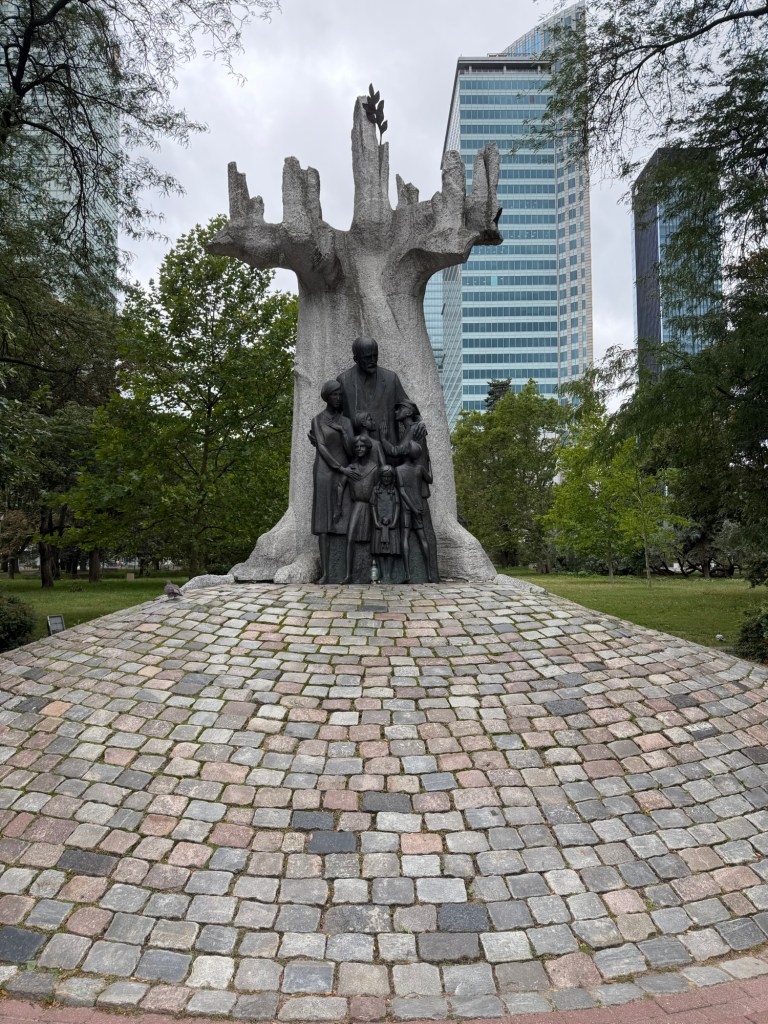
The bronze is Janusz Korczak, with six children gathered under him. The tree behind is granite, dead, and its broken branches make the shape of a menorah. The whole thing stands on a low mound paved with setts.
The plate on the plinth gives two names. Janusz Korczak first, in the larger letters, and beneath it Dr Henryk Goldszmit, which is the name he was born with. Korczak was the pen name. He was a paediatrician who wrote for children and about them, ran two orphanages, one Jewish and one Polish, and broadcast on the radio as the Old Doctor. In 1919 he drafted a constitution for children, which was an eccentric thing to do at the time and looks less eccentric now.
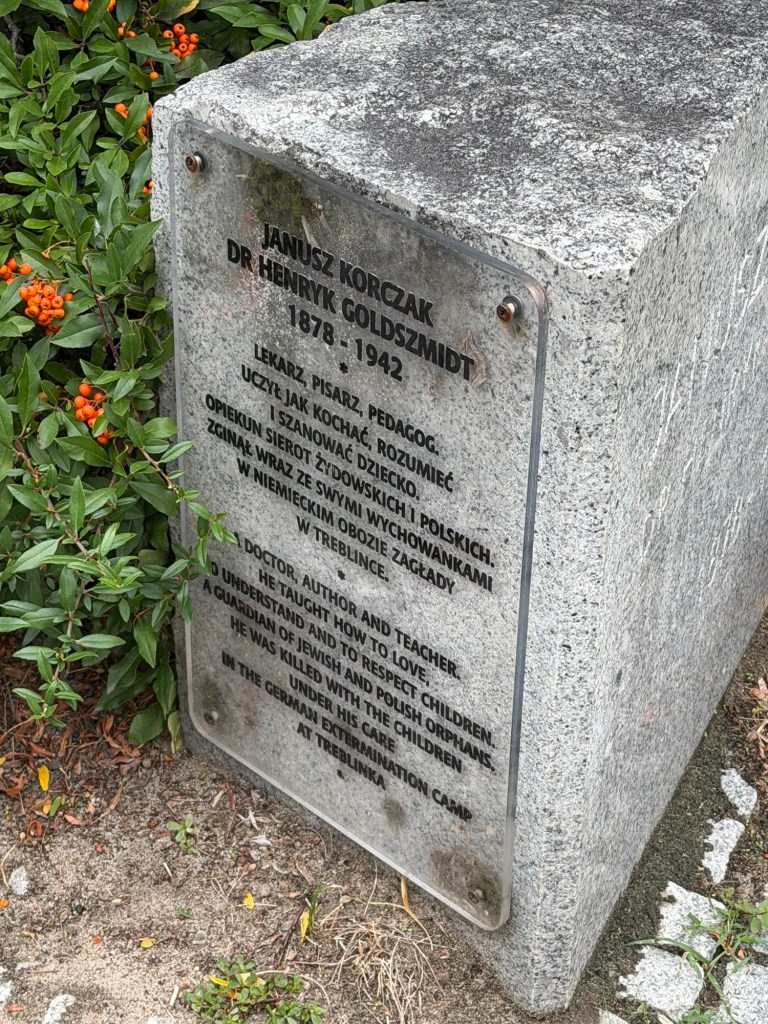
The English on the plate is plain to the point of bluntness. He taught how to love, understand and respect a child. He was a guardian of Jewish and Polish orphans. He was killed with the children under his care in the German extermination camp at Treblinka. Not a Nazi camp, not a Polish one. German. The wording on that stone was chosen with some care, and I do not think anyone who put it there expected the point to go unnoticed.
What the plate does not say is the part that kept me on the bench a good deal longer than I had meant to be there. When the ghetto was created, the orphanage was moved into it, and then moved again, and Korczak went with it. He was offered a way out more than once, by people in a position to arrange it, and he refused each time on the grounds that he was not going to leave the children. In August 1942 he walked out of the building with them and about a dozen staff, to the Umschlagplatz, and onto a train. Around two hundred children. He is generally reckoned to have been sixty-four.
Set into the paving a few feet away is a rusting cast-iron plate marking the spot where the foundation stone was laid. Fundacja Shalom on the left, the Polish Korczak Association on the right, and the date: Warszawa, 19 września 2003.
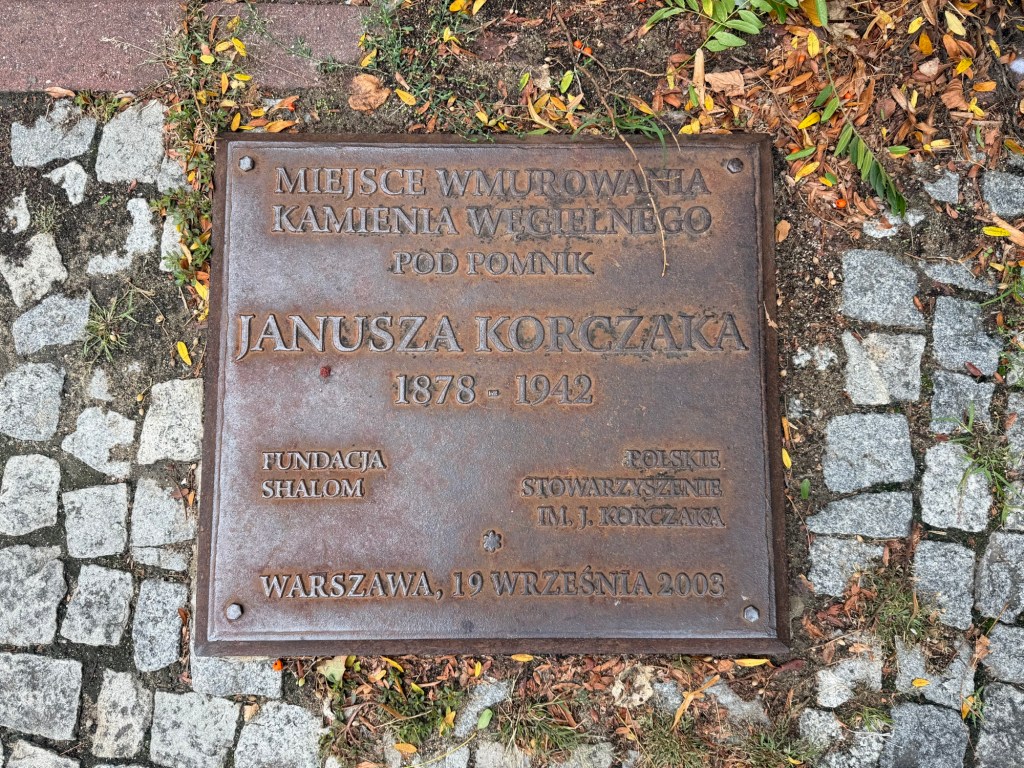
Three years passed between that stone and the statue, which for a public monument is quick work. The gap behind it is the one that gives you pause. A monument to Korczak was first proposed just after the war, and then nothing happened for half a century. The idea was revived in 1999, went to international competition in 2001, and the statue was unveiled on the first of June 2006, which is Children’s Day. Sixty years to put up a figure of a man every child in the country was already taught about.
I sat there a while, and watched people arrive at it.
They came past steadily. Most looked. A fair number stopped, and stood, and took the whole thing in. Almost none of them read the plaque. One couple took a selfie more or less in passing and went on their way, and they now have a photograph of themselves beside a grey man and six children about whom they know nothing at all.
I am in a poor position to be sniffy about it. Twenty minutes earlier I had walked up to the same statue and seen a statue. The only thing separating me from that couple is that I bent down and read the writing.
Yesterday I stood in front of a wall running wartime photographs on a screen, under letters two storeys high: nie tylko patrz, pamiętaj. Don’t only look. Remember. At the time it felt like a fair remark aimed at a man who had spent an hour walking past walls without knowing what any of them were. From the bench it looked less like an instruction and more like a description of what happens if nobody gives you one.
You cannot move in this city without walking into history of a scale that does not really fit in the head. I had gone out looking for a bench, and the bench came with all of this attached.
Through the glass
A little further on there is a sheet of glass standing in a black frame on the grass. Printed on it is a photograph of a ruined street: gutted tenements with their fronts torn off. Because the glass is clear you look straight through the ruins, and what lines up behind them is the Palace of Culture and Science.
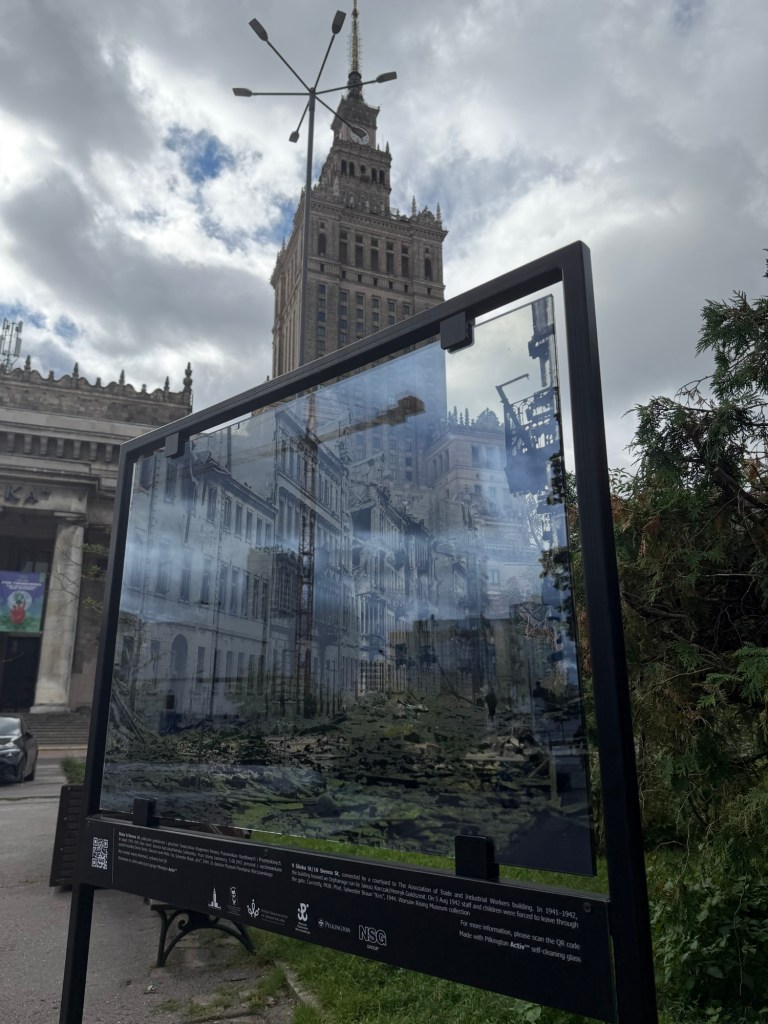
The caption underneath identifies the building. Śliska 9 and Sienna 16, joined by a courtyard to the Association of Trade and Industrial Workers. In 1941 and 1942 it housed Korczak’s orphanage, and the caption names the gate they were taken out through. The photograph was taken in 1944 by Sylwester Braun, who worked under the name Kris, and belongs to the Warsaw Rising Museum. Then, in the flattest words on the panel: Currently, PKiN.
Which corrects something I had assumed on the bench. The statue in the park is near the place, not on it. The building itself stood over here, and the Palace is now sitting on the address, so there is no wall left to fix anything to. Instead they have stood the ruins up on glass at eye level, so that the thing which replaced them lines up behind, and left you to do the arithmetic.
Ornament
Round the far side of the park, hard against the Palace, there is an obelisk. Grey stone, a considerable height, a band of Greek key running round the plinth and carved swags hanging beneath it, and, so far as I could see, not a word written on it anywhere.
Which makes it the only thing I have looked at in three days that commemorates nothing whatsoever. It is not a monument. It is part of the building. The 1952 plan for the site describes the Palace standing on its plinth, approached by wide steps, and then lists what goes around it: lawns, fountains, and two free-standing obelisks. Somebody drew them in with the flowerbeds.
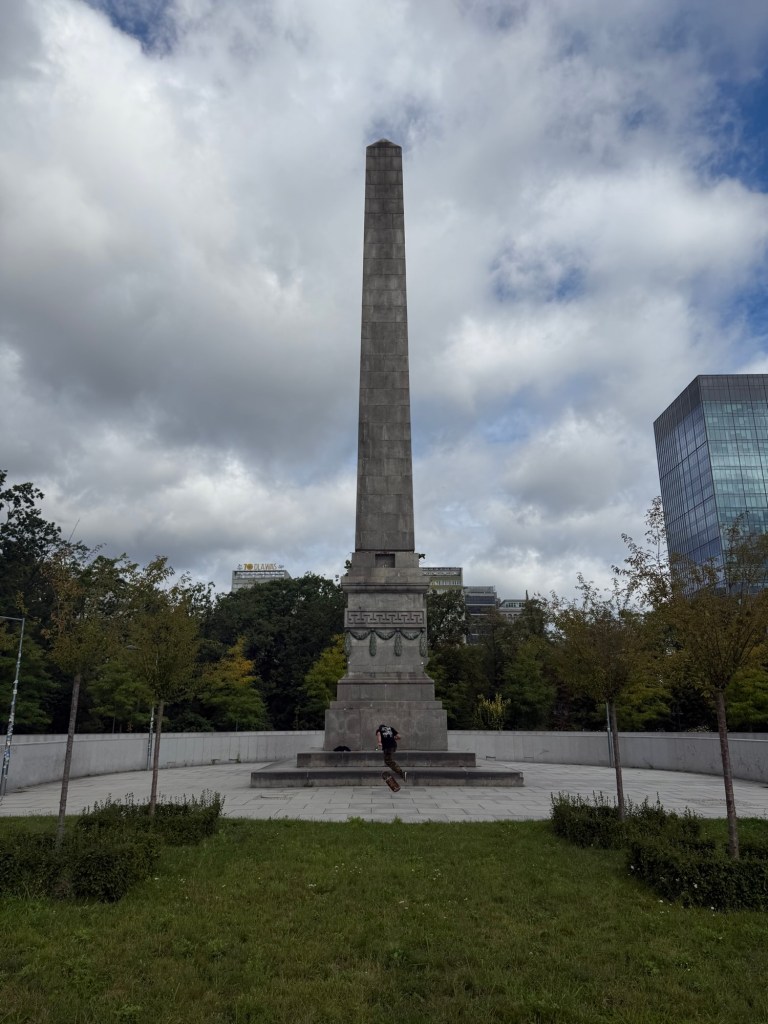
A lad was using the paving in front of it to practise varial flips, and landing a good proportion of them.
Sixty years to raise a statue of Korczak. This one arrived with the lawns.
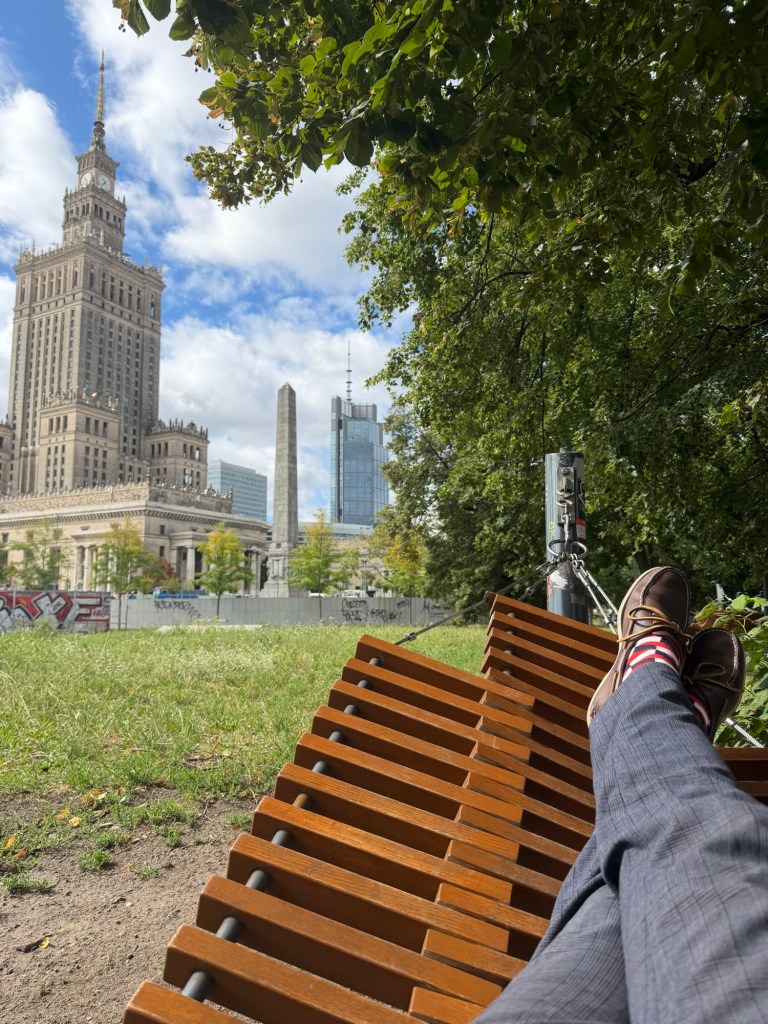
Further into the park the cloud finally cleared off, and I found what the park does best: wooden loungers slung on cables between the trees, somewhere between a deckchair and a hammock. I got into one, put my feet up, and lay looking at the Palace, the obelisk and a glass tower standing in a row.
The way back
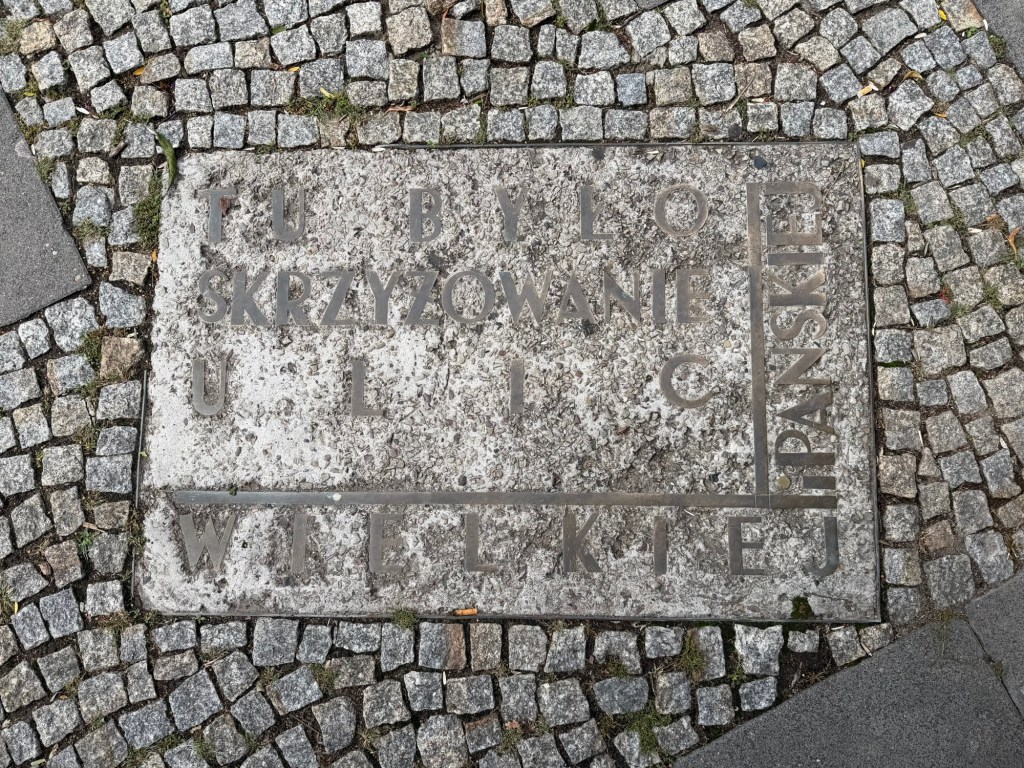
Walking back to the hotel I nearly trod on a stone slab set into the pavement, lettered straight into the paving: Tu było skrzyżowanie ulic Wielkiej i Pańskiej. Here was the crossroads of Wielka and Pańska streets. Wielka is not there to be crossed any more. Pańska is, in places.
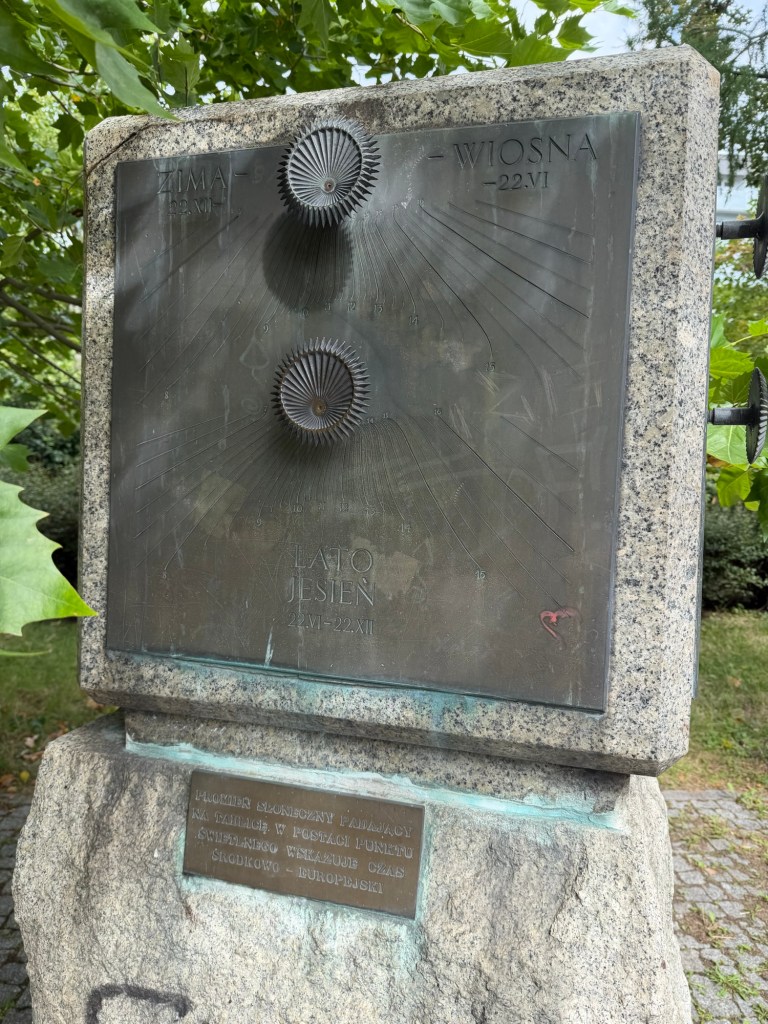
Then a sundial on a granite pillar, bronze, scratched about a bit, with the year divided across two dials: winter to spring on the upper one, summer to autumn on the lower. A small plate at the bottom explains that the sunbeam falling on the dial as a point of light gives Central European Time. It was doing so, accurately, to nobody in particular.
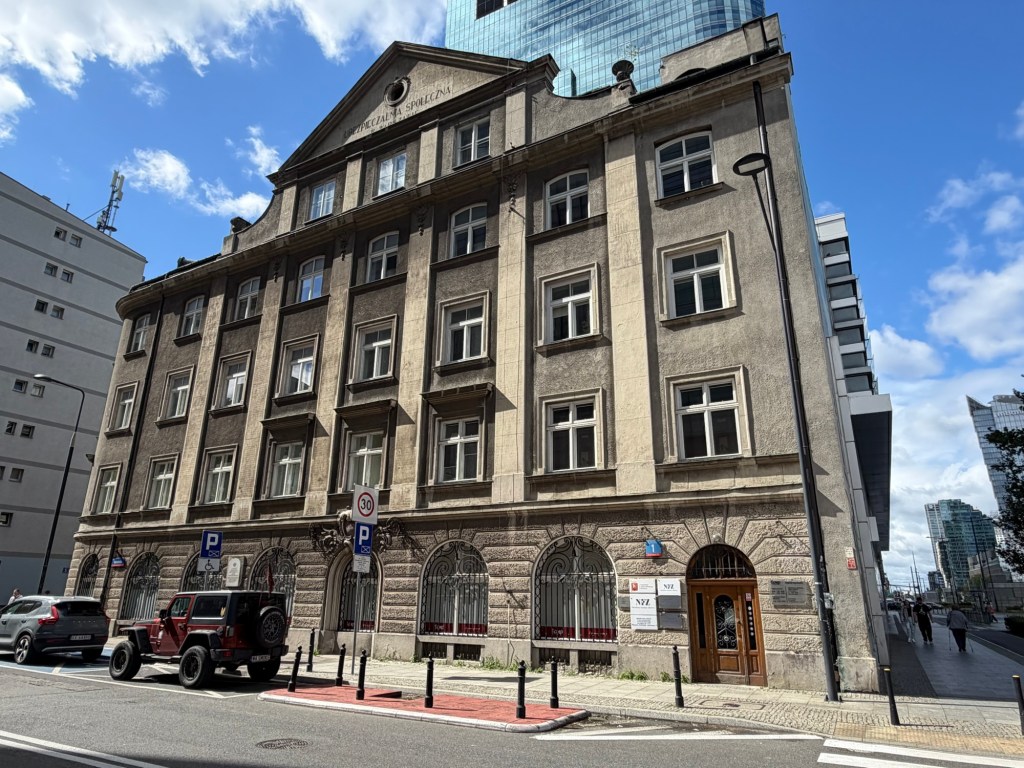
And then, on a corner where Pańska does survive, a building that has no business being there at all. Five storeys, heavy grey stone, a curved gable with lettering across the pediment: Ubezpieczalnia Społeczna w Warszawie. The Social Insurance Institution. Everything around it is glass and thirty storeys.
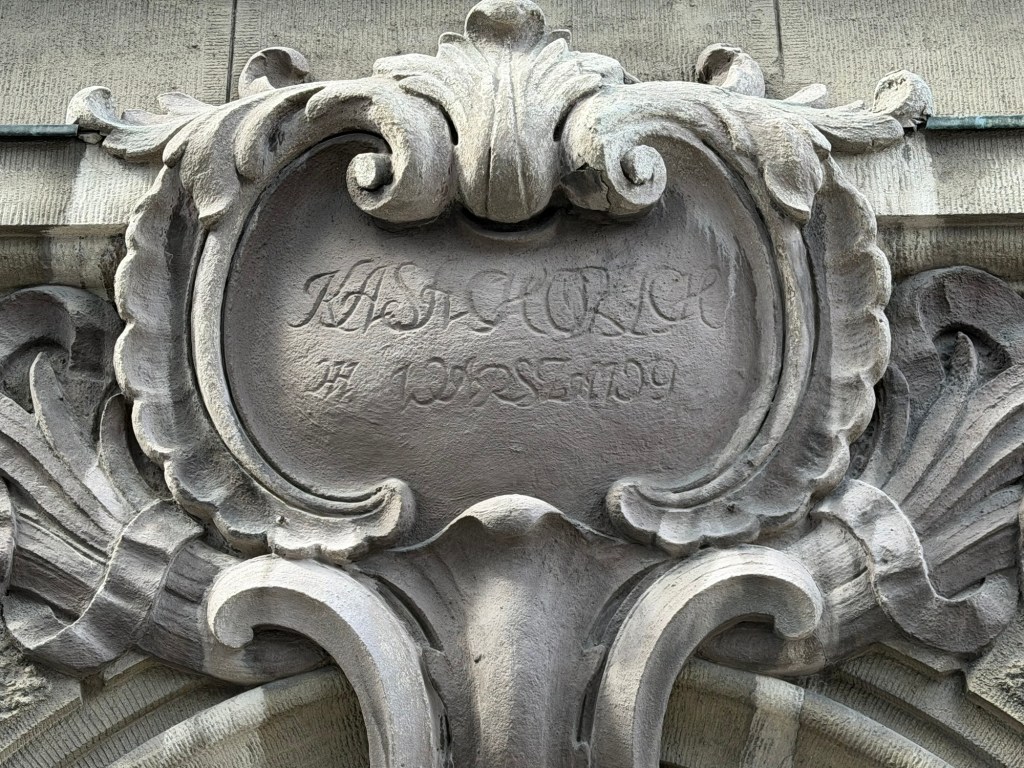
It was finished in 1925 to a design by Henryk Julian Gay, and built for the Kasa Chorych, the city sickness fund, whose name is worked into the cartouche over the door in a script that took me three goes to read. In 1935 the insurance system was reformed and the Ubezpieczalnia moved in, and put its own name on the pediment above the old owner’s name without removing it. Today it is a clinic, with the national health fund’s notices screwed to the wall beside the door. Four employers, one set of stone clothes.
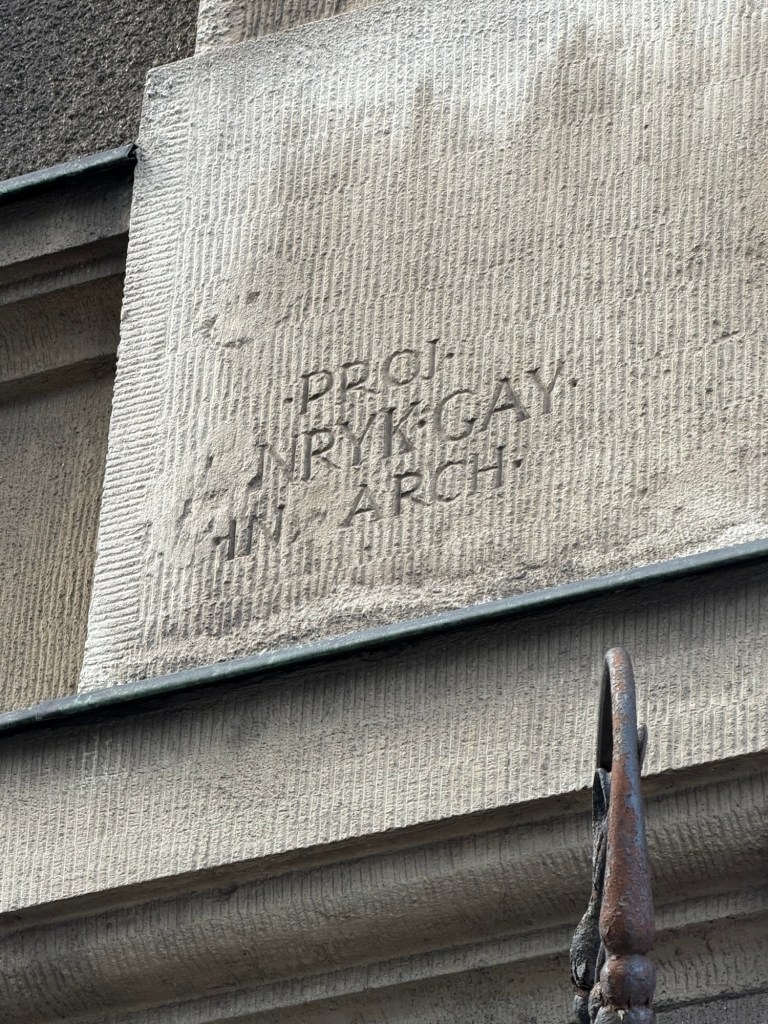
The architect signed it. On the front elevation, cut into the stone in Roman capitals: proj. Henryk Gay, inż. arch. Not a plaque put up afterwards by anybody’s association. He carved his own name into his own building and went home.
The plaque is lower down, at shoulder height, and in Polish only, with no English underneath. In this building, between 1940 and 1942, in the Warsaw ghetto, Luba Blum-Bielicka ran the Jewish nursing school. For her heroism and dedication she was awarded the Florence Nightingale Medal by the International Red Cross.
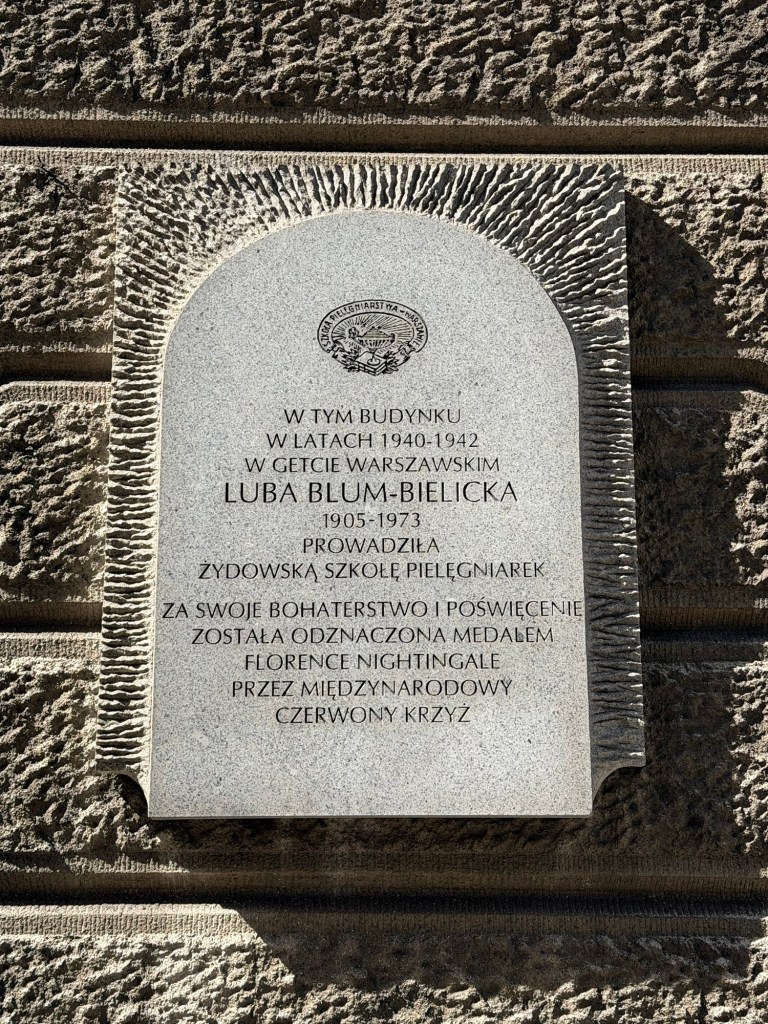
The school was the only educational institution the Germans permitted inside the ghetto. Blum-Bielicka had run it since 1939 and brought it in here when the walls went up, into a building she called one of the most beautiful in the ghetto, which tells you something about the rest of it.
During the Great Deportation in August 1942, the nurses were taken out to Plac Grzybowski. One account of the day has them due to be marched to the Umschlagplatz alongside the children I had spent the morning reading about. Blum-Bielicka argued the Germans out of it, on the grounds that there would be epidemics and they would need nurses, and got her own two away as well.
She survived, and died in Warsaw in 1973, which is the second date on the plaque. Her husband, one of the leaders of the Bund and a fighter in the Ghetto Uprising, was killed in 1943.

