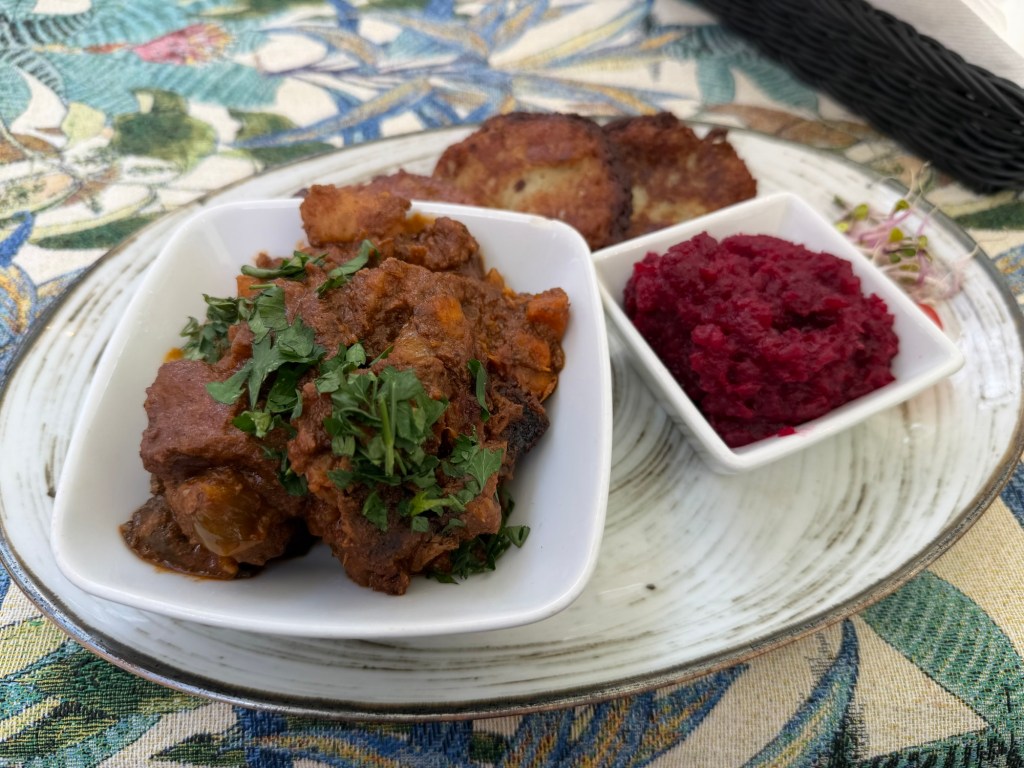
The wild boar at Kamienne Schodki was excellent, and came with potato cakes and a dish of grated beetroot. I had got about as far as that when the sky went out and it rained the way it only rains in August, straight down and all at once. I was under a parasol on the terrace, which meant I was going nowhere for a while, which in turn meant another beer. I want to be clear that the weather ordered it and not me.
My girlfriend was still in Łódź, and staying there another night, so the afternoon was mine whether I wanted it or not. Twenty minutes later the rain was over and it came back hot and bright, and I paid and went out into it.
The morning had already settled the main question. Almost nothing here is original, and I had spent half a day working that out and thinking it was the end of the thought. It was not. What the afternoon added was that the city will tell you so itself, on wall after wall, if you stand still long enough to read.
Świętojańska
Up first to the Archcathedral Basilica of St John the Baptist, at the top of Świętojańska, a few minutes from the Market Square. From the street it is a plain brick box with a stepped gable, and after a morning of stucco and pastel there is something restful about a building that is only brick.
It does not look old, though. The brick is too even, the edges too sharp, and the gable has the clean stepped geometry of something drawn on a board rather than arrived at over four centuries. There is no sag anywhere in it. That is not a complaint. It went up in the 1950s and it does not pretend otherwise.
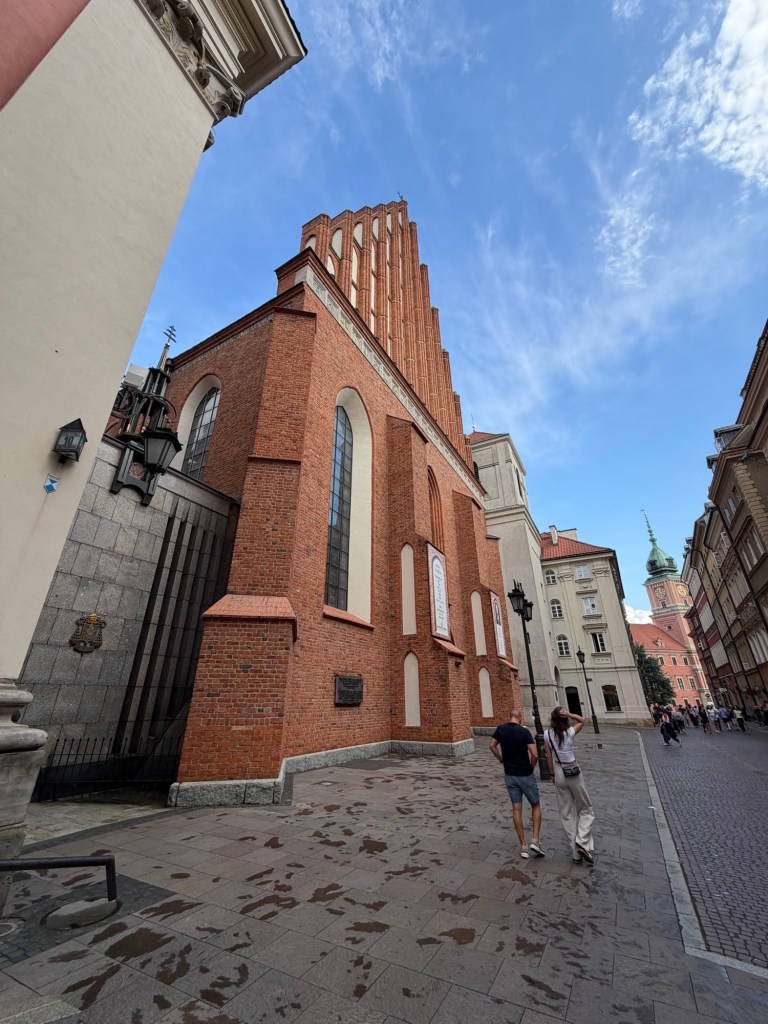
I knew it had been rebuilt. Everything has. What I did not know is that the thing they put back is not the thing that was lost. In the 1830s and 40s the cathedral was rebuilt in English neo-Gothic to a design by Adam Idźkowski, who gave it a new front with a tower in the middle, enlarged the windows, took down some of the chapels and lowered the roof. That is the building that stood here in 1939. In 1944 the south wall came down during the Rising, the inside burnt out, and after the surrender the Germans blew up what was left. The north wall of the chancel survived, and the Baryczka chapel.
What went back up between 1948 and 1956, under Jan Zachwatowicz with Maria and Kazimierz Piechotka, was not Idźkowski’s church. It was a fourteenth century one, worked up from a Zygmunt Vogel watercolour of the front with its plaster stripped off, and from Gothic churches in Chełmno and Wrocław. Zachwatowicz said later that he had sketched Idźkowski’s version first and could not make the proportions work once he tried to take it upwards. It has also been argued that English neo-Gothic was politically unwelcome by then, being too cosmopolitan for the people paying for it. Either way, the building that was destroyed and the building that replaced it are not the same building, and the replacement is the older of the two.
Zachwatowicz is the man whose plaque I had stood in front of on Castle Square an hour before this, on my way to lunch, without knowing who he was.
Next door, sharing a wall with it, the Jesuit church of Our Lady of Grace, patroness of the city. Its door is bronze, with a woman and an angel in half relief coming out of the metal, and the lintel above gives the name of the church and then three dates: 1609, 1944, 1970. Built, destroyed, put back, and cut into the stone over the door where anyone walking past can read it.
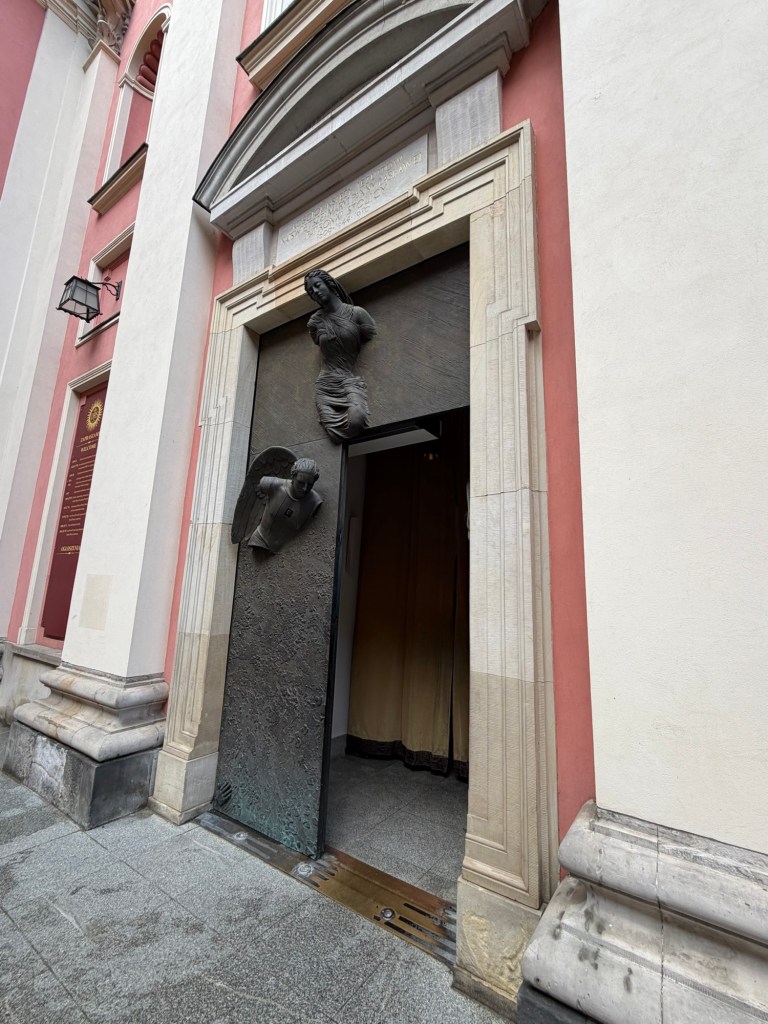
This one does not look old either, and for the same reason. The Jesuits started putting it back in 1948 and had the shell up by 1957. The tower followed in 1969, and they were still fitting out the inside in 1973. Almost nothing of the original furnishing survived, so what stands there now is a twentieth century interior behind a seventeenth century face. The door is younger again. Igor Mitoraj made it in 2009, which accounts for the woman and the angel, who are his and not the sixteen hundreds’.
Which leaves the pair of them shoulder to shoulder, put back in the same years by the same city, to opposite principles. The cathedral came back as something older than the building that was lost. This one came back as precisely what it had been, Mannerist front and all.
I went in through that door. I did not photograph the inside. There were people at prayer, several of them alone and clearly not there as visitors, and it seemed a poor way to repay being let in. So I stood at the back for a while and looked at the vaulting instead.
It was only afterwards, going back through the photographs, that I worked out I had never been in the cathedral at all. I had looked at it from the street, admired the brick, walked forty feet and gone into the building next to it. The cathedral can wait until tomorrow, when I may have company and will certainly have better supervision.
The Market Square
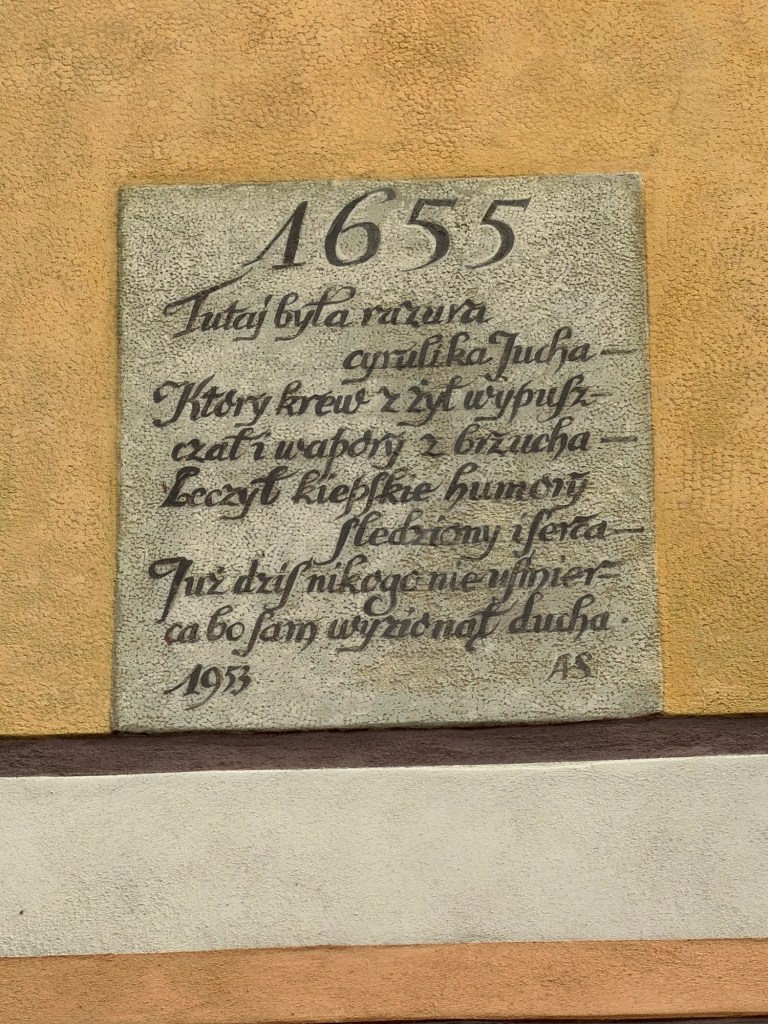
Somewhere on the Market Square, small and set well above eyeline where almost nobody would see it, there is a stone with a comic verse on it. It records that a barber-surgeon called Jucha kept his shop on that spot in 1655, let blood from veins and vapours from bellies, and treated the bad humours of the spleen and the heart. It ends by noting that he murders nobody these days, having given up the ghost himself. The joke is on his name. It was cut in 1953.
Which is to say that in the middle of putting a bombed city back together, somebody stopped to make a pun about a seventeenth century bloodletter, and then placed it where you would have to be looking up to find it.
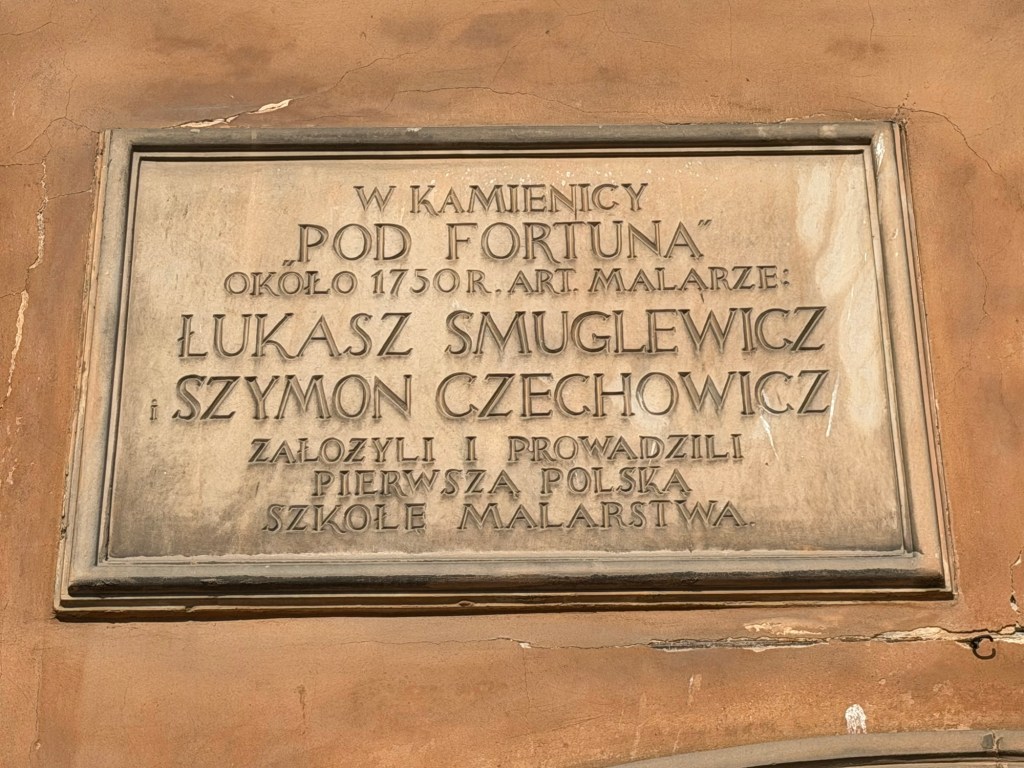
Two more on the same square, and both of them worth stopping for.
A stone tablet records that in the house called Pod Fortuną, around 1750, the painters Łukasz Smuglewicz and Szymon Czechowicz founded and ran what it calls the first Polish school of painting. No students named, no address beyond the house sign. A trade taught in a room over a shop.
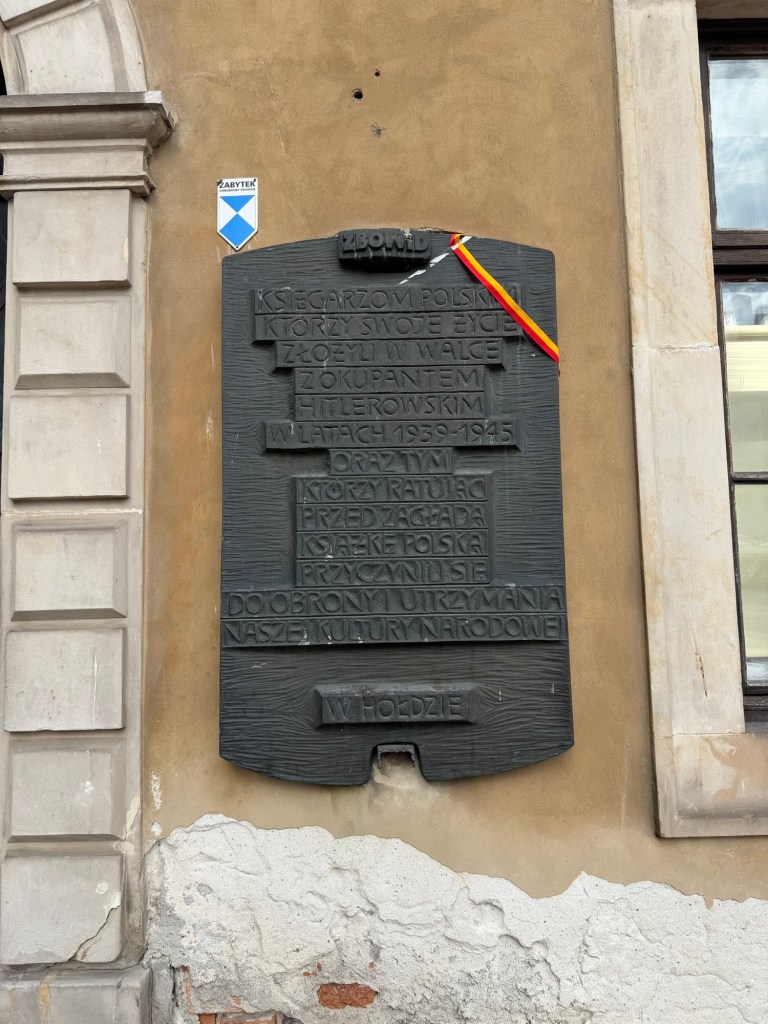
And a dark cast panel, with a heritage shield beside it and a red and yellow ribbon knotted to one corner, to Polish booksellers. To those who lost their lives fighting the German occupier between 1939 and 1945, and to those who, by saving the Polish book from destruction, helped defend and keep the national culture. It ends with two words: in tribute.
It was put up by ZBOWiD, the veterans’ association of the People’s Republic, which is its own small piece of history. Booksellers, on a square that was rubble, remembered by the state that came after.
Jezuicka
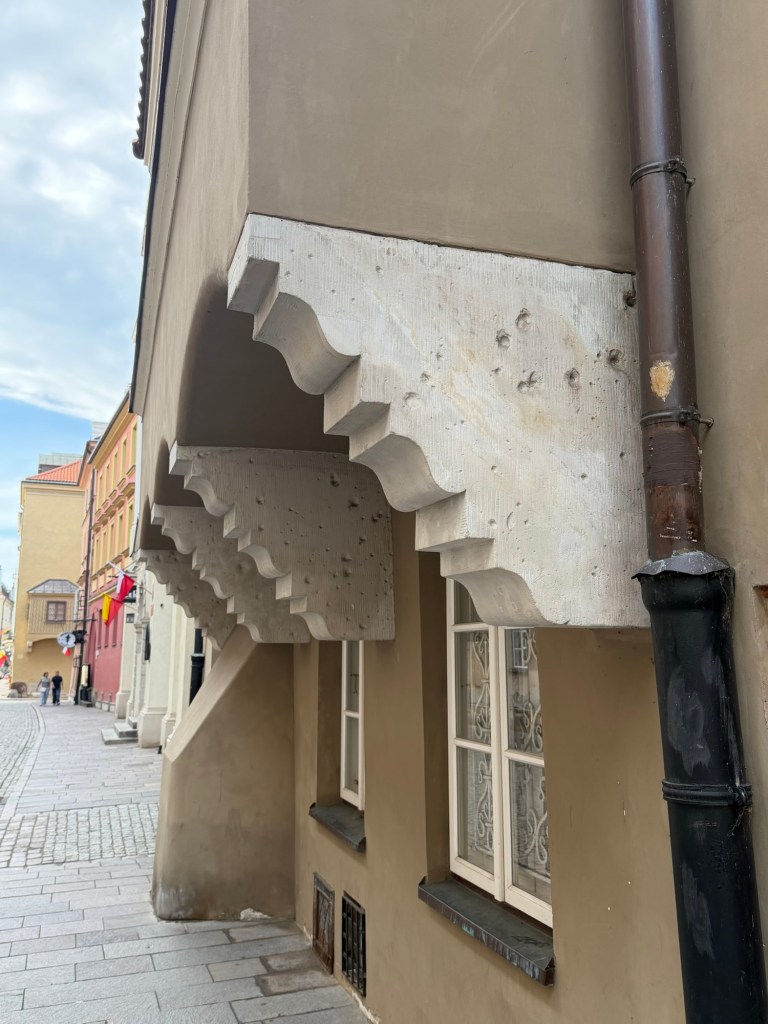
Off the south east corner of the square runs Jezuicka, which is short and quiet and has the corner house at the far end, where it meets Kanonia. This is the canonry built in 1541 for Stanisław Boniecki, a canon and the Warsaw official, and the upper floor juts out over the street on an oriel added after 1611, carried on a row of stepped stone brackets.
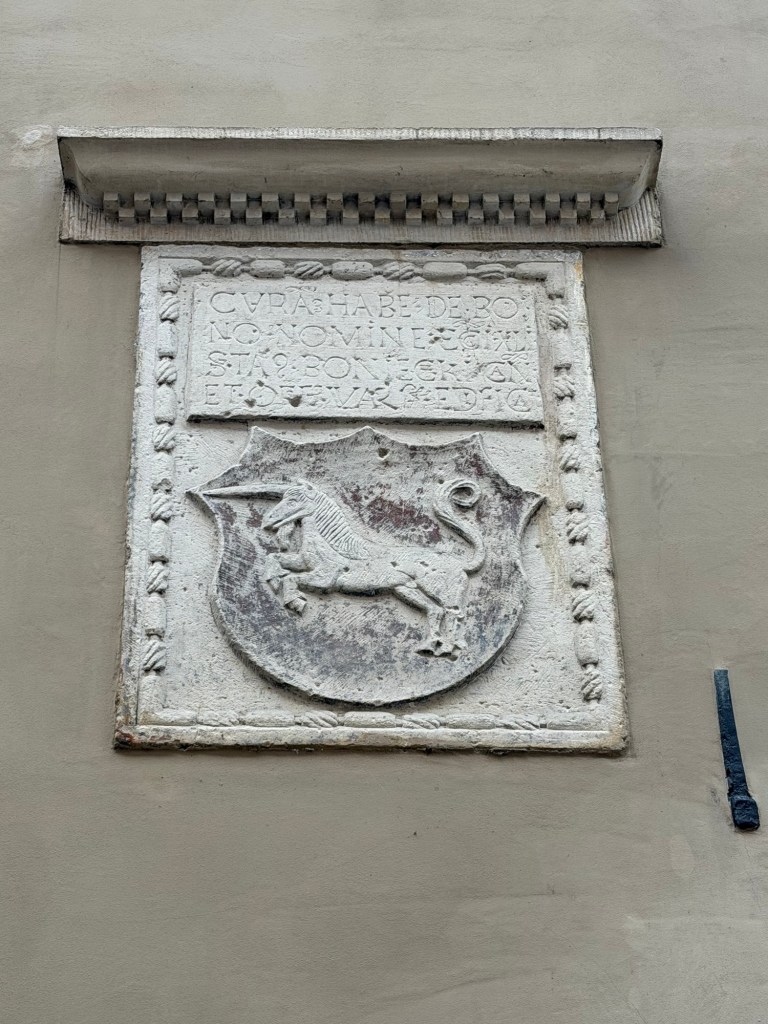
Set in the wall is his foundation tablet: a Latin line from Ecclesiasticus, have care of a good name, his name and his office beneath it, and under that a shield with a unicorn on it. The unicorn is the arms of Bończa. The tablet is a reconstruction. The fragment of Gothic wall a little further along the same elevation is not.
The brackets under the oriel are pitted all over. Small craters, some shallow and some not, scattered across faces that otherwise carry the neat vertical lines of the chisel. I am not qualified to say what made them and I am not going to pretend otherwise, but they do not look like tooling.
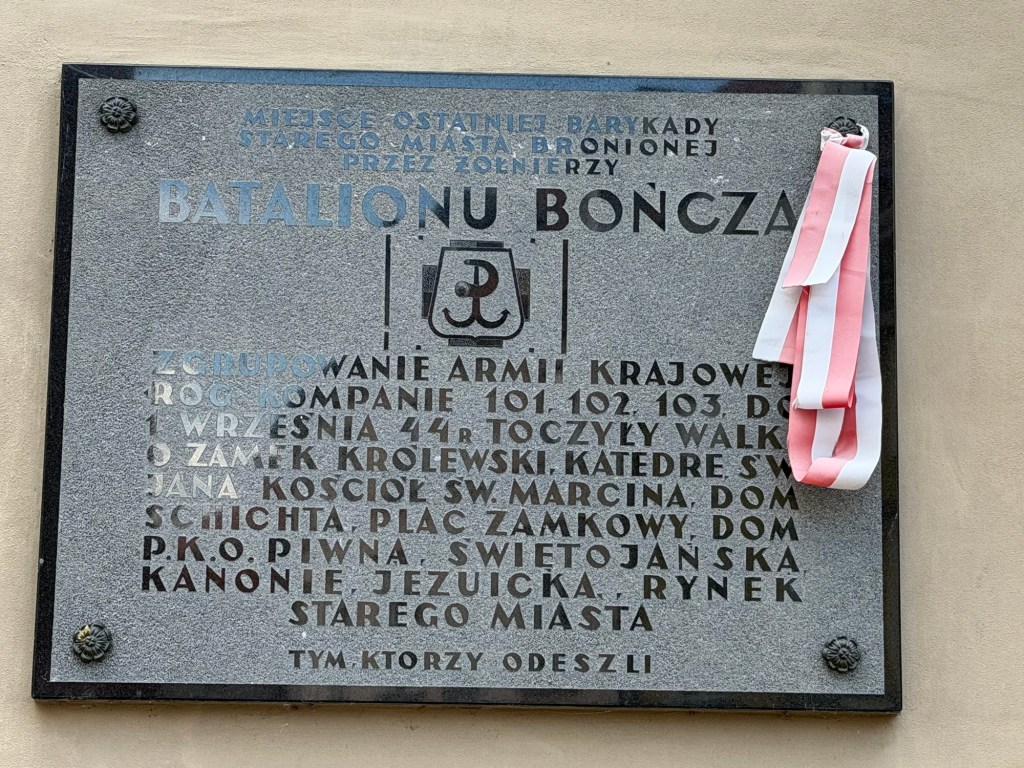
Whatever they are, the name on the wall follows you up the street. The battalion that fought the last of the Old Town, three companies of it, holding the Castle and the cathedral and Piwna and Świętojańska and this street, was called Bończa too.
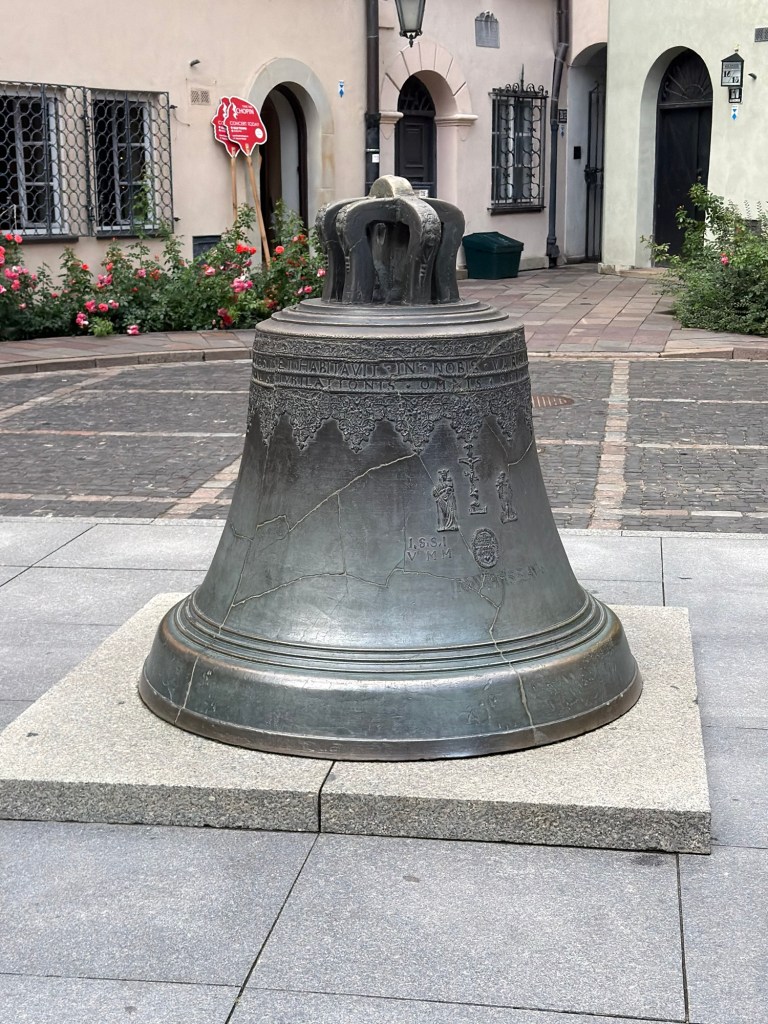
Behind the cathedral is Kanonia, which is called a square and is in fact another triangle. There is a bell in the middle of it, standing on a stone slab at ground level rather than hanging in anything. It is cracked from crown to lip. The Latin band around the shoulder carries a line from John: dwelt among us.
On the walls around it, three more plaques, because of course there are.
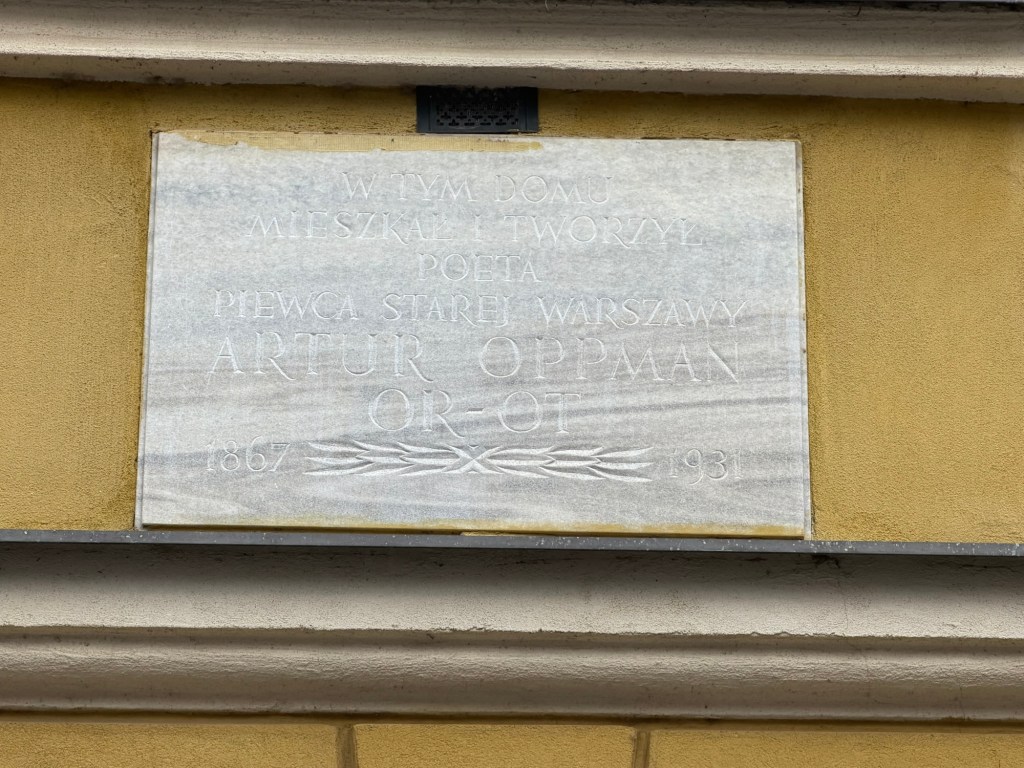
One to Artur Oppman, who wrote as Or-Ot, 1867 to 1931, who lived and worked in that house and whom the stone calls the singer of old Warsaw. I had read him that morning without knowing it. The verse on the plaque to the mother of the unknown soldier, over on plac Piłsudskiego, is his.
One to Stanisław Staszyc, 1755 to 1826, who housed the Society of the Friends of Learning in that building for a time, and whom the stone calls a reviver of civic spirit, a sage, a benefactor, and a giver of millions to the nation.
And one, with a red and white ribbon tied to its corner, marking the site of the last barricade of the Old Town, held by the soldiers of the Bończa battalion of the Home Army. It lists what they fought over: the Royal Castle, the cathedral, St Martin’s church, Castle Square, Piwna, Świętojańska, Kanonia, Jezuicka, the Market Square. Every street I had walked that afternoon, set out as a list of objectives. It ends: to those who have gone.
Celna
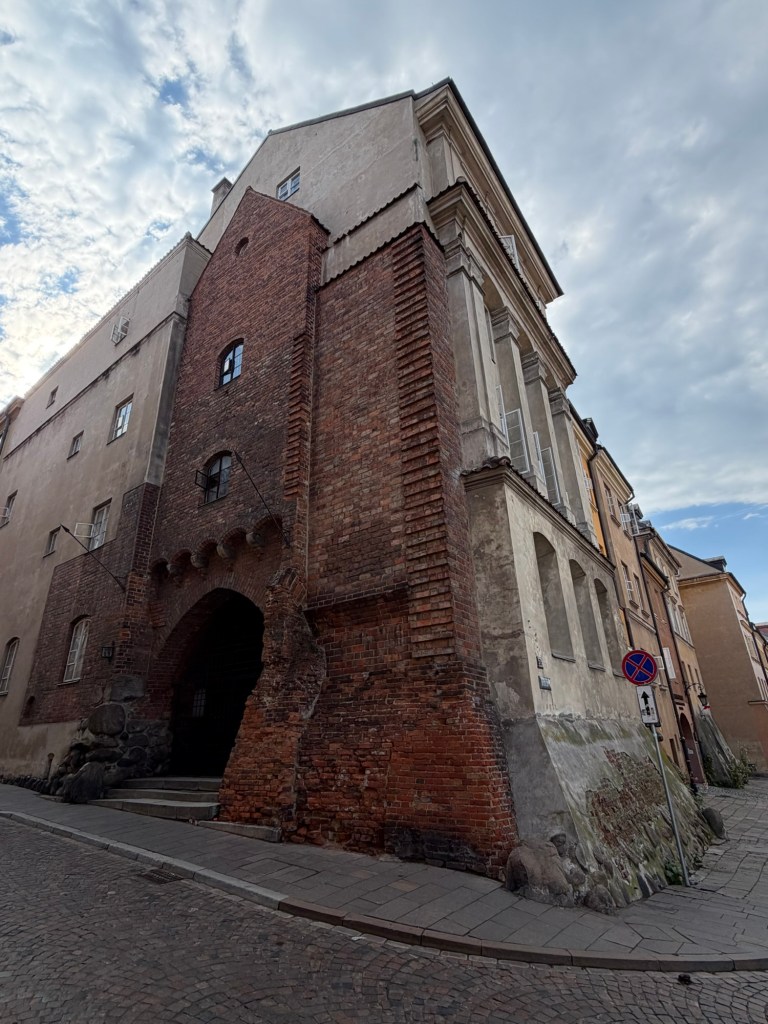
Down the far side of the square, where Celna meets Brzozowa and the ground starts falling away towards the river, there is a great slab of red brick with a pointed arch cut through it and steps going up into the dark. It is the side wall of a granary. Because it stood against the town wall it had to carry a passage for the watch, and that passage, with the ones through the buildings either side of it, made a continuous lane running behind the defences. A short length of it survived inside the eighteenth century Jesuit house that was later built onto the end, which is the plastered block with the blind arcading standing awkwardly against it in the photograph.
It is on the short list of the oldest surviving fabric in the Old Town. After an afternoon of copies, reconstructions and recut inscriptions, it is good to stand in front of something that has simply been here the whole time.
The Walls
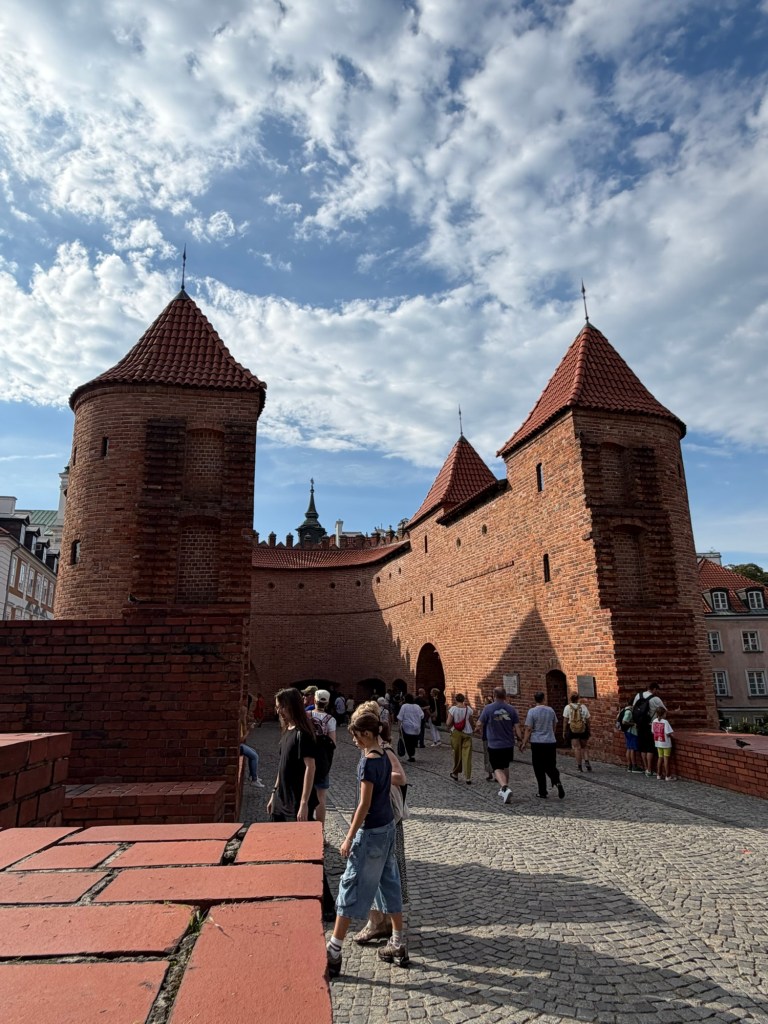
Then up to the Barbican, which is the opposite trick. Rebuilt from 1950, but rebuilt out of original Gothic brick, the oversized kind, recovered rather than made new. A reconstruction assembled from genuine medieval material, at the other end of the same walk as a genuine medieval wall wearing an eighteenth century front.
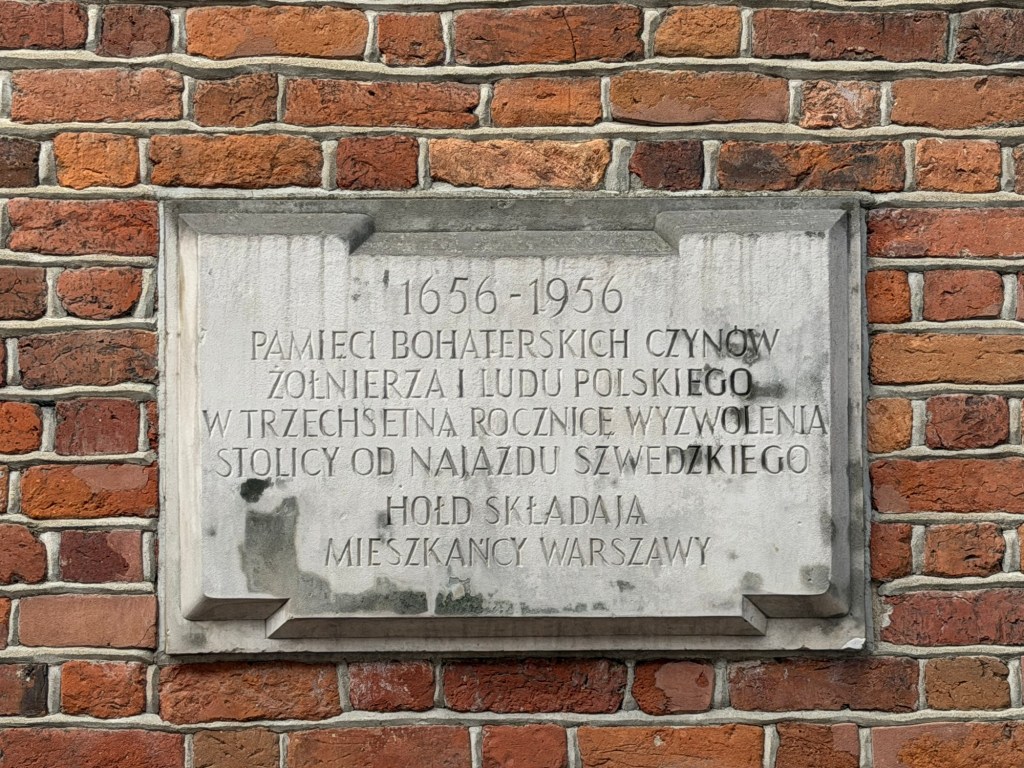
Set into the brick on the way through is a plaque I would have walked past if I had not by now developed the habit. Two dates, three hundred years apart: 1656 and 1956. To the memory of the heroic deeds of the Polish soldier and the Polish people, on the three hundredth anniversary of the liberation of the capital from the Swedish invasion. Tribute paid by the inhabitants of Warsaw.
Eleven years after the city was flattened, somebody put up a memorial about a different war entirely, one that ended two hundred and eighty nine years before this one started.
Długa
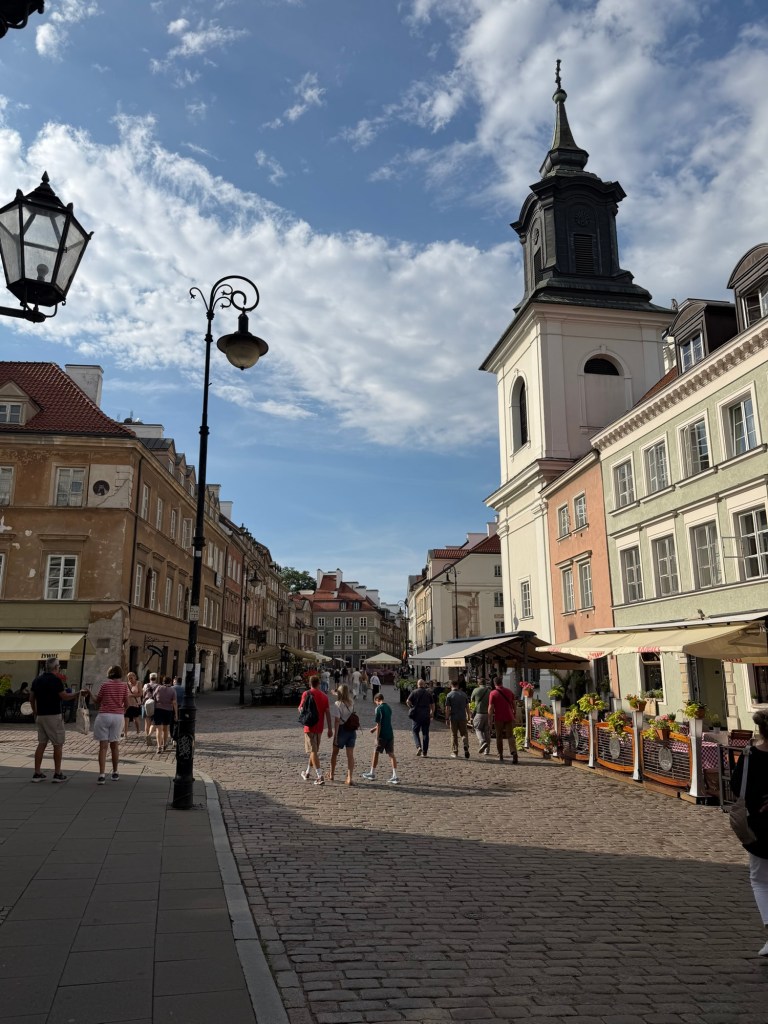
Through the gate and out the other side, and the streets change. Wider, quieter, fewer parasols, and a long view down Freta towards the New Town.
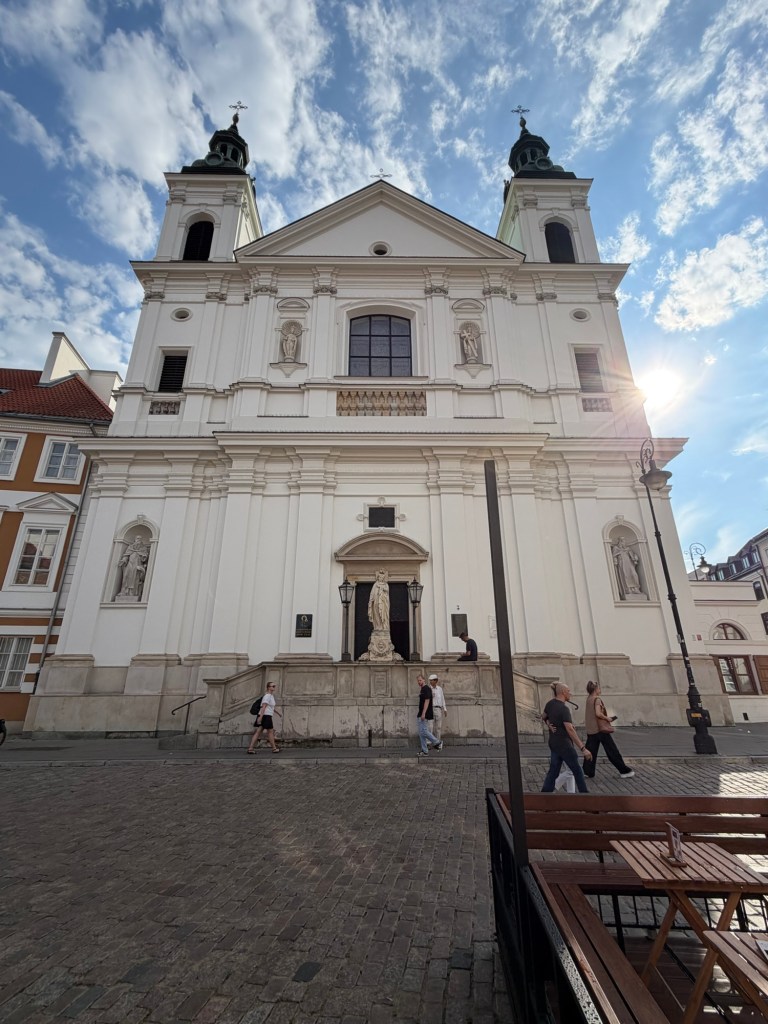
On the corner stands the church of the Holy Spirit, a wide baroque front with two towers and a figure of the Virgin over the door. The present building went up between 1707 and 1717. The one before it, a wooden church with the first hospital in Warsaw attached, was destroyed by the Swedes, and in 1662 John Casimir gave the ruins and the ground to the Pauline fathers as thanks for the defence of Jasna Góra. So the plaque I had just read on the walls and the church I was now standing in front of are the same war, fifty yards apart. It burnt in 1944 and was rebuilt in the fifties.
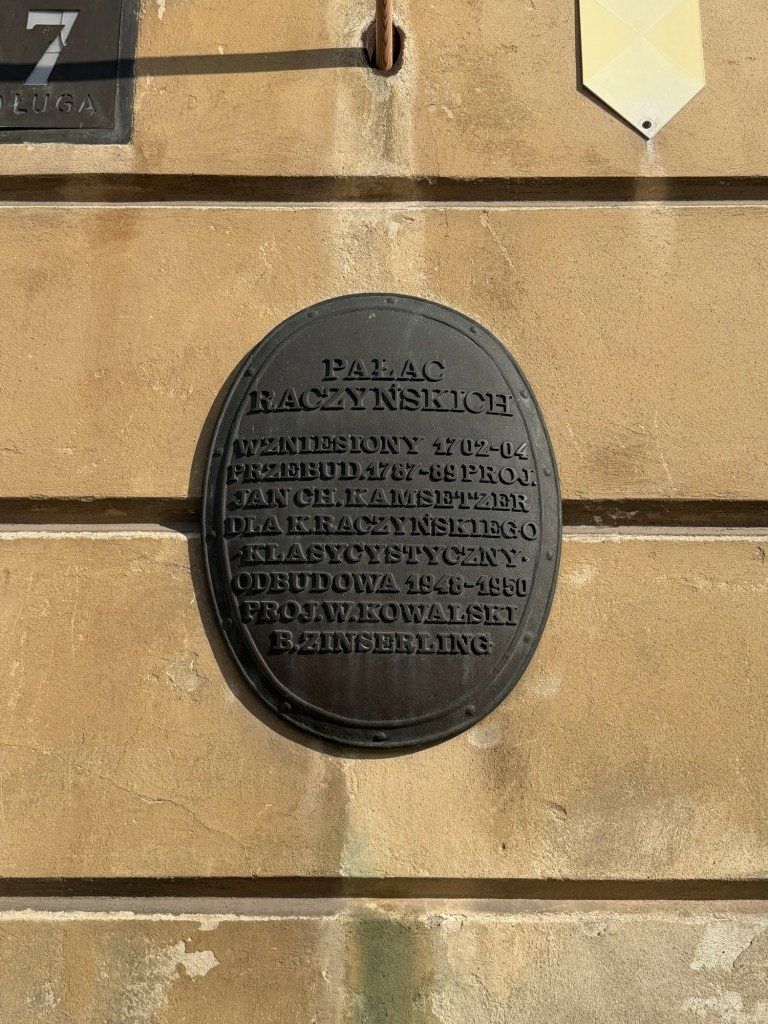
A little way along Długa, at number seven, is the Raczyński Palace, and it carries three plaques that between them do the whole thing.
The first is the ordinary oval kind that this city puts on everything: raised 1702 to 1704, rebuilt 1787 to 1789 to a design by Jan Chrystian Kamsetzer for a Raczyński, classical, reconstructed 1948 to 1950. Nobody hiding anything, again.
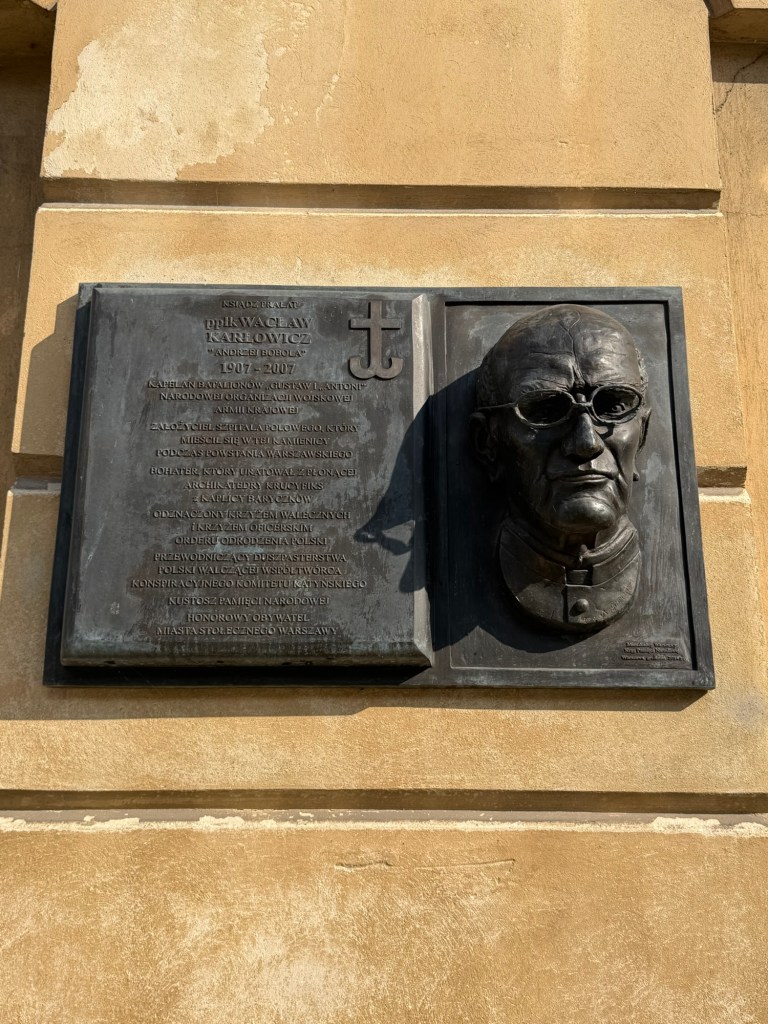
The second is a bronze book with a face beside it, to Father Wacław Karłowicz, 1907 to 2007, chaplain to the Gustaw and Antoni battalions of the Home Army. It records that he founded the field hospital that stood in this building during the Rising, and that he carried the crucifix out of the burning cathedral, out of the Baryczka chapel. It hangs in the one church on this walk that I did not actually manage to go into.
The third is the one that stops you. A stone slab, and cut into it: this place is sanctified by the blood of Poles who fell for the freedom of the homeland. On 2 September 1944, in the insurgent hospital, about four hundred and thirty people were murdered.
Underneath it, a small plaque carrying the English translation, put up by a Polish committee in California. The Polish says hitlerowcy. The English says the Germans. Somebody made that decision, and it is the same decision I have been making since I got here.
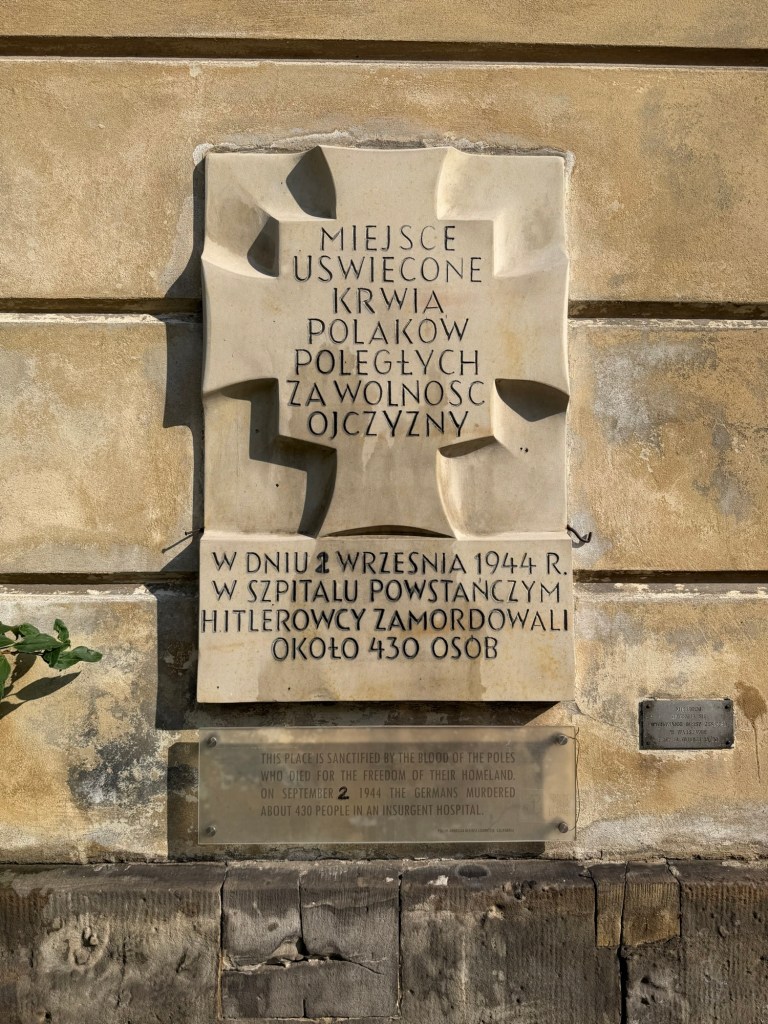
Four hundred and thirty in a hospital on one street, on the same day that fifty were shot against a wall in the Old Town.
Podwale
Back round the outside of the walls to Podwale, where the outer circuit meets Wąski Dunaj, and on the stump of one of the round towers there is a small bronze boy.
He is about five feet nothing. The helmet is too big and sits down over his eyes, the camouflage smock is too big, the boots are too big, and a sub machine gun hangs across his front. Somebody has tied a red and white band round the helmet. Somebody else has left a bouquet of red and white flowers in the crook of his arm, and a ribbon on the plinth, and both of them are fresh.
The Little Insurgent. Jerzy Jarnuszkiewicz modelled the figure in 1946, as a student, while working as a volunteer clearing rubble, and it won a prize in a competition for a sculpture to mark the Rising. For nearly forty years afterwards it existed mostly as a souvenir, a plaster and then a metal statuette sold to visitors by the thousand, until the Warsaw scouts raised the money to cast it at full size. It was unveiled on 1 October 1983 by Jerzy Świderski, who in 1944 had been a fourteen year old runner in the Gustaw regiment.
Which is the same regiment whose chaplain founded the hospital on Długa. I had read his plaque forty minutes earlier.
A year to the day after the unveiling the scouts added a red sandstone tablet on the wall behind, with the scout cross on it and a line from a wartime song. Children of Warsaw, we will go into battle; for every stone of yours, Capital, we will give our blood.
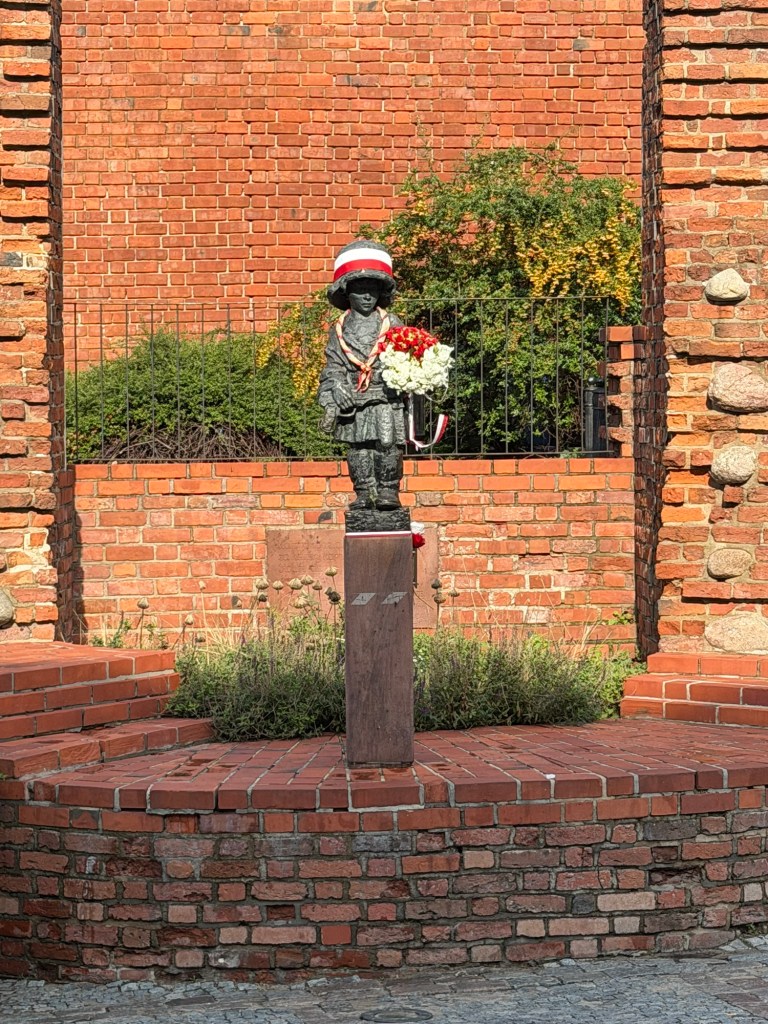
The sculptor came to dislike it. He said he had given in to a sentimental urge to pay a debt to the children who fought, and then became ashamed of the thing, and reproached himself for having worked on the most private feelings people have. That is his own verdict on his own work and I am not going to argue with him about it.
I stood there a while anyway. He is the right height. That is the whole argument.
Piekarska
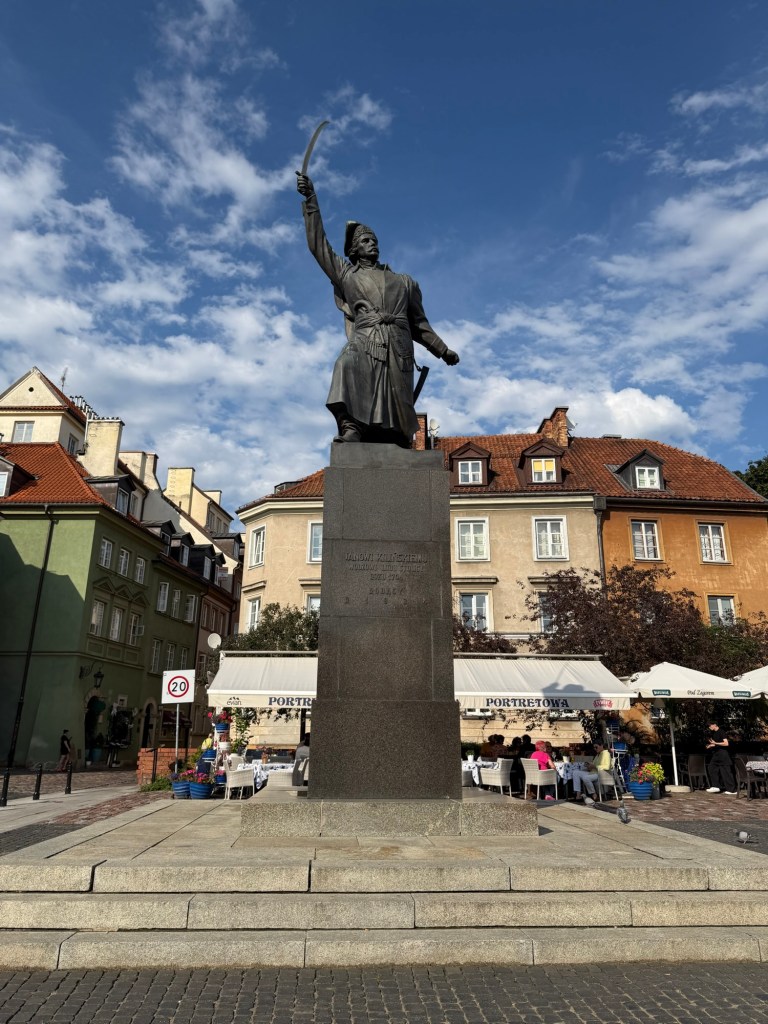
Along the wall from him, where Piekarska comes out on Podwale, a man in a nobleman’s coat and a square cap stands on a granite block with a sabre in the air. Jan Kiliński, a shoemaker, who in April 1794 led the people of the Old Town against the Russian ambassador’s residence a little way up the road.
The plinth says only: to Jan Kiliński, leader of the people of the capital in the year 1794, from his compatriots. The sculptor was Stanisław Jackowski and it was unveiled on Krasiński Square in 1936, in front of the president, after which every guild in Warsaw processed through the city carrying the tools of its trade.
In February 1942 a scout called Aleksy Dawidowski climbed the Copernicus monument and took down the German plaque. In reprisal the Germans dismantled Kiliński and put him in the cellars of the National Museum. He was supposed to be destroyed; the museum’s director talked them out of it. In March Dawidowski painted on the museum wall, in Kiliński’s voice, people of Warsaw, I am here. Notices went up the same day signed Mikołaj Kopernik, astronomer, announcing that in revenge for the removal of the Kiliński monument he was extending winter by six weeks.
The reprisal saved him. Off his plinth and underground, he came through the Rising that levelled everything around him. He lost the sabre and got a new one. He is one of very few things standing in this city that is actually the thing itself.
On the gable of the house on the corner there is a clock, and it is not like any other clock. The dial is a great irregular blot of brown mosaic with a spiked sun bursting out of it, four moons in their phases set around it, and the hours marked by the signs of the zodiac in copper. On the hour the figures move and it plays a tune.
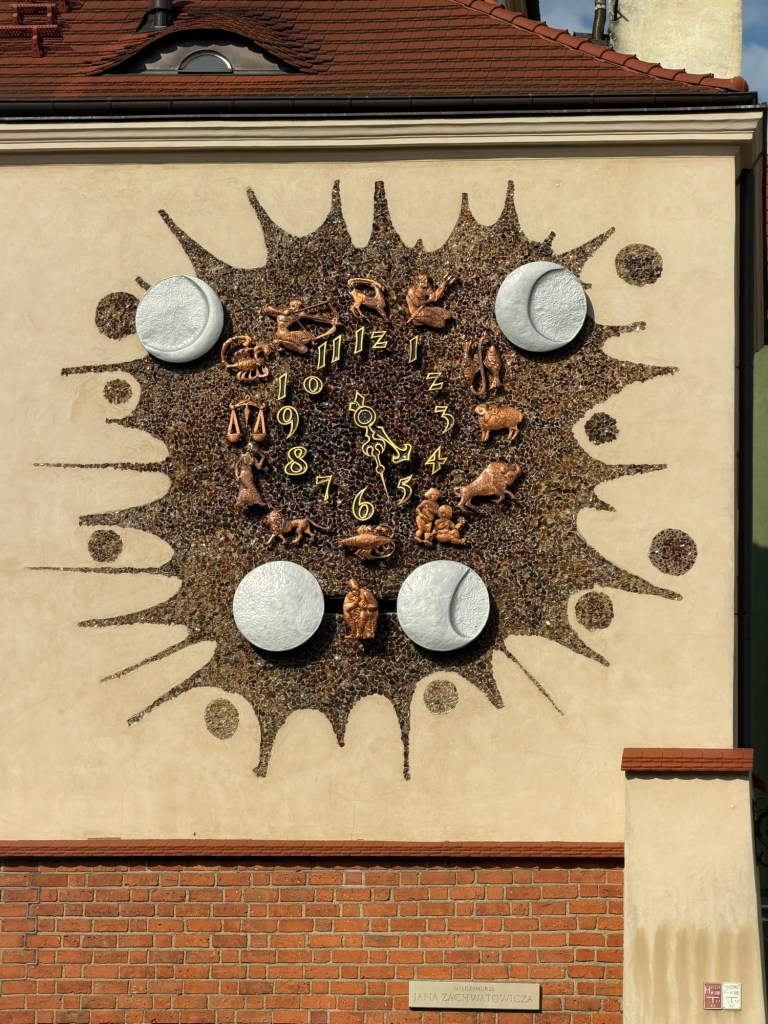
The house behind it was raised out of the rubble by the craft guilds and held the museum of artistic and precision crafts for decades, which is why the clock is there at all. A watchmakers’ guild put a clock on the wall of the house they had rebuilt.
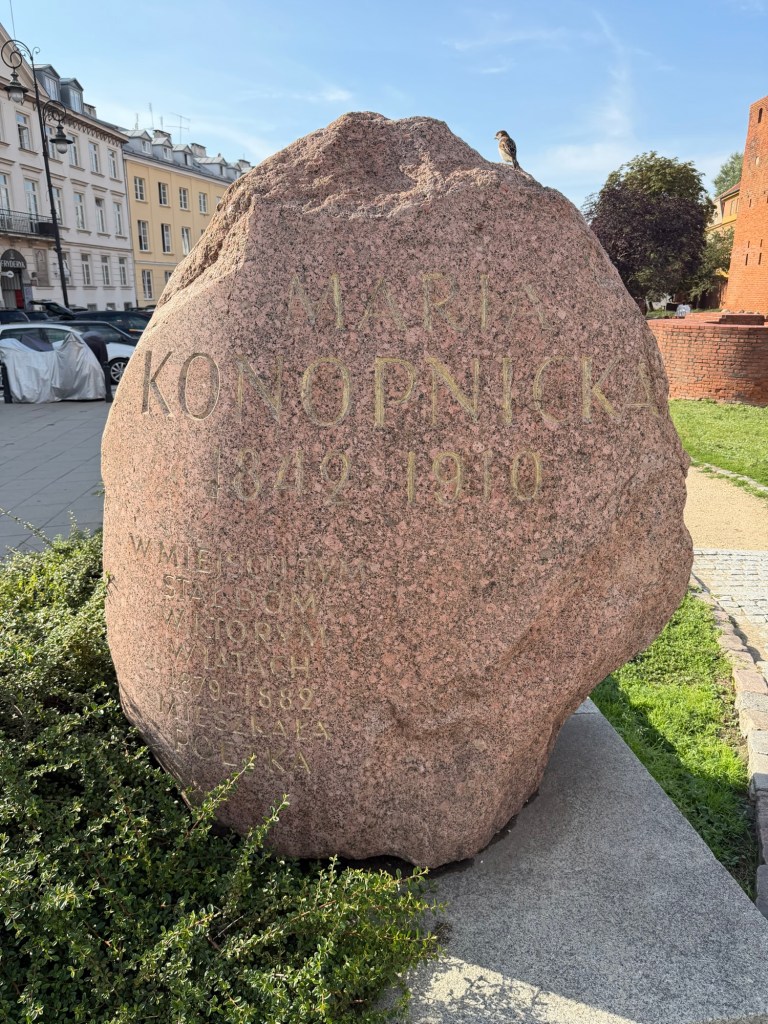
And then aimed it at the neighbour. The tune it plays on the hour is a setting of a poem by Maria Konopnicka, and on the grass at the foot of the same corner sits a pink granite boulder with her name cut into it, 1842 to 1910, and a line recording that the house she lived in between 1879 and 1882 stood on that spot. There was a sparrow on the top of it and it did not move for either of us.
Cut into the brick below the clock, small enough to miss, is the name of the walkway I had been standing on all this time. Międzymurze Jana Zachwatowicza. The strip between the inner and outer walls, named after the man who rebuilt them.
That is three times in one day. His plaque on Castle Square before lunch, his cathedral after it, and now the ground under my feet. I have stopped calling it a coincidence.
Długa 9/11
Further up Długa there are two more, on two more buildings, and by now I was reading every wall I passed.
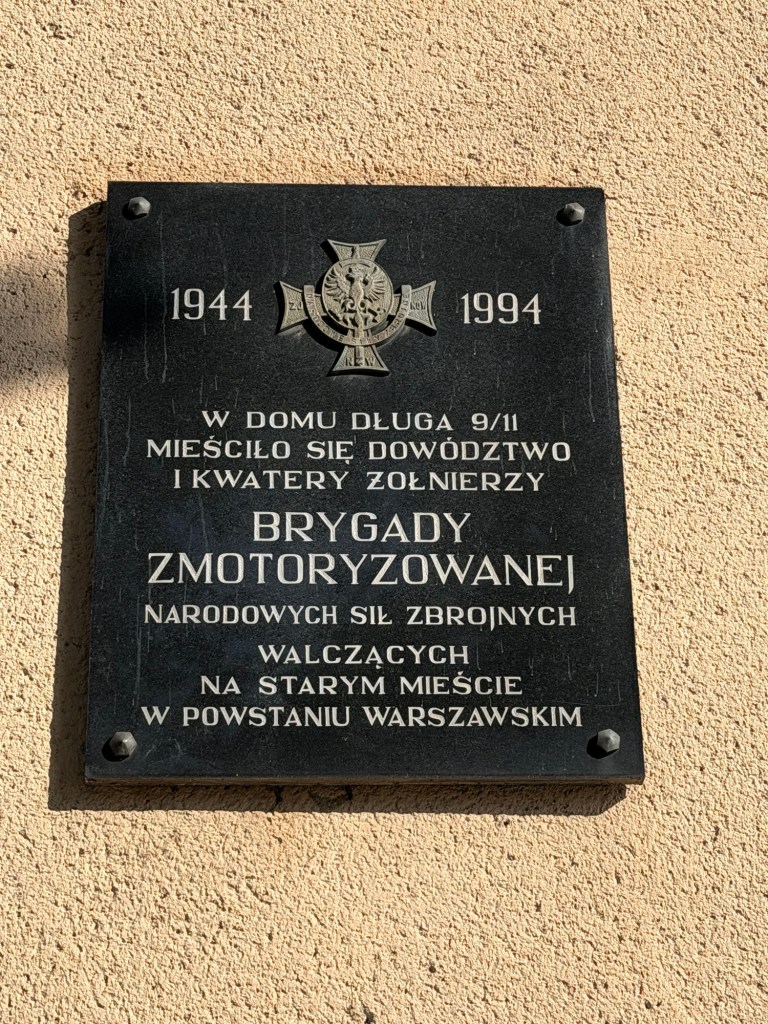
At number 9/11, a black slab with two dates, 1944 and 1994, recording that the house held the command and quarters of the motorised brigade of the National Armed Forces, which fought in the Old Town during the Rising.
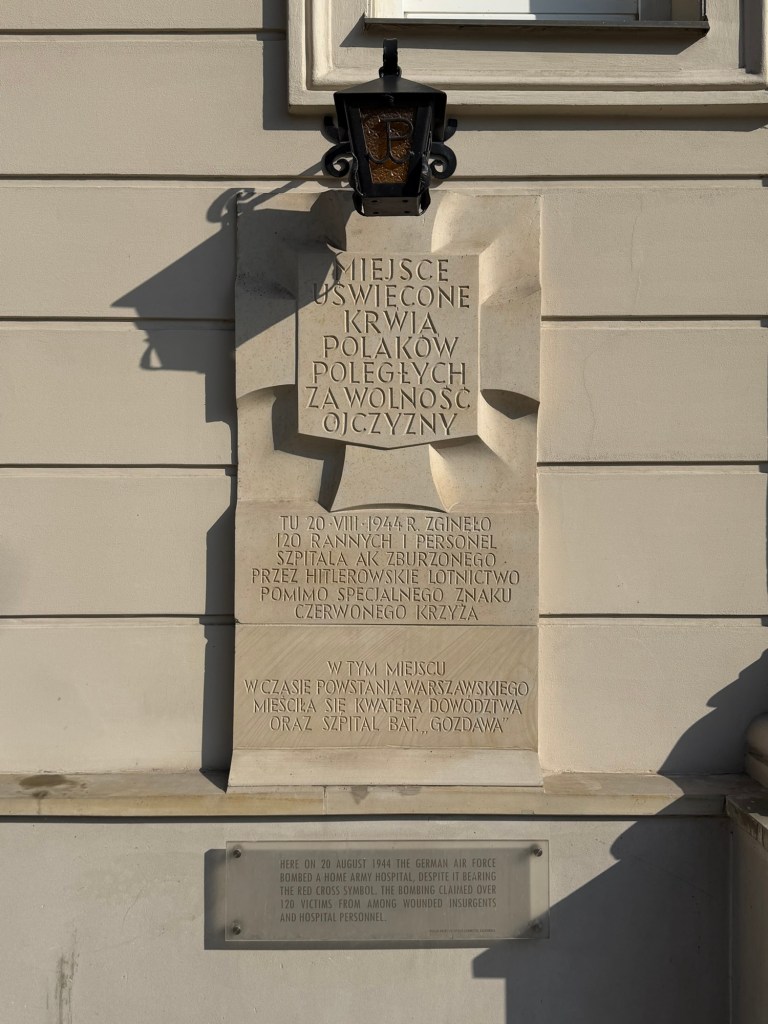
And a few doors on, the same opening words I had read outside the Raczyński Palace half an hour before. A place sanctified by the blood of Poles who fell for the freedom of the homeland. Here, on 20 August 1944, a hundred and twenty wounded and the staff of a Home Army hospital were killed when it was destroyed from the air, in spite of the Red Cross marked on it. Below that, a second inscription: in this place during the Rising stood the command quarters and hospital of the Gozdawa battalion.
Underneath, a small plate in English. Same committee in California as the last one.
Two hospitals on one street, thirteen days apart. Four hundred and thirty at one end and a hundred and twenty at the other.
The Field Cathedral
The Field Cathedral of the Polish Army stands on the same street, and its walls are not walls so much as a noticeboard.
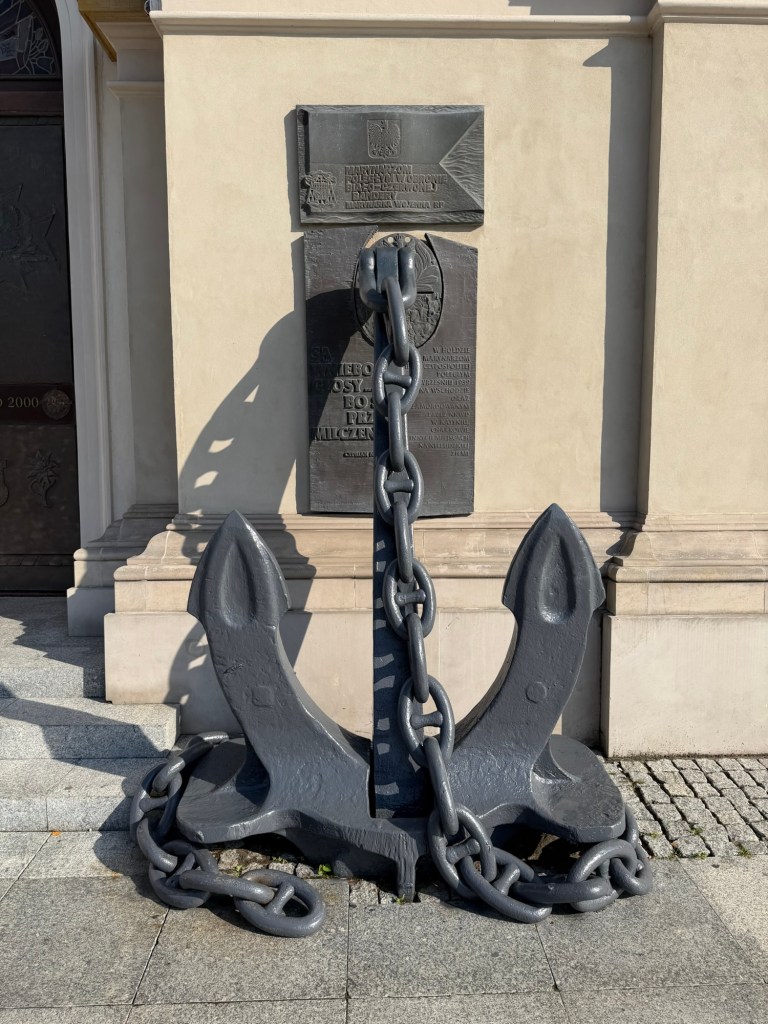
The doors are bronze, with an eagle on one leaf and a cross on the other, and IUBILAEUM AD 2000 cut across the middle.
Outside them, on the pavement, a ship’s anchor as tall as I am with its chain lying loose around the flukes. Above it a plate to sailors who fell defending the white and red ensign, and beside that another in tribute to the sailors of the Republic who died in the east in September 1939, and to those murdered by the NKVD at Katyń, at Kharkiv and elsewhere.
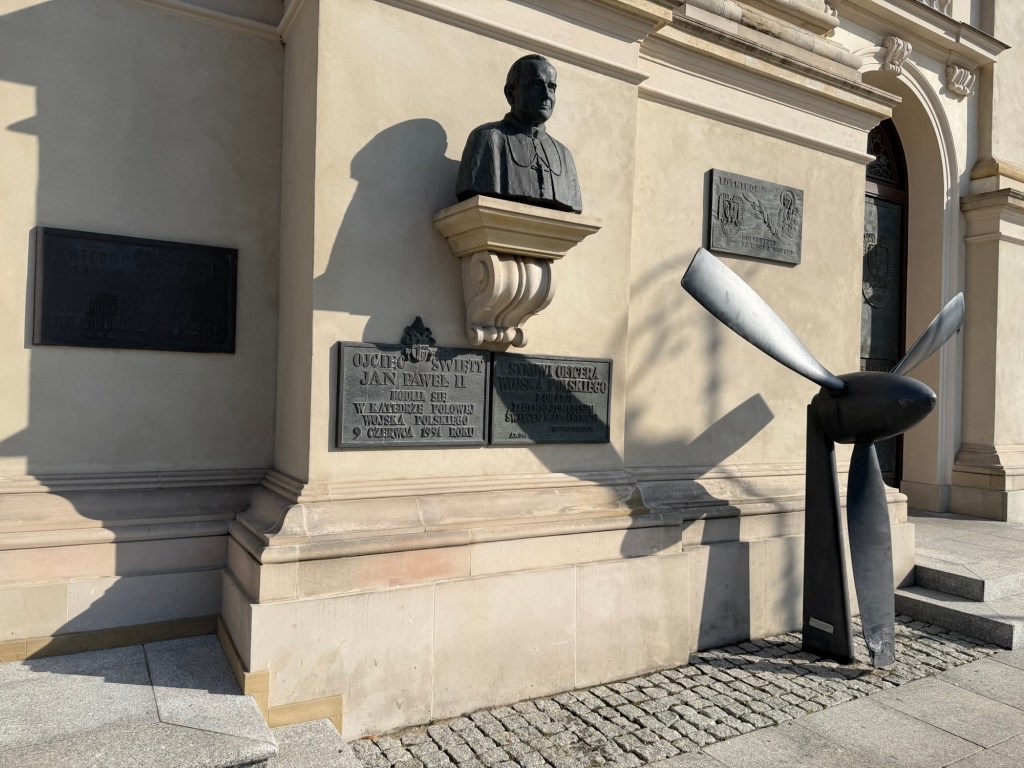
Round the corner of the same wall, a bronze bust on a stone bracket, two plaques beneath it, and an aircraft propeller standing upright on the cobbles. One plaque records that John Paul II prayed in this cathedral on 9 June 1991. The other is addressed to the son of a Polish Army officer, on the golden jubilee of his ordination. The Pope twice, then. Once by name, and once as a soldier’s boy.
Krasiński Square
And then the Uprising monument, which is the last thing and the largest.
It is in two parts. The near group is people going down: a woman lowering herself into a manhole, a man in a helmet handing her down, a priest standing beside them with his hands folded, waiting. That is the sewers, which is how the Old Town got out when it could no longer be held.
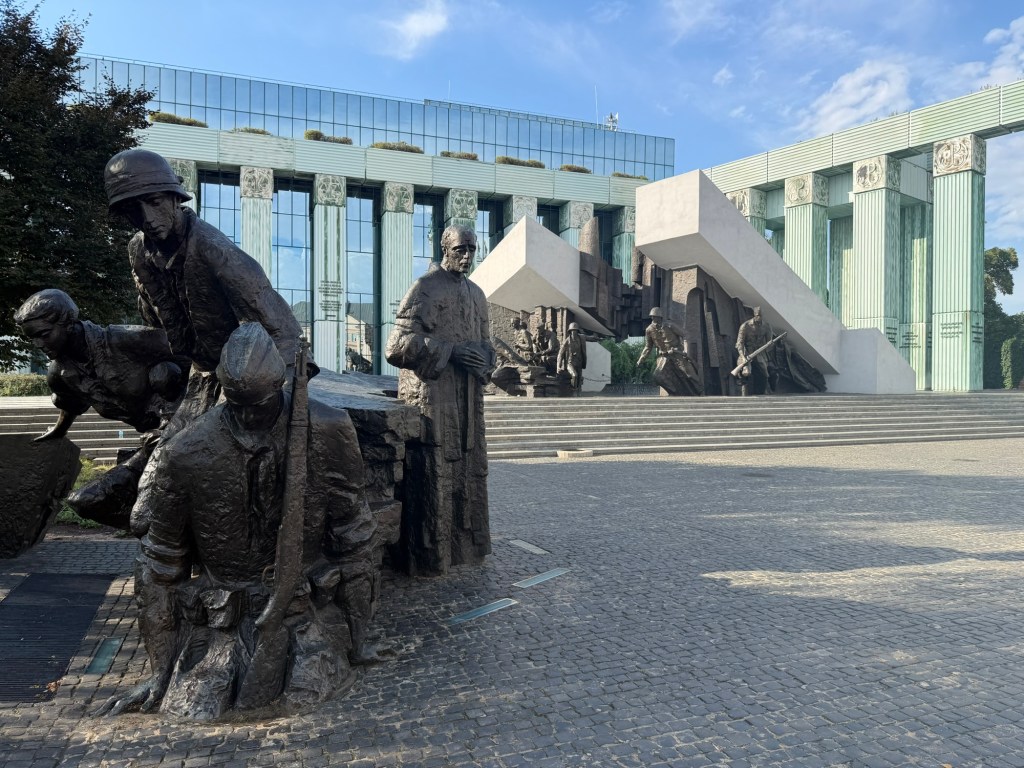
The far group is people coming out from under a great slab of concrete that is tipping over on them, running with rifles, one of them pointing the way. The whole thing is by Wincenty Kućma to a design by Jacek Budyn, and it was unveiled on 1 August 1989, which was the last summer of the old order.
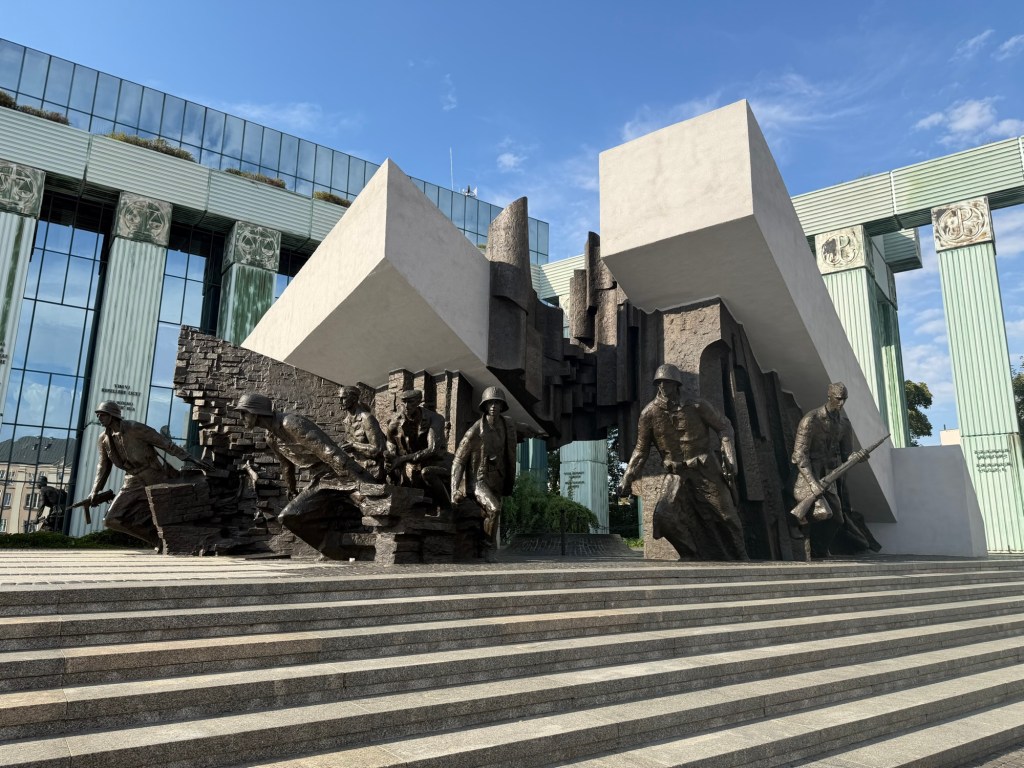
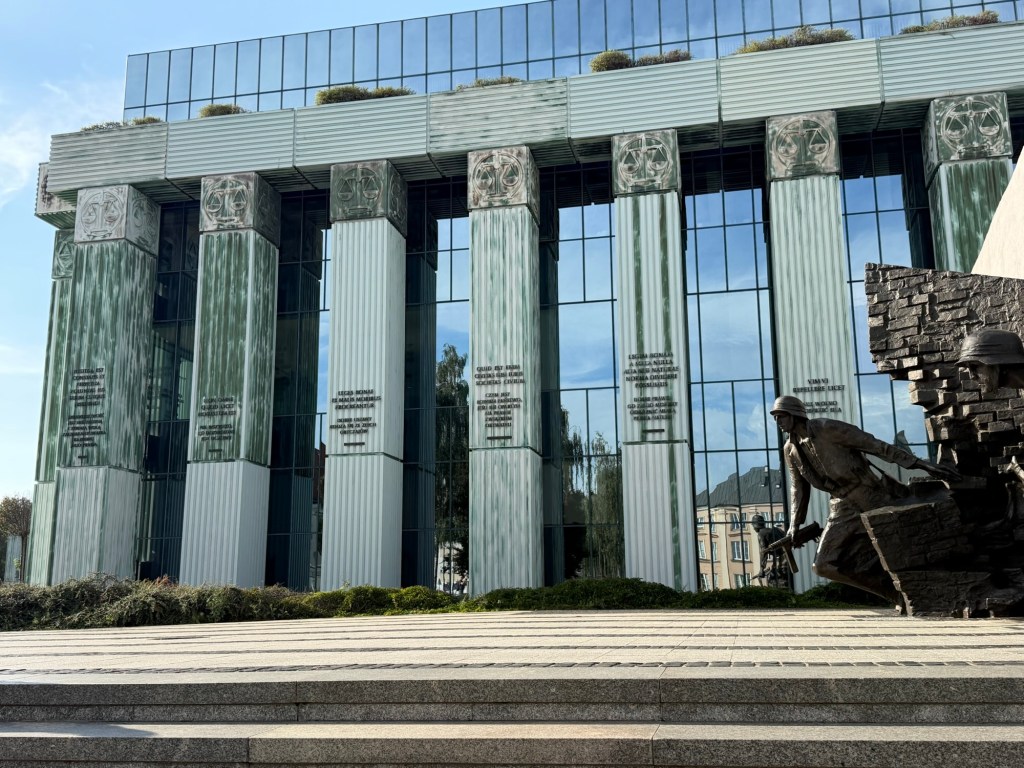
The building it stands in front of is the Supreme Court, and its columns are covered in Latin. Justice is the constant and perpetual will to give each man his due. Not everything that is permitted is honourable. Good laws are born of bad habits. For what is a state but a society of citizens under law. Force may be repelled by force.
That last one is cut into the column nearest the man with the rifle.
On the brick wall behind the monument, the anchor of Fighting Poland in bronze, two letters high, and the words Warsaw Rising 1944.
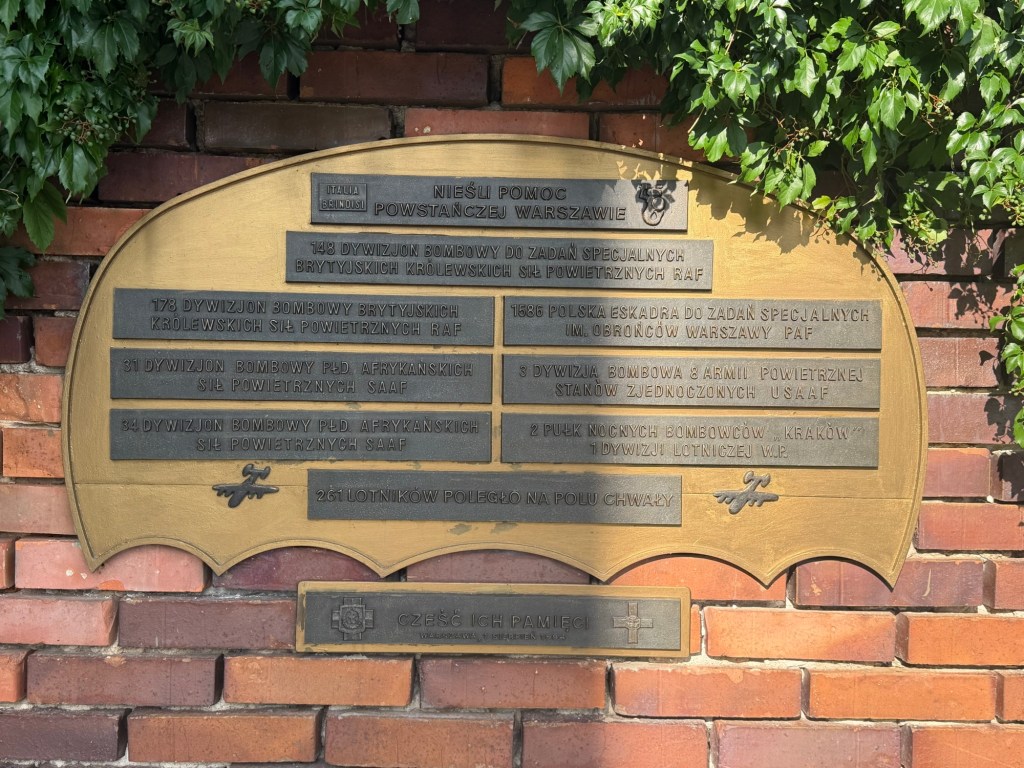
And on the same brick, a plaque I did not expect and stood in front of for a while. They brought help to insurgent Warsaw. Then a list: 148 Squadron RAF, 178 Squadron RAF, 1586 Polish Special Duties Flight, 31 and 34 Squadrons of the South African Air Force, the 3rd Bombardment Division of the United States Eighth Air Force, and the 2nd Night Bomber Regiment Kraków. Two aeroplanes cast either side of the last line: two hundred and sixty one airmen fell. It was put up on 1 August 1994, and the tab at the top says where they flew from. Italy. Brindisi.
South Africans, over Warsaw, from the heel of Italy, in 1944.
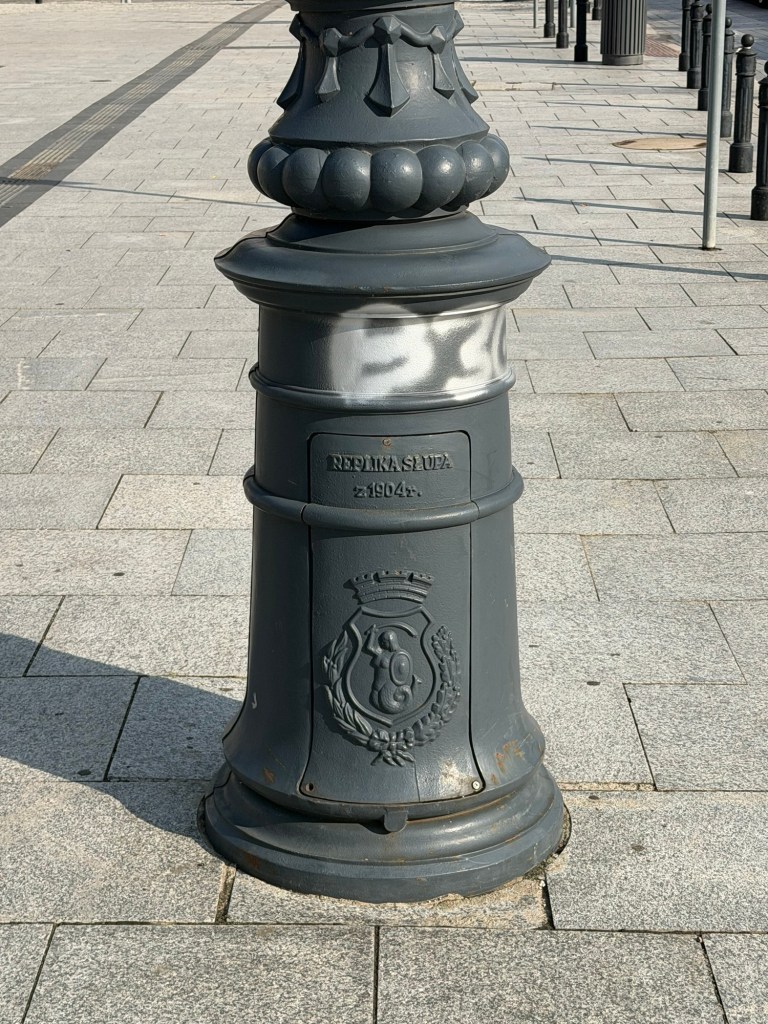
Walking back I stopped at a lamp post, because it had a small cast plate on the base of it that said, in Polish, replica of a column of 1904, with the city arms underneath.
Even the lamp posts tell you they are copies. I have been in this city for two days and I do not think I have seen it claim to be anything it is not.