Poland, then. I am not going to set the whole plan out here, partly because some of it may not come off and partly because a list of place names is not a blog post. Enough that we flew to Warsaw last night, my girlfriend to the country she comes from and me to a country I have been to twice and still barely know. Wrocław once and Bielsko-Biała once, neither of which prepares you for anything else. Everything ahead of us this fortnight is new ground.
The journey deserves one sentence, which is the highest compliment a journey can be paid: Ronaldsway, Heathrow, a long afternoon in between, and Warsaw by night.
We landed at nine. Coming out of the terminal my girlfriend stopped mid sentence, which she does not often do, and there on the pavement was a man with red hair. Michał Krystian Wiśniewski: Ich Troje, two Eurovisions, and the most recognisable head of hair in the country. He was entirely happy to be photographed with her. He was born in Łódź, which is where she is from, and he holds German citizenship as well as Polish, which is a combination I have some sympathy with. Ten minutes on Polish soil and the trip had already produced a coincidence I could not have arranged.
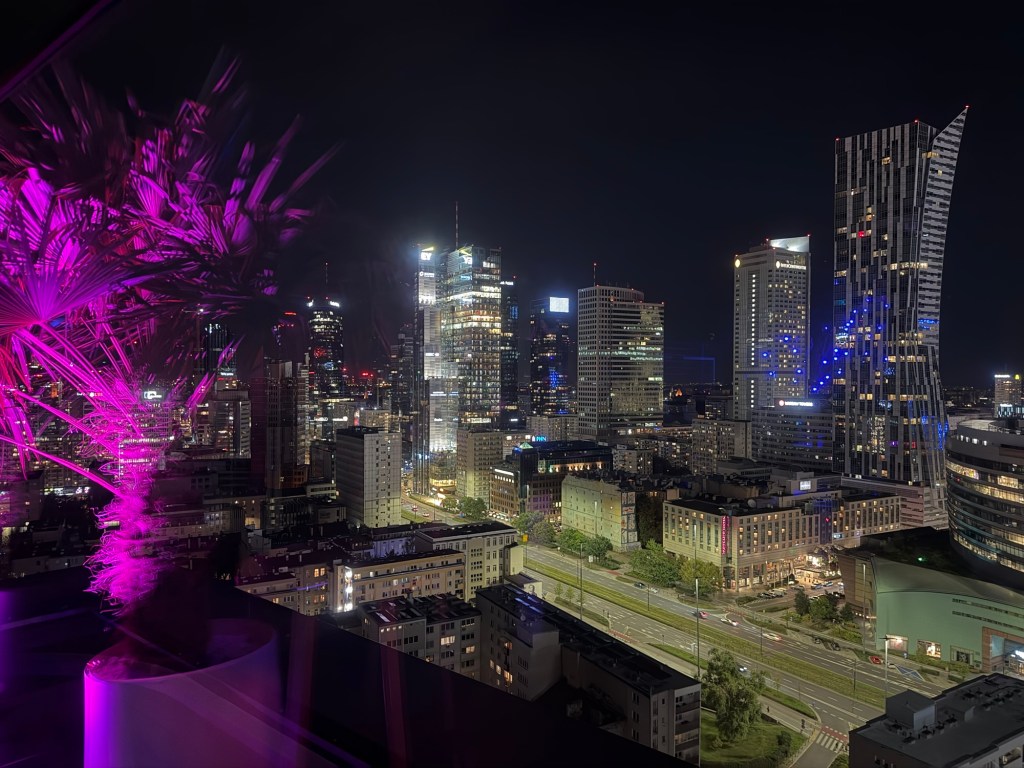
Then an Uber, and the hotel, and a bar nineteen floors up with the whole skyline laid out in front of it. We had a couple of drinks and looked at it. Not many, and not for long, because she was up at four for the bus to Łódź and a dentist. Some people go on holiday to relax.
She was gone before I woke. I worked through the morning, then put my shoes on and went out to find lunch, which is how the rest of the day happened.
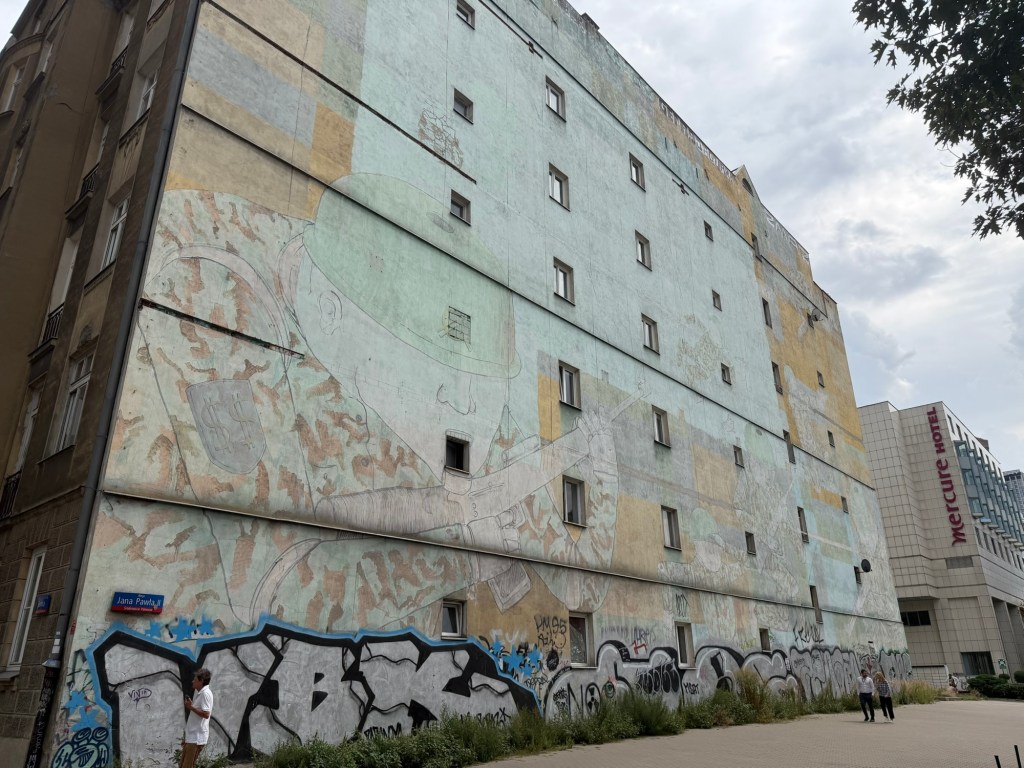
Sienna is an ordinary street, and most of it is post-war, but at number 45 there is a building that is not. It is called the Kamienica pod Żaglowcem, the tenement under the sailing ship, after the tiled ship in its entrance. It went up early last century. It stood inside the ghetto, was taken out of the ghetto before the Rising, and largely for that reason it is still standing when almost nothing around it is. During the Rising the Home Army grouping Chrobry II ran its command from inside it.
Two things are painted on it. On the tall blank flank facing the avenue there is an enormous faded green mural by the Italian artist Blu, who worked on it through the second half of 2010: puppet soldiers, strings, falling bombs, and money symbols on their helmets and shields. The device I stood and squinted at turns out to be a sickle crossed with a euro sign. He painted it over the ghost of an old communist-era advertisement and used a real window as the open mouth of one of the figures, which I only saw after I had walked past it twice.
Round the back, on the wing, is the other one: hands and flags and a woman on a ladder, with Solidarność on one panel and Charta 77 on another. That went up in 2020 for the fortieth anniversary of Solidarność, and there is a twin of it in Prague, the two cities marking the fact that the Polish and Czechoslovak oppositions spent the eighties passing books and paper and encouragement across a border neither of them was supposed to cross.
Which is a lot for one building. The ghetto, the Rising, a pacifist Italian in 2010 and the memory of 1980, all hanging on the same walls, and no sign anywhere telling you so.
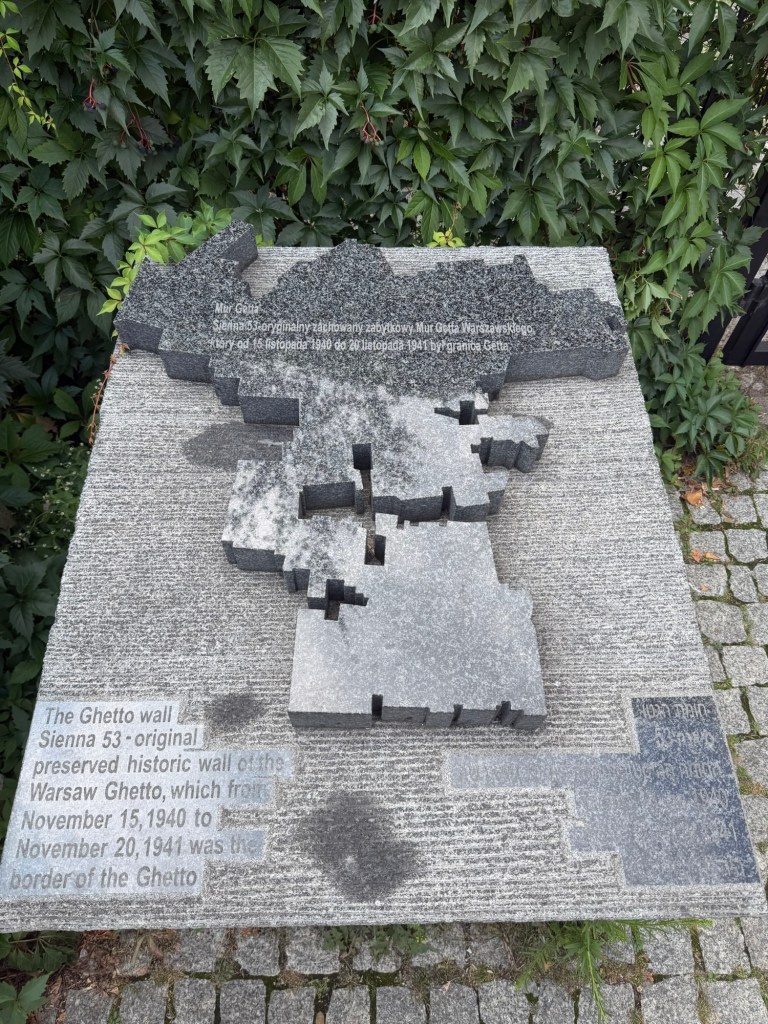
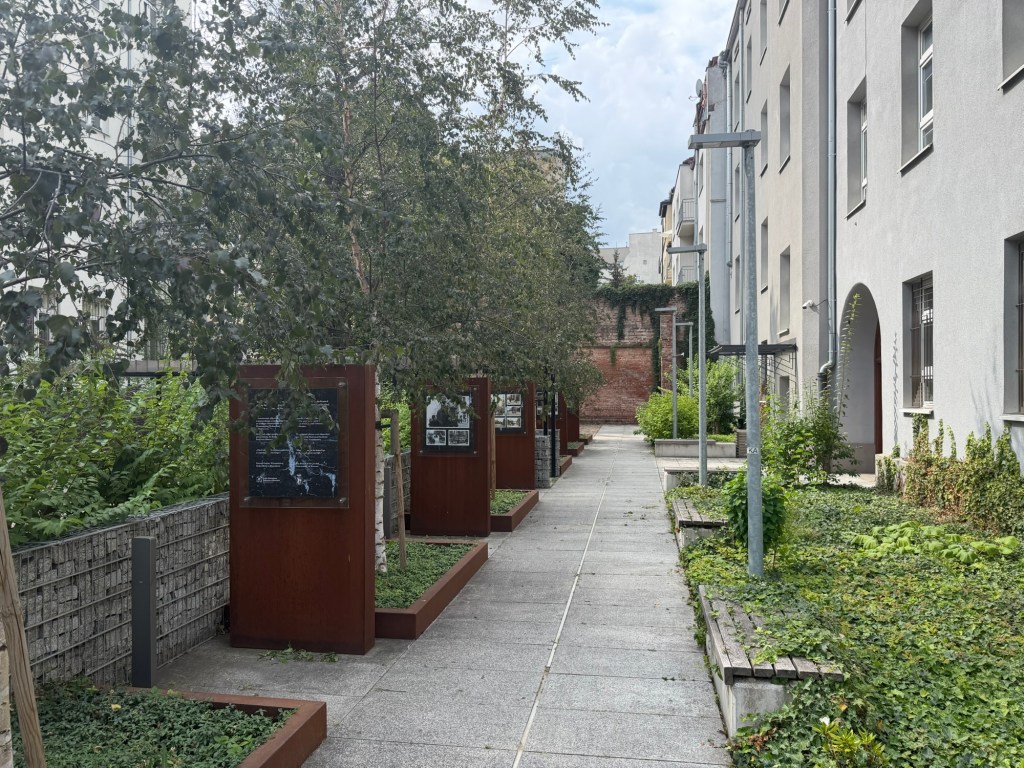
On the other side of the street, I walked past a piece of brick wall with ivy growing over it and a granite marker set into the ground in front. Sienna 53. An original surviving stretch of the wall of the Warsaw ghetto, which from 15 November 1940 to 20 November 1941 was the boundary. I had not gone looking for it. It is simply there, between a car park and a block of flats, on the way to lunch.
I had not expected to meet that kind of history quite so soon, or quite so casually. There is no ticket and no queue. You come round a corner and there it is, and then you carry on walking.
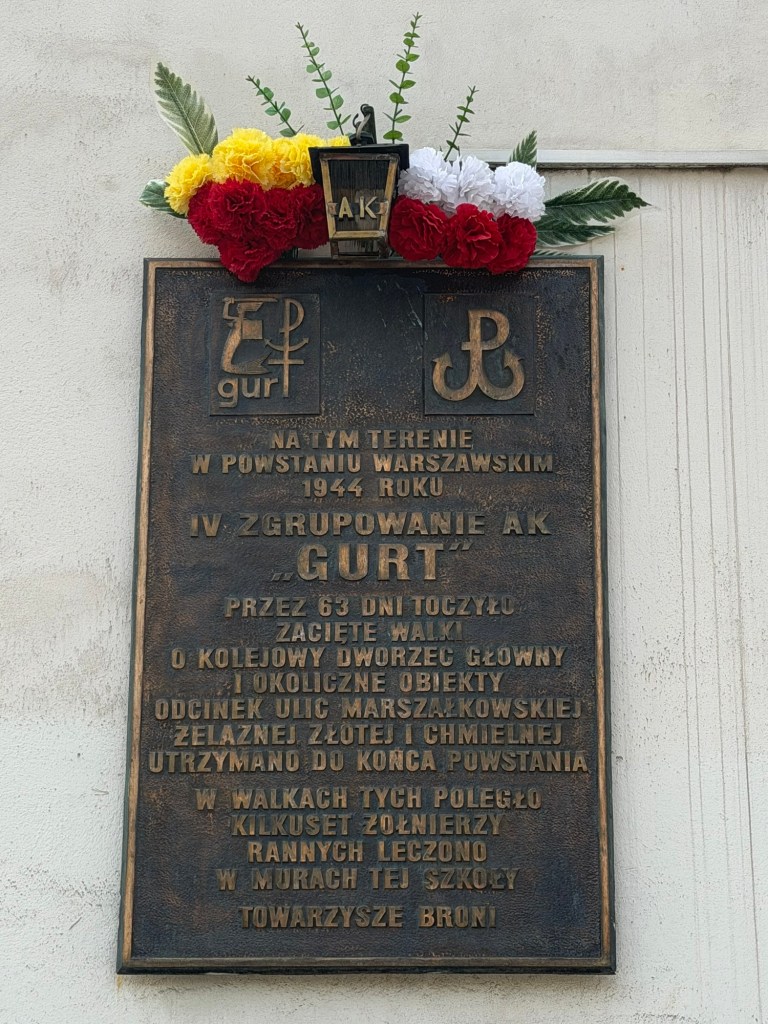
A few doors on there is a plaque on a school wall, with fresh carnations in red and white and yellow above it and a small lantern marked AK. The Fourth Grouping of the Home Army, codename Gurt, which for sixty three days in 1944 fought for the central station and the streets around it, and held that ground until the end of the Rising. The wounded were treated inside the school. Someone had been there recently with flowers.
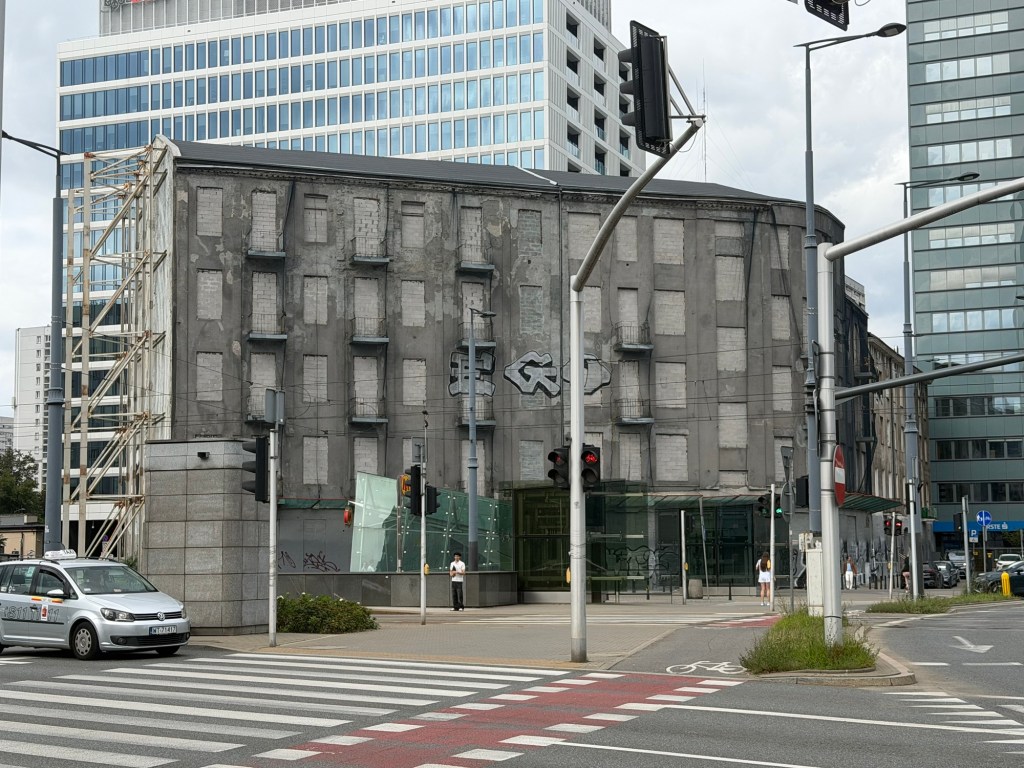
The street let me out at Rondo ONZ, which as far as I can tell is the money end of town: glass towers on three corners, a metro entrance, a great deal of traffic. On the fourth corner stands a five storey building the colour of a wet pavement, every window bricked up, graffiti at street level, a new roof and nothing else. It is the Osnos tenement, Twarda 28, put up in 1911 by a Jewish Warsaw businessman with shops along the ground floor. It stood inside the ghetto from 1940 and came through the war. The communists stripped the ornament off its face in the sixties and drove the new roundabout through, and the last residents left in 2009. It is listed now, which means it can neither be knocked down nor afforded.
The detail I liked best is that it sits at an angle to everything around it. Every other building on that junction squares up to the modern street. This one is still lined up with the old course of Twarda, a street that was rubbed out sixty years ago. The building is the only thing left that remembers where the road used to go.
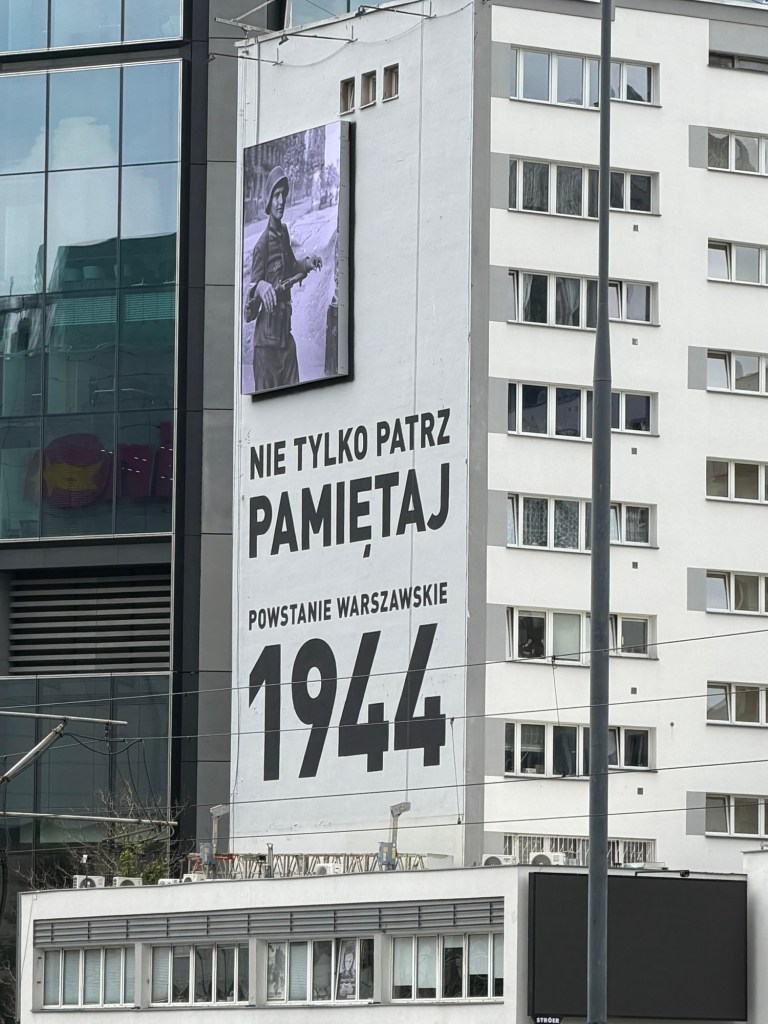
A little further on I looked back the way I had come, and there was a wall on the other side of the road carrying a screen. It was running photographs from the war, one after another, a soldier in a helmet holding a machine pistol, then something else, then something else again. Underneath, in letters two storeys high: nie tylko patrz, pamiętaj. Powstanie Warszawskie 1944. Do not only look. Remember.
Which was a fair enough thing to say to a man who had spent the last hour looking at walls without knowing what any of them were.
And then the Palace of Culture and Science, which you cannot miss and which I found harder to look at than anything else all day. Stalin’s gift to Warsaw, built between 1952 and 1955 to a design by Lev Rudnev, and it is enormous. The odd part is that it is no longer the biggest thing here. There were taller towers standing behind me while I looked at it, all glass and daylight, and none of them registered at all. The Palace does not need to be the tallest. It is austere and it is heavy and it simply refuses to be ignored, which was presumably the entire point.
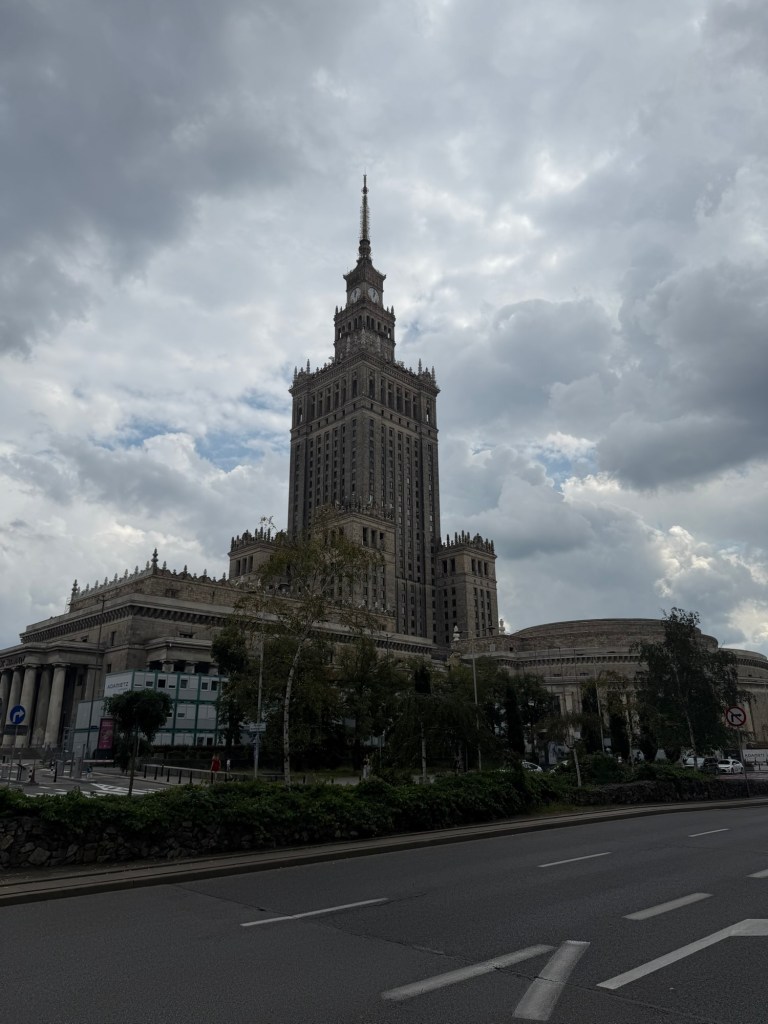
One occupier flattened the city and the next put this in the middle of it and called it a present. Poland’s relationship with the Soviet Union confuses me more the closer I get to it, and I suspect the answer is not simple for the people who live here either.
Then north west to plac Grzybowski, which is a triangle rather than a square and quieter than it has any right to be, given what is around it.
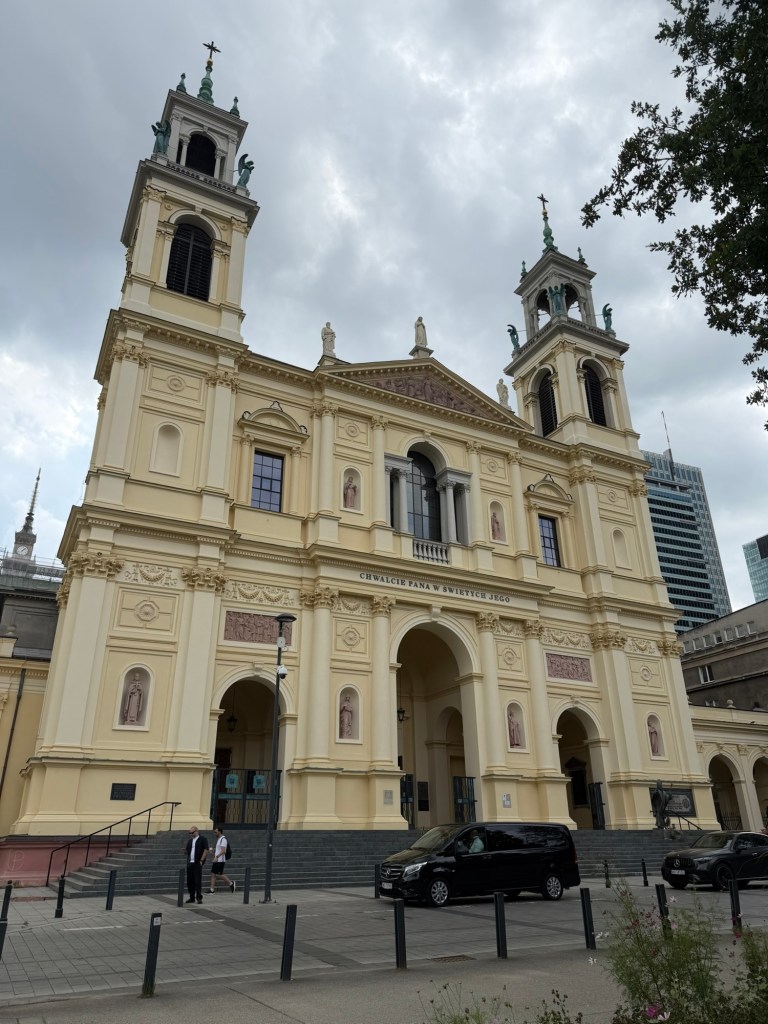
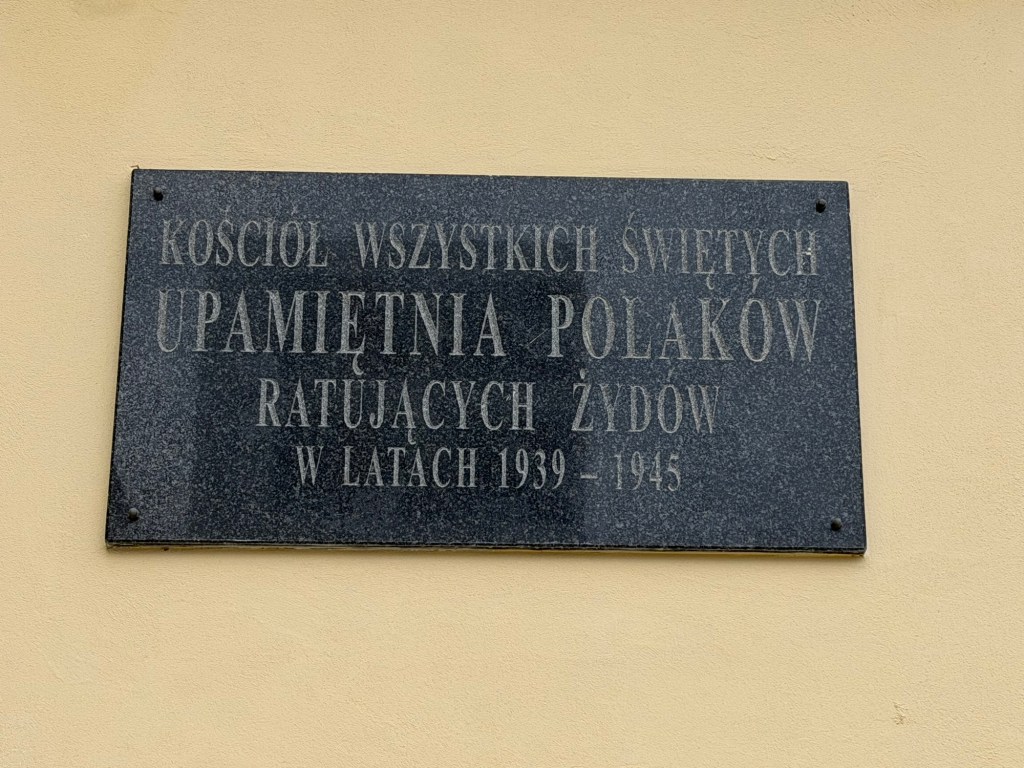
The church on it is All Saints’, begun in 1861 to a design by Henryk Marconi and the largest in the city. Under the occupation it was one of only three churches to end up inside the ghetto, and it served the Christians of Jewish descent who had been shut in there with everyone else. The parish priest was Marceli Godlewski. He was, before the war, openly hostile to Jews. He then spent the occupation issuing baptismal certificates by the dozen, hiding people in his own presbytery, and walking children out of the ghetto. The estimates of how many he saved run from one thousand to three. Yad Vashem named him Righteous Among the Nations in 2009, sixty four years after he died. There is a plaque by the door recording that the church commemorates Poles who saved Jews between 1939 and 1945.
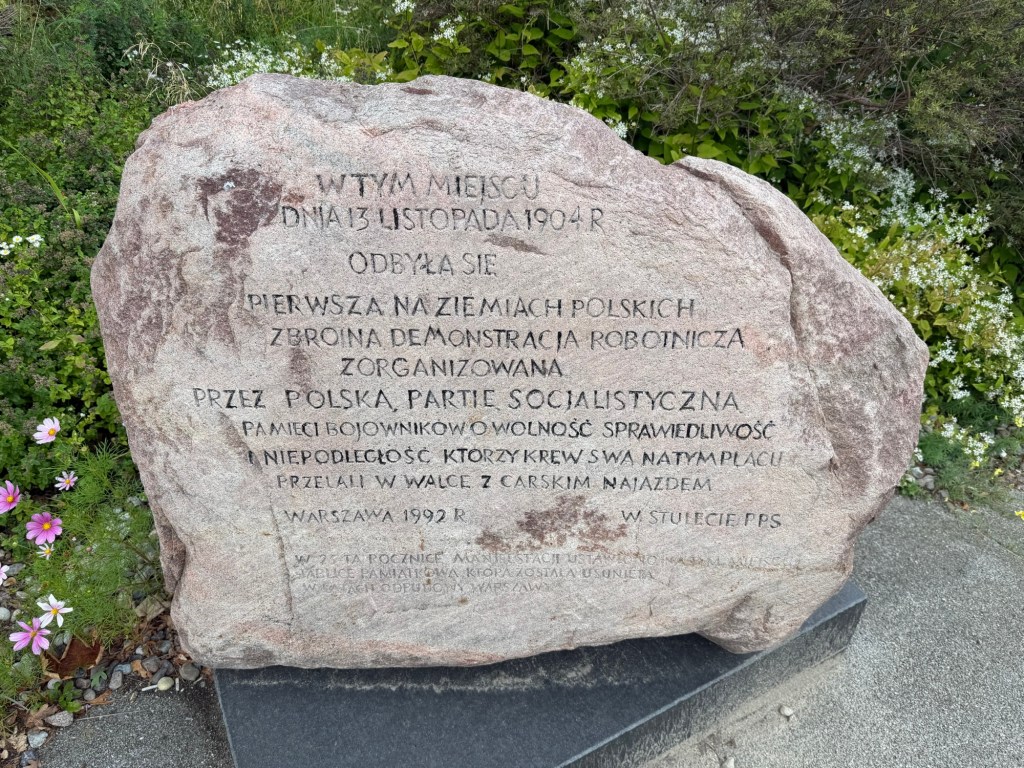
On the grass beside it sits a boulder with an inscription cut straight into the stone. On this spot, on 13 November 1904, the first armed workers’ demonstration on Polish soil, organised by the Polish Socialist Party, against the Tsarist occupier. The stone went up in 1992 for the party’s centenary.
I stood in front of that one longer than I expected to, because I am closer to it than I look. My father’s family were German farmers in the flat country west of here, settled under the Russian crown a century before any of this, on land the Tsar had recruited them onto. In November 1904, when the police were shooting people on this square for rising against the occupier, my great-great-grandparents were out there farming, and their daughter, my great-grandmother, was five years old. Her birth had been registered a few years earlier at the local civil office in Russian, in Cyrillic, dated twice over so that the Julian and the Gregorian calendars would agree.
For the Poles here, the Tsar was the occupier and the stone says so. For my lot he was simply the state: the language you did your paperwork in, the office where you registered a child. Same empire, same decade, same flat country. Two entirely different things.
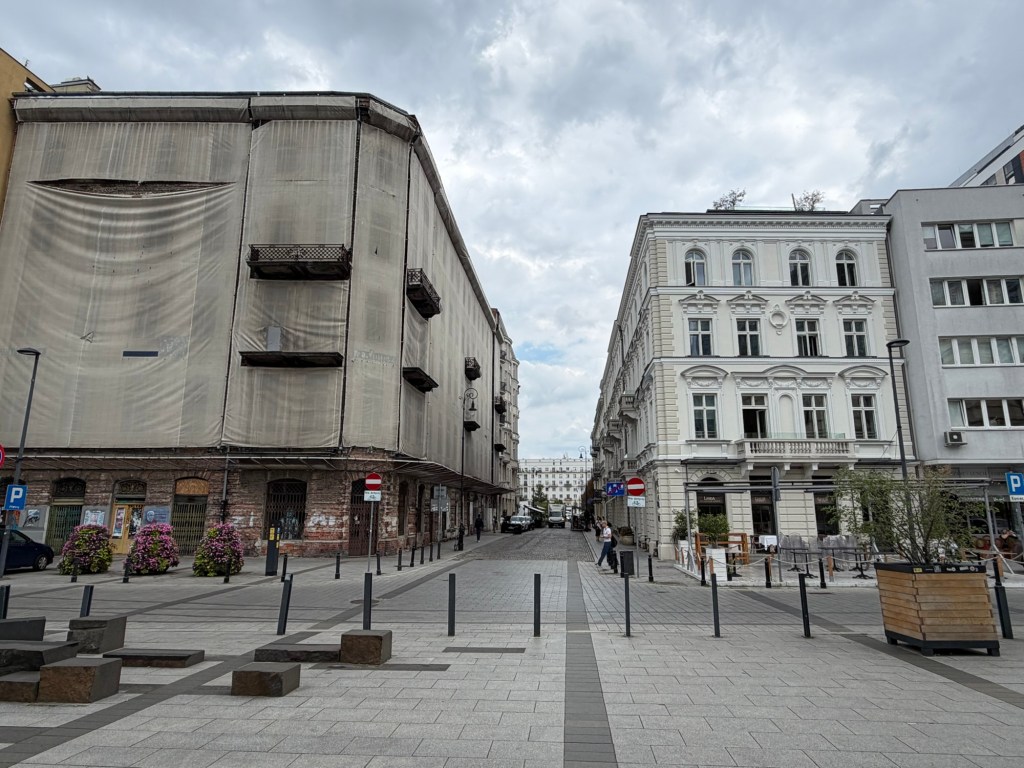
Off the corner runs Próżna, which was cut through in 1879 and is the one street of the old Jewish quarter with its tenements still standing on both sides. It is an odd thing to walk down. One side has been restored to within an inch of its life, cream and immaculate. The other is bare brick under netting, windows boarded, the render gone, and it looks precisely like a building that has seen things and would rather not discuss them.
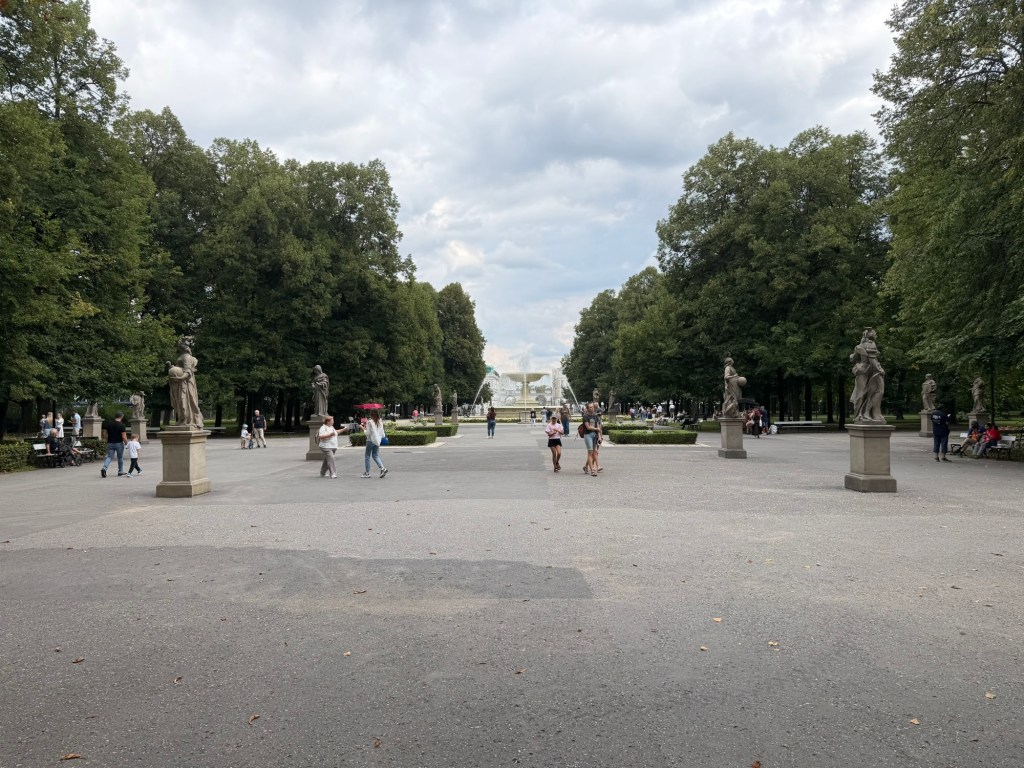
From there into the Saxon Garden, which is the oldest public park in the city and, after the morning I had had, a considerable relief. Gravel avenues, baroque statues on plinths, a fountain at the end of the axis, families, prams, ice creams, a man asleep on a bench. For about ten minutes Warsaw was simply a pleasant place to be outdoors.
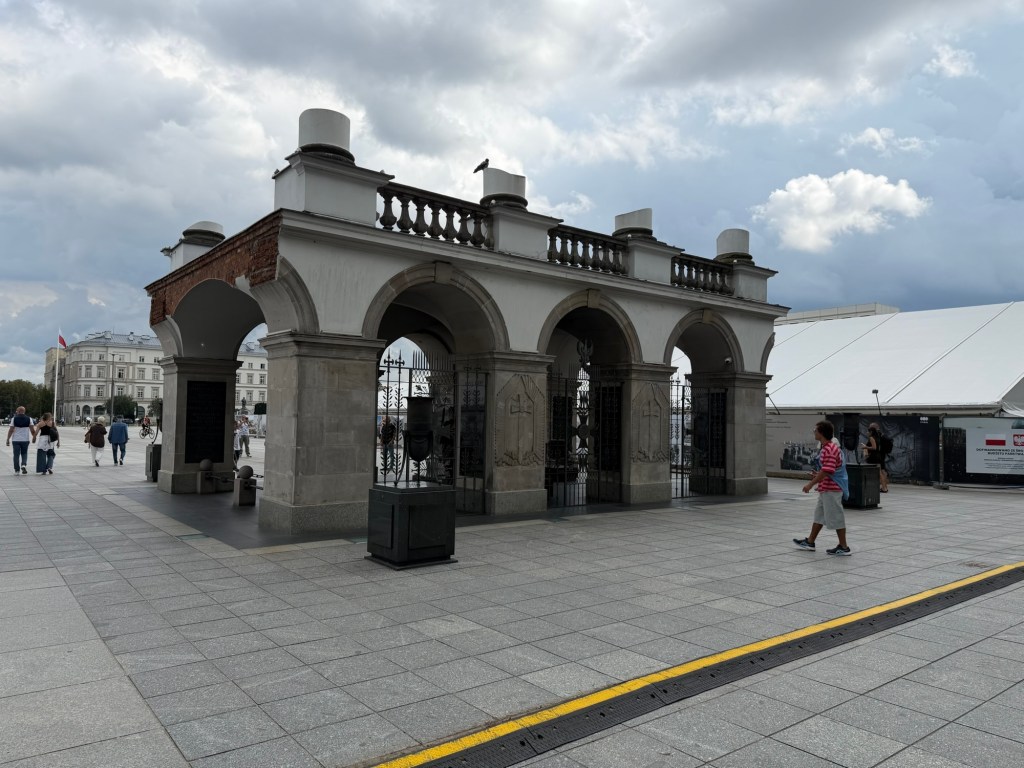
At the head of the garden stands the Tomb of the Unknown Soldier, and it took me a moment to understand what I was looking at. It is three arches. That is all that is left of the Saxon Palace, which the Germans blew up in December 1944, and if you walk round the back you can see the raw brick where the rest of the building used to continue. They kept the fragment because the tomb was already under it. The whole of Poland’s memorial to its unknown dead is housed in the surviving scrap of a building that was destroyed.
Underneath, the flame, and two soldiers standing guard. I had not expected them, and I was not ready for how much I minded. They are very young. They do not move.
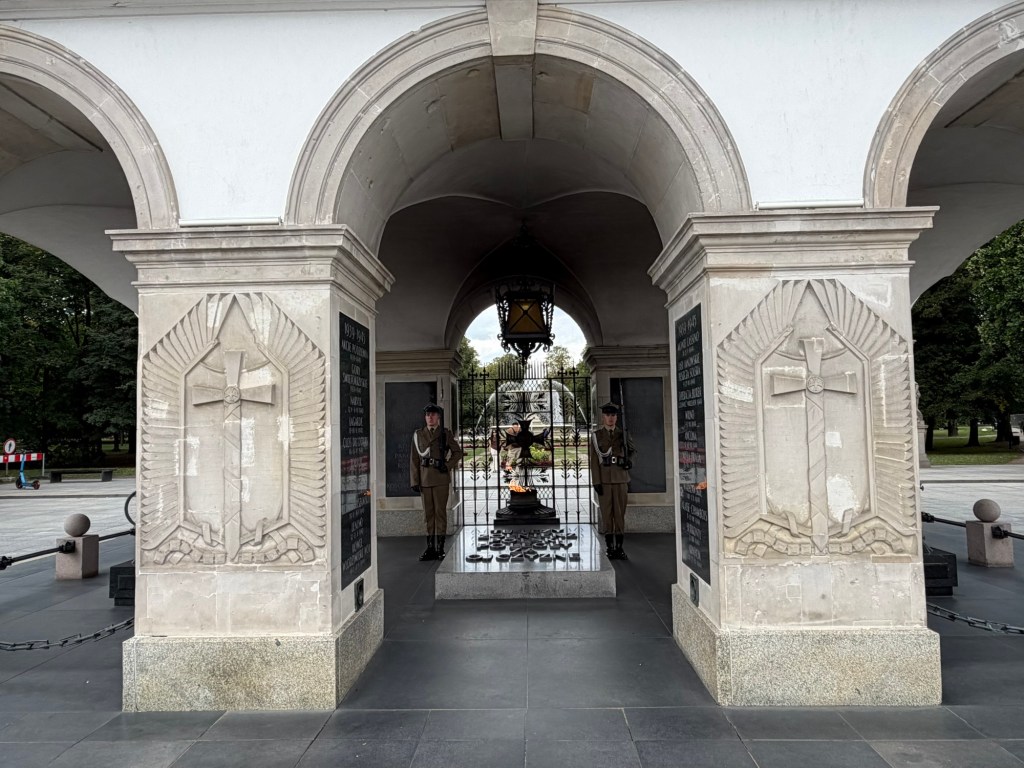
On the piers all around are the battle honours, cut into black granite: the places where Polish soldiers fought. Narvik. Tobruk. Bologna. Breda. Kołobrzeg. The Oder, the Lusatian Neisse, Bautzen, Wilhelmshaven, Berlin. And among them, in the same lettering as all the rest, Getto Warszawskie, 19 April to 16 May 1943. The ghetto uprising, listed as a battle of the Polish army, which it is.
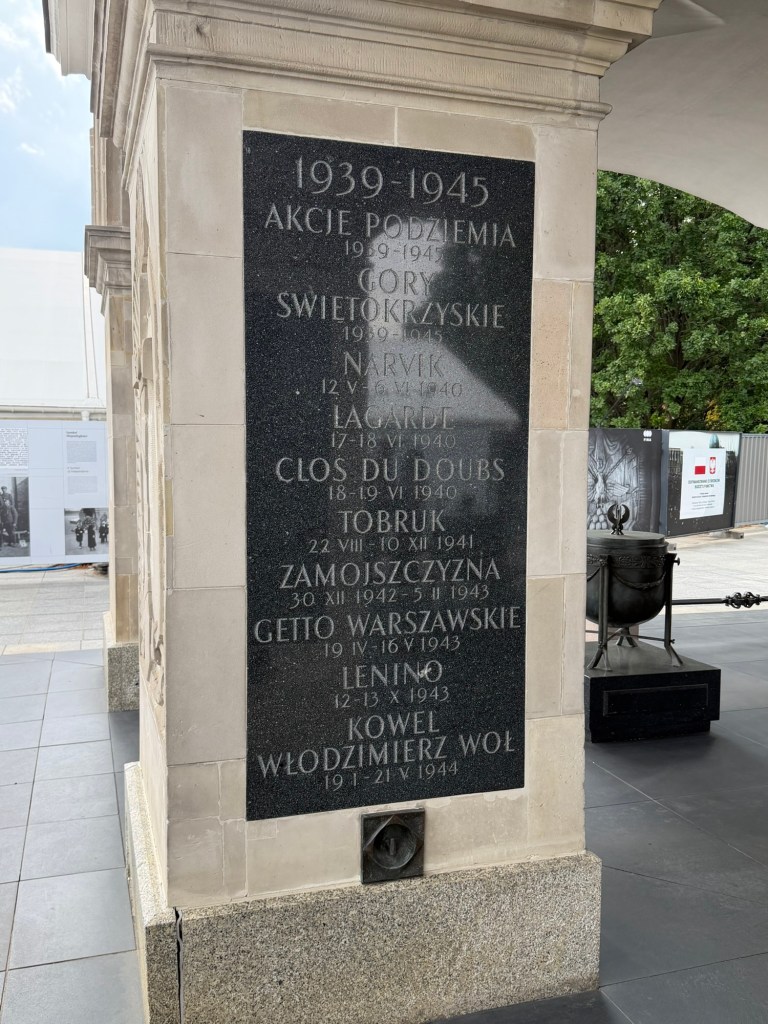
Read the piers properly and you realise the stone is doing something remarkable. Underground operations, 1939 to 1945: that is the Home Army, loyal to the government in London. Narvik and Tobruk and Bologna: that is the army in the West, the one that got out. And Lenino, 12 and 13 October 1943, which is something else again.
Lenino was the first action of the 1st Kościuszko Infantry Division, raised in the Soviet Union under Zygmunt Berling and fighting inside a Soviet army. Two days in the mud of eastern Belarus. The attack failed, the division lost about a fifth of its strength, and Stalin took the episode straight to Tehran to demonstrate to the Western allies that he had Poles of his own who would fight. Militarily it was a disaster. Politically it was exactly what it was meant to be.
The communists then made it a founding myth. For four decades Polish Army Day was moved to 12 October, the anniversary of Lenino, displacing 15 August, which had marked the defeat of the Bolsheviks outside Warsaw in 1920. It went back to 15 August after 1989.
So the tomb holds several Polish armies that were never on the same side of anything. The underground, the exiles, and the men Stalin raised. Nobody has scrubbed any of them off. The one that could most easily have been quietly chiselled away after 1989, when the whole apparatus of Soviet memory was being dismantled, is still there in the same lettering as Tobruk, because the men who died at Lenino were Polish soldiers whatever they were being used for.
That is the thing I keep circling. Somebody made a decision here to keep all of it, including the parts that are embarrassing and the parts that were forced on them.
The square the tomb stands on is called plac Piłsudskiego, and one side of it is the flank of a government building, covered in plaques. I went along them slowly, because by that point I had stopped being in a hurry.
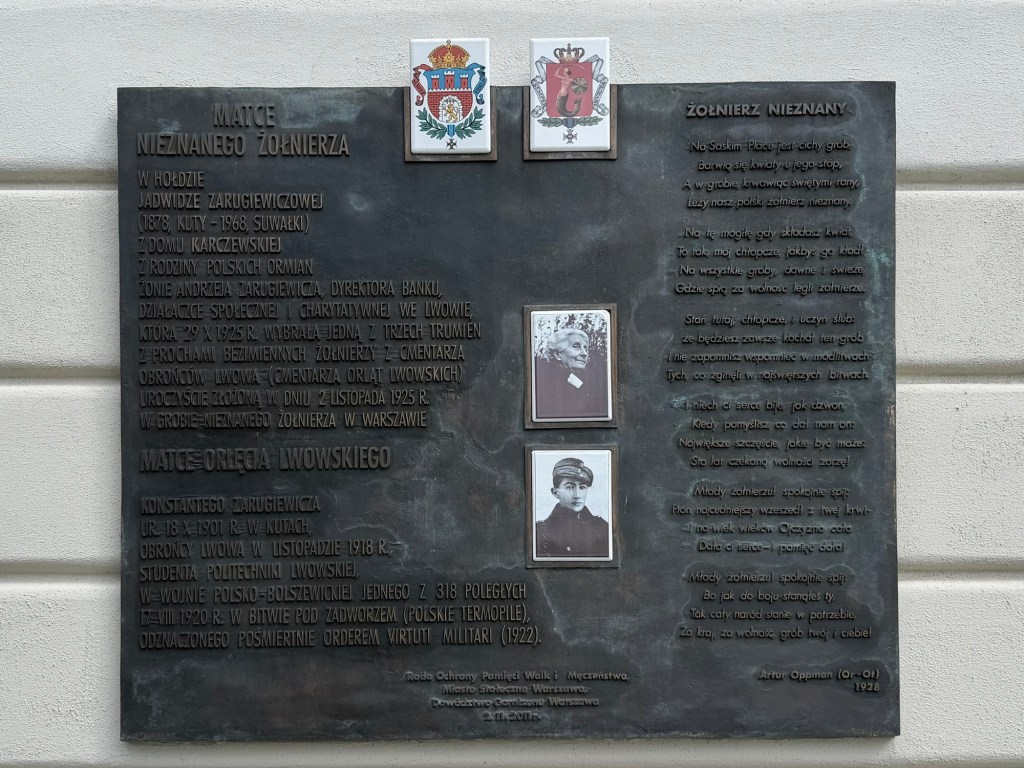
One is to Jadwiga Zarugiewiczowa. In 1925, when Poland was choosing whom to bury under the arcade, three coffins of unidentified soldiers were brought from the defenders’ cemetery at Lwów and a mother was asked to pick one. She was chosen for the task because her own son had been killed and never found. Konstanty Zarugiewicz was nineteen, a student at the Lwów Polytechnic, one of three hundred and eighteen killed at Zadwórze in August 1920, a stand the Poles call their Thermopylae. She walked up to the three coffins and laid her hand on one. When they opened it, it held a boy of about fourteen with no rank at all, shot through the head and the leg, identified only by a soft peaked cap with an eagle on it, which meant he was a volunteer. That is the man lying under the flame. The reason she was qualified to choose him is that she could not bury her own.
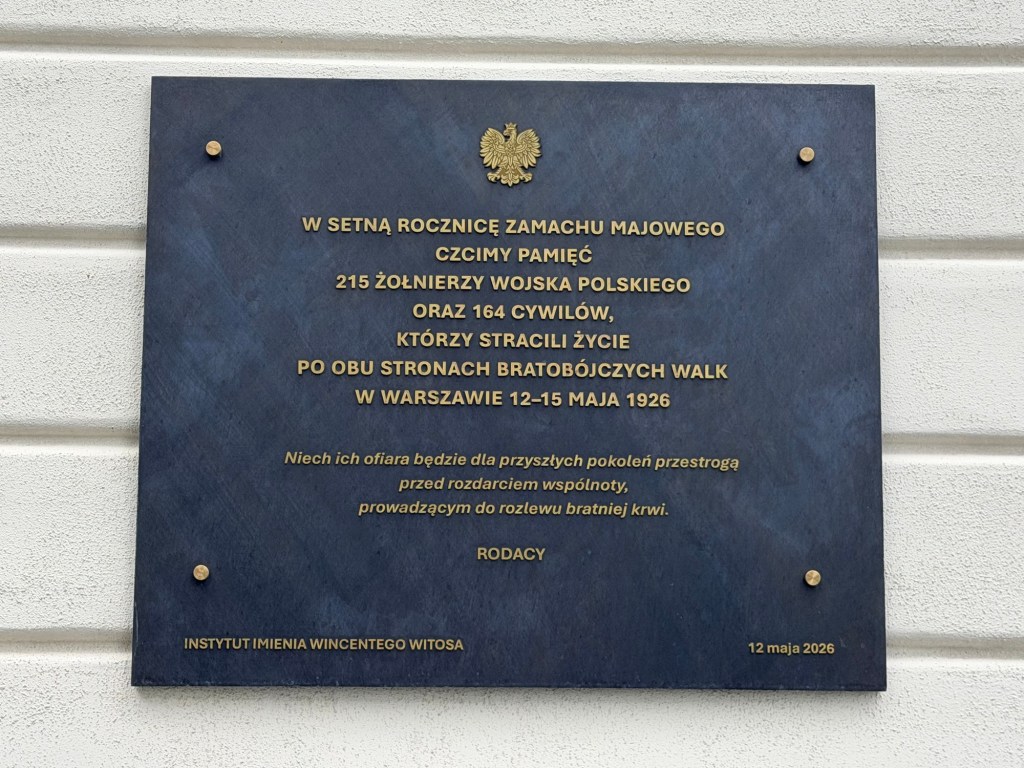
Further along there is a plaque so new the bronze has not begun to go green. It went up on 12 May this year, the hundredth anniversary of the May coup, and it commemorates two hundred and fifteen soldiers and one hundred and sixty four civilians who died on both sides of three days of fighting in these streets in 1926. On both sides. It asks that their deaths stand as a warning against tearing a community apart until it spills its own blood. It is signed, simply, compatriots.
Piłsudski launched that coup. His statue is about a hundred yards away.
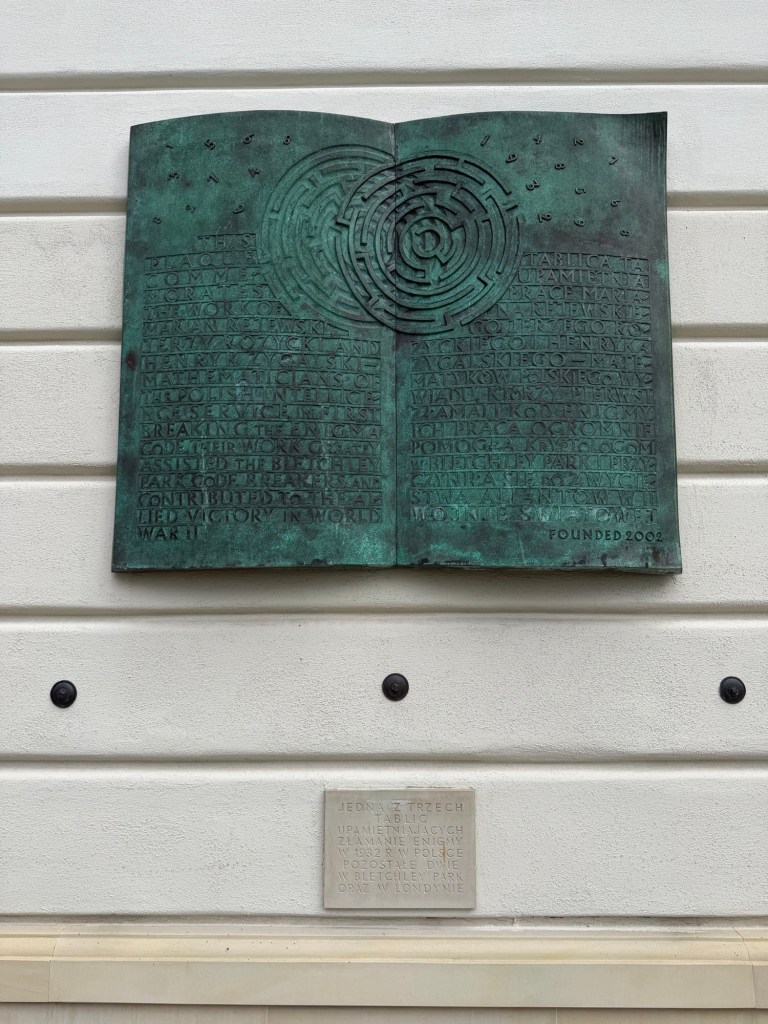
And then, further along still, a bronze book with a maze cut into it, in Polish and English, to Marian Rejewski, Jerzy Różycki and Henryk Zygalski, the three mathematicians of Polish intelligence who first broke Enigma in 1932 and handed the work on. A smaller stone underneath notes that this is one of three such plaques. The other two are at Bletchley Park and in London. I have walked past one of them without knowing this one existed.
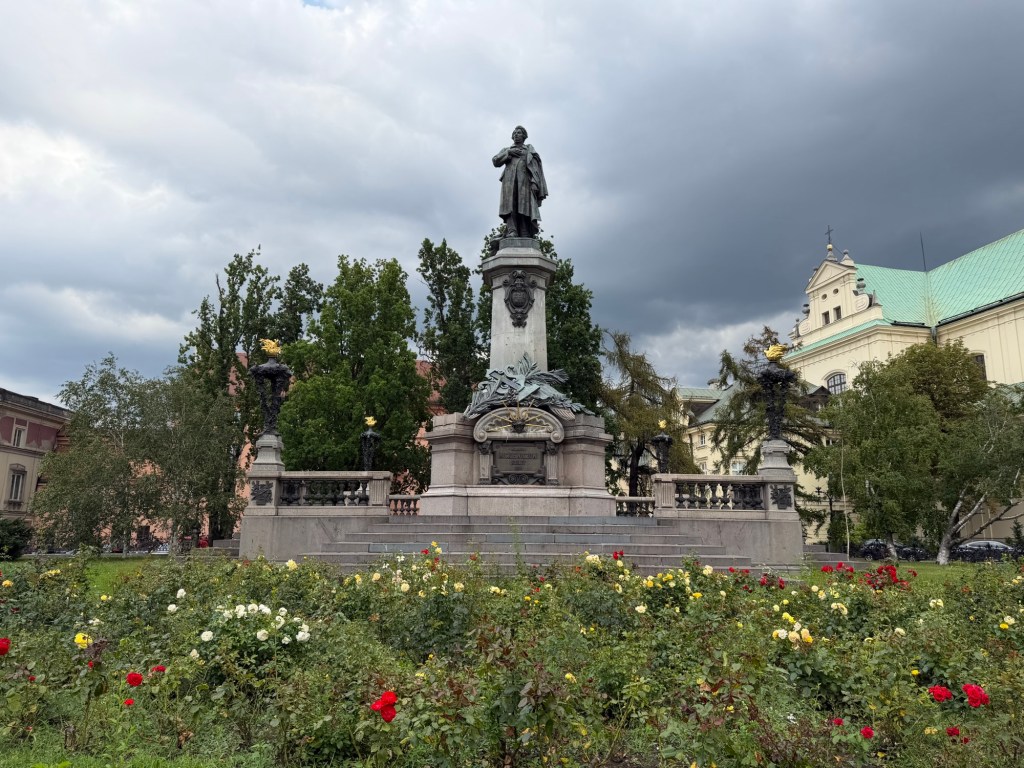
Krakowskie Przedmieście next, which is the handsome end of town: wide, cobbled, lined with palaces and churches and cafes, Mickiewicz on his plinth in a bed of roses, people eating ice cream. After the morning I had had it felt like walking out of one film and into another.
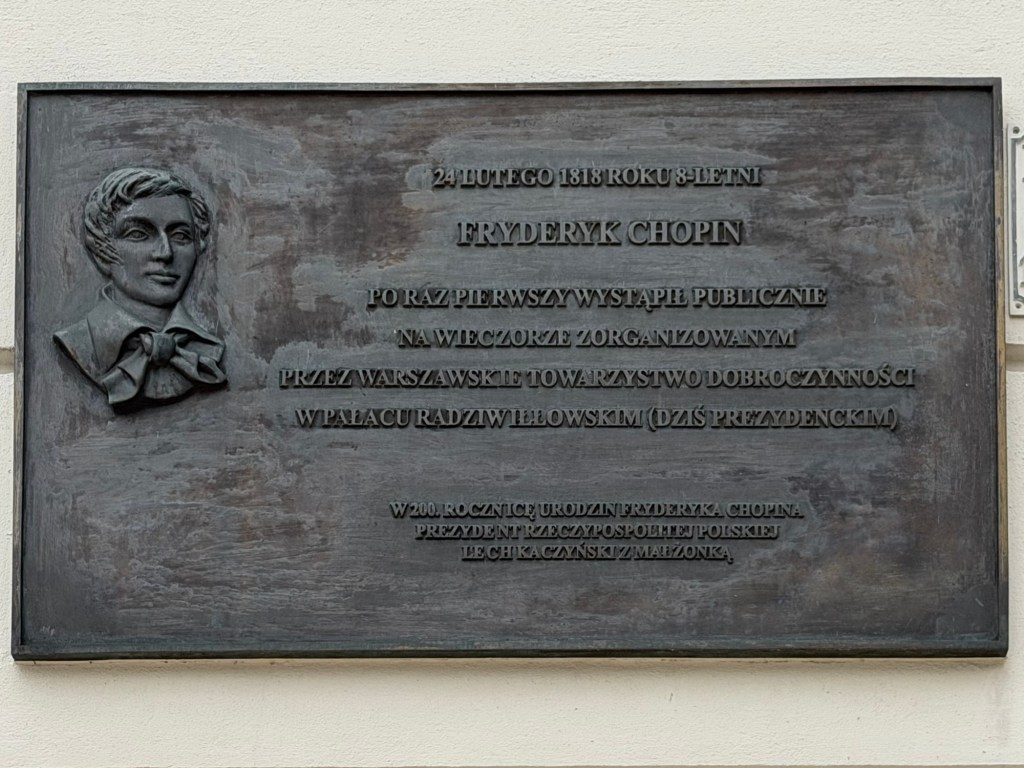
Outside the Presidential Palace I stopped at a plaque I could not read and looked up later, and I am glad I did. On 24 February 1818 an eight year old boy gave his first public performance in that building, at a charity evening got up by the Warsaw Charitable Society, when the place was still the Radziwiłł Palace. The boy was Chopin. He is my favourite composer and I had no idea. He began in a fundraiser.
Six days ago I stood in front of another Chopin plaque, in St James’s Place, and made my girlfriend wait while I read it. That one marks the house he left in November 1848 to play at Guildhall, at a ball got up for Polish refugees. He was thirty eight and dying, and he never played in public again.
So I have now stumbled across both ends of the man inside a week, in two cities, without looking for either. He began at eight years old at a charity concert in Warsaw and he finished at thirty eight at a charity concert in London, and both times somebody was raising money for somebody else. I do not know what to do with that except write it down.
The Warsaw plaque went up in 2010, the bicentenary of his birth, in the name of the President of Poland and his wife. Both were killed at Smolensk that April. The President’s own plaque is fixed to the same wall, directly beneath the one about the boy at the piano.
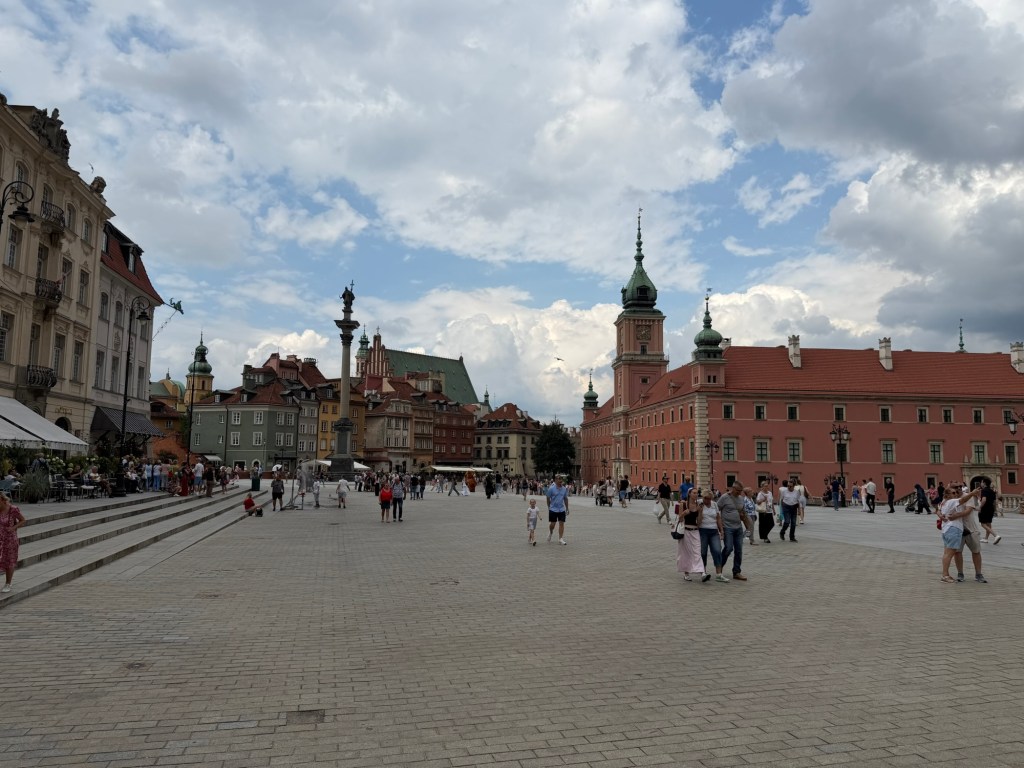
And then Castle Square, and the Old Town, which stopped me dead. It is beautiful. Sigismund on his column, the castle in red and pink, the tall narrow houses in ochre and green, the brick of the city walls, and crowds of people enjoying all of it.
The catch, and I did not know this until I checked, is that almost none of it is old. The Germans levelled the Old Town after the Rising, deliberately and street by street, and what stands there now was put back between 1949 and the early sixties, working from pre-war surveys and from the views Bernardo Bellotto painted in the 1770s. It is on the UNESCO list, and it is on the list precisely because it is a reconstruction.
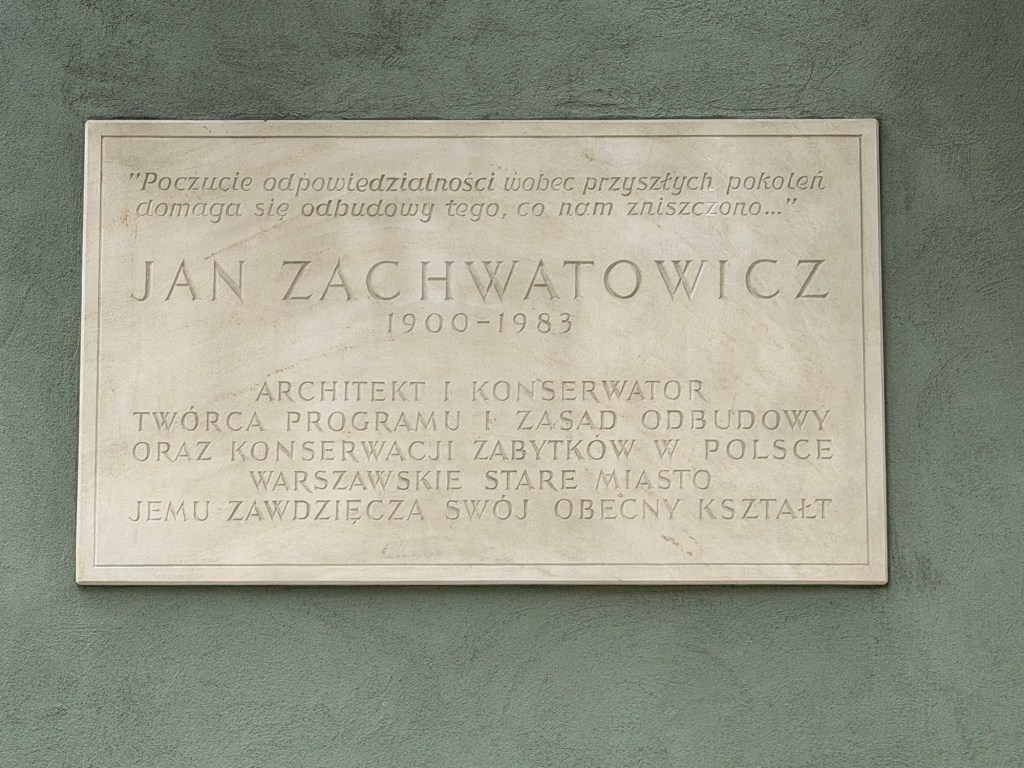
There is a plaque there to the man who decided to do it. Jan Zachwatowicz, 1900 to 1983, architect and conservator, who wrote the principles by which Poland put its monuments back and to whom, the plaque says, the Warsaw Old Town owes its present shape. His words are cut above his name. A sense of responsibility towards future generations demands the rebuilding of what was destroyed for us.
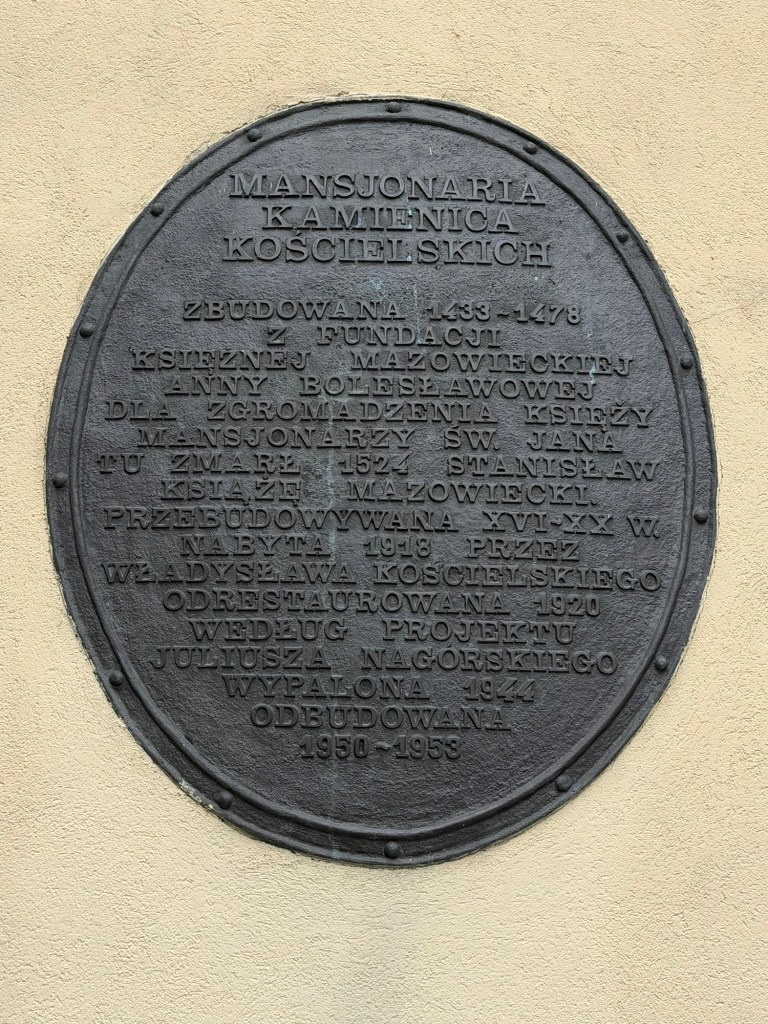
Once you know, you start seeing it declared everywhere. On one house an oval plaque runs through the building’s whole life like a cv: put up between 1433 and 1478 on the endowment of a Duchess of Mazovia, a duke died in it in 1524, rebuilt across four centuries, bought in 1918, restored in 1920, burnt out in 1944, rebuilt 1950 to 1953. The last two lines are in the same lettering as the first. Nobody is hiding anything.
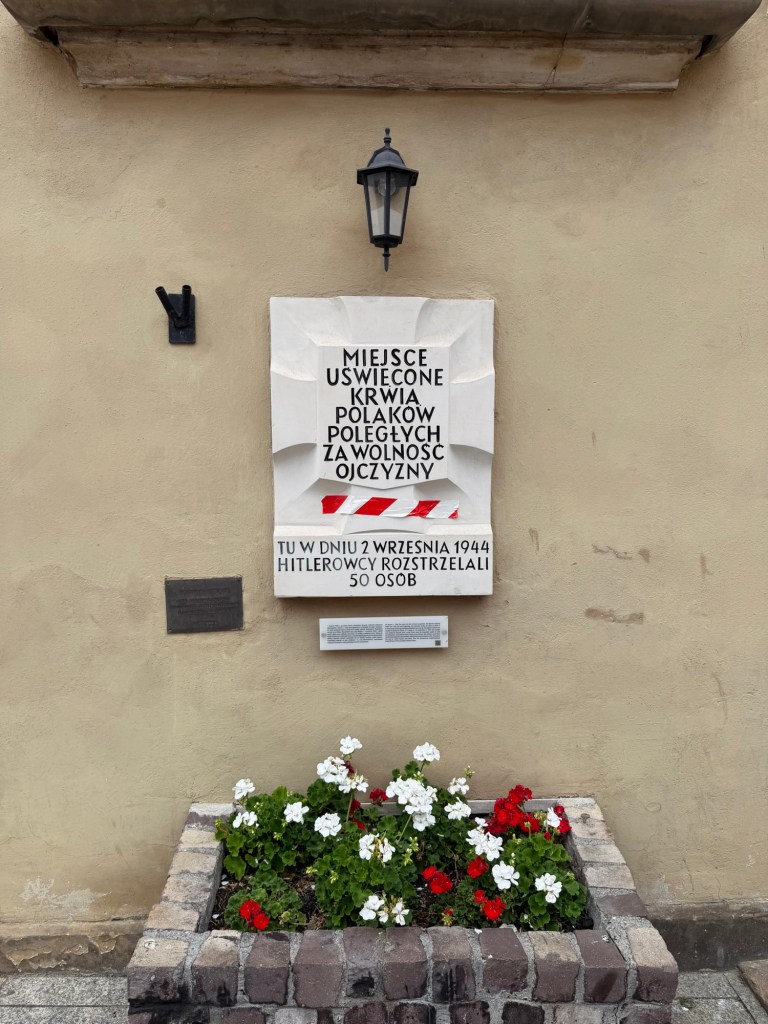
And on another wall, under a lamp and above a bed of red and white geraniums: a place sanctified by the blood of Poles who fell for the freedom of their country. Here, on 2 September 1944, the Germans shot fifty people. That one is a few steps from a stand of horse cabs and an ice cream queue.
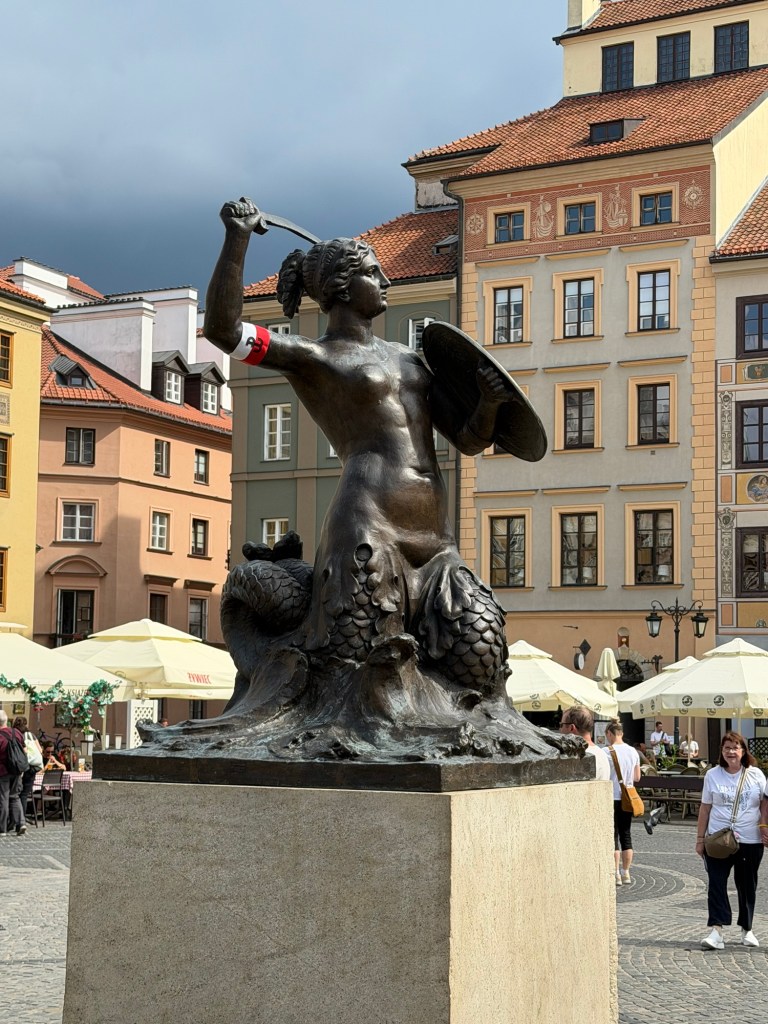
The Market Square is the full picture postcard, all colour and parasols and people having lunch. In the middle of it stands the Mermaid, who is the city’s own arms, sword up and shield out. Somebody has tied a red and white armband round her raised arm with the anchor of Fighting Poland on it. The city’s coat of arms, dressed for the Rising, in the middle of a square full of tourists.
I liked her more than I expected to, for reasons that have nothing to do with Warsaw. There was a mermaid story attached to the water near where we used to live on the Moselle, and I have not thought about it in years.
Then lunch, finally, at Kamienne Schodki, where I had wild boar. There will be pierogi enough in the days ahead.
I like this city enormously and I have been sad all afternoon, and the two are the same feeling. It is how the history here is arranged. Most of it is not here. What survived stands about the place in pieces: a stretch of brick, a plaque with fresh flowers on it, one tenement facing the wrong way, one street with its buildings still on both sides. The absence is the thing you are actually being shown. The remnants are only there to point at it.
Which brings me back to something my girlfriend said yesterday, lightly, the way you say a thing you have known your whole life. Most of Warsaw is new build, she explained, because my lot levelled it. She meant it as a fact rather than an accusation, which is somehow worse. I am half Manx and I am German on my father’s side, and I have two more nights in this city before we drive north to look for the place where my grandfather was stationed.

