Yesterday, half past two for the coach, meant sharp.
Past the ground I had walked the day before and over the river. The coach carried an emblem on the side certifying it as an approved carrier for the Department of Defense.
We drove past the Pentagon, headquarters of what the administration now prefers to call the Department of War. The President ordered the change last year, but only as a secondary title, because renaming a department properly takes an Act of Congress. The House passed it just over a week ago by 216 votes to 212, tucked inside the annual defence bill. The Senate has not. It may not be settled until after the midterms, and the budget office reckons the change will cost up to a hundred and twenty five million dollars, there being somewhere near seven and a half thousand references to alter in American law.

The Past Grand Master of the District of Columbia rode out with us and talked most of the way, which made the journey. He told us that Shuter’s Hill, where we were going, had once been proposed as the site of the Capitol, and that Washington would not have it because it stood too close to his own house. I have since found that the Memorial’s own historians call this a persistent rumour.
We also left, by accident, without our own Grand Secretary. He took it in good humour.
The Memorial is owned in common by all the Grand Lodges of the United States, which is a rare thing in a country that does not agree about much.

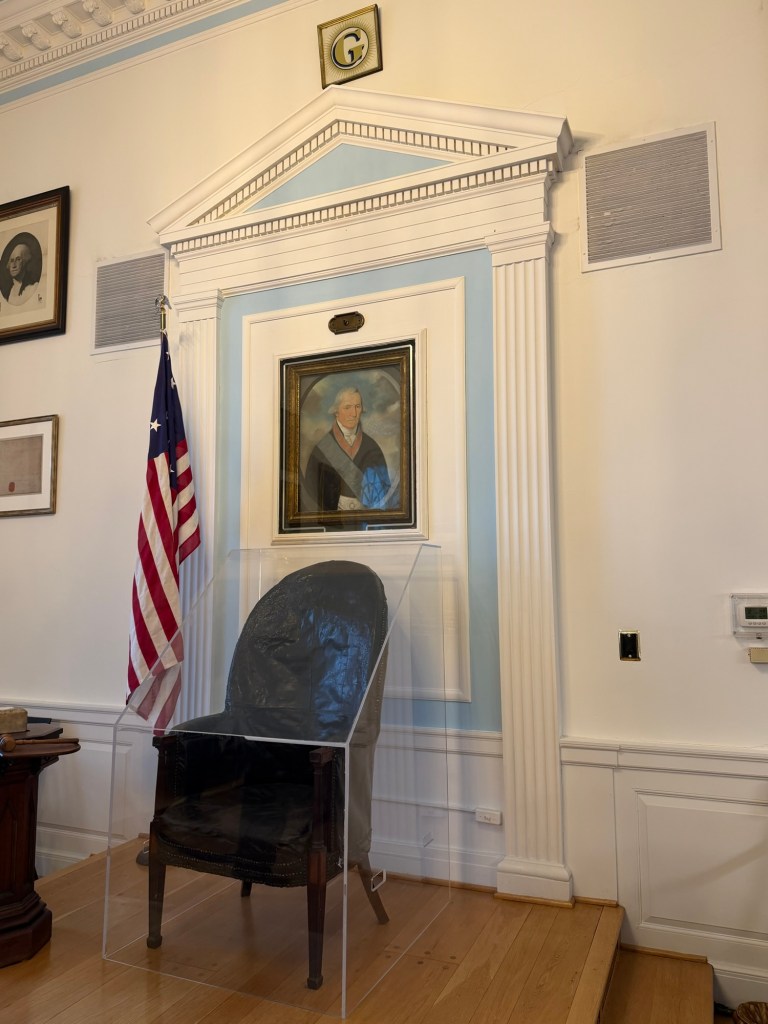
First we had a rehearsal, next we had a tour: the great statue of Washington, regalia from orders I had never heard of, and the viewing platform at the top with the whole city laid out across the river. Not to mention George Washington’s actual Masonic apron, his chair in situ as the Master’s chair in a model lodge room and various other artefacts belonging to the man.
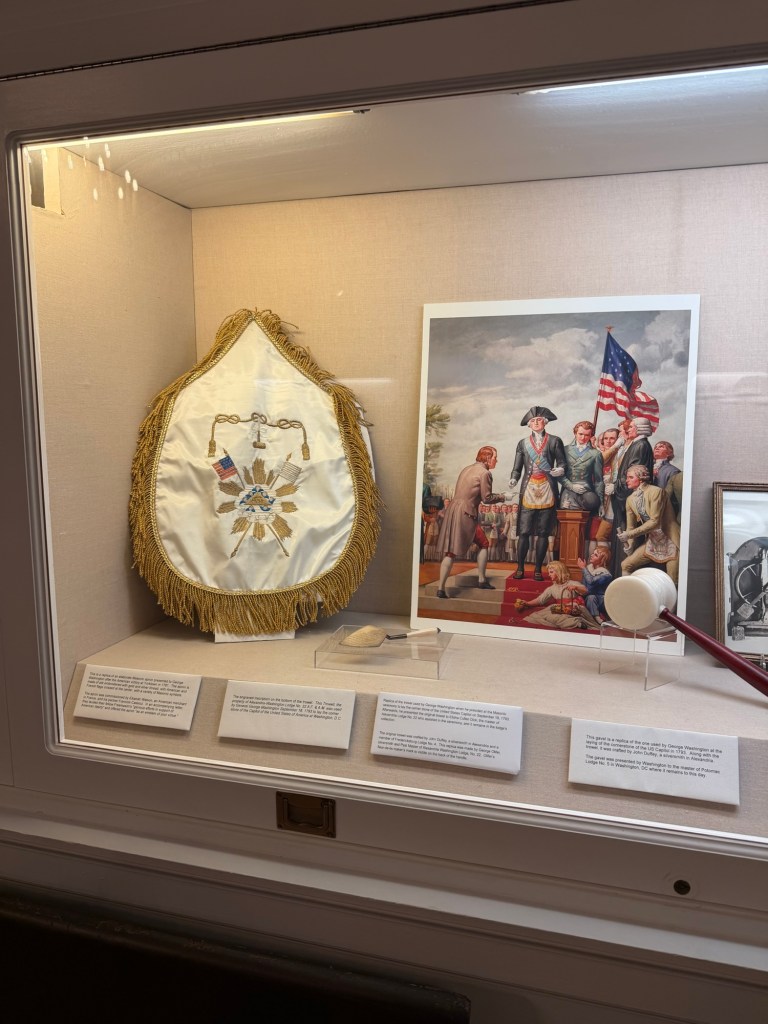
An especially interesting object was a portrait of Washington sometime during his sixth decade. It depicts him in his regalia, but most strikingly, shows a man quite different to the image we have become used to. The explanation followed that conventional portrait artists at the time depicted men in the ideal of that era, and that here, that was not the case. Whilst I found this fascinating, I was mainly left with some form of existential crisis.
Dinner came before the meeting rather than after it, which is the wrong way round by every convention I know. A buffet, and table wine; no beer. The Junior Warden of an English lodge is the officer charged with calling the brethren from labour to refreshment. I mention this only to record that on the night I stood in to hold the office, refreshment was a glass of red.
Then the meeting, and I cannot really put it into words.
Somewhere in excess of five hundred brethren. Grand Masters from all over the world, every one of them in different regalia, so that the room read as a sort of index of the whole Craft. Our Pro Grand Master was there.
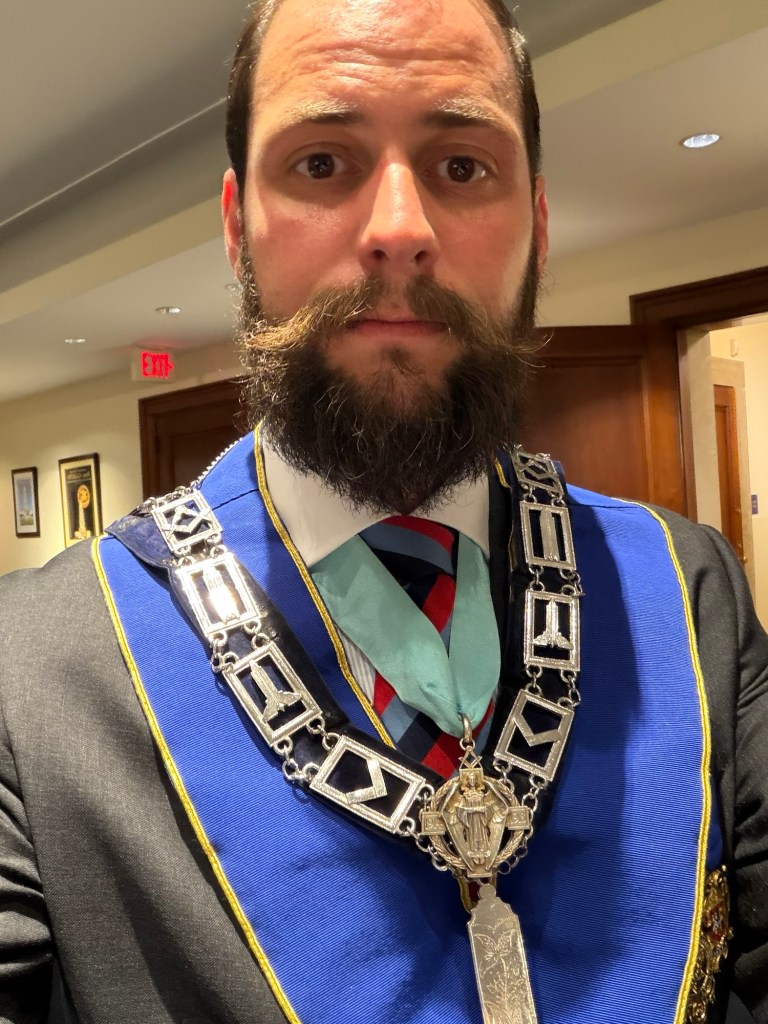
Potomac Lodge No. 5, the oldest lodge in the District of Columbia and older than the District itself, lent us their officers’ collars. So I processed in behind the Master wearing the Junior Warden’s collar of a lodge founded in 1789, and sat down in the middle of a room that felt less like a temple than an oratorium, rather more exposed than I am used to, with a pedestal at my side rather than shielding my front.
Lodge No. 5 are the custodians of Washington’s gavel, and Alexandria-Washington No. 22, the lodge that lives in this building and of which Washington was the first Master, keeps his trowel. Both were on a table in front of us, which is why both lodges were spoken of during the evening. The gavel is not overly ornate, with a marble head and cherry handle, made for George Washington to use at the laying of the Capitol cornerstone in 1793 and given by him afterwards to the head of Potomac Lodge. It has been lent out ever since. Polk at the Smithsonian in 1847, Truman at the Washington Monument in 1948, Eisenhower at the Capitol extension in 1959, and this February it sat on the Speaker’s rostrum for the State of the Union, the first time in its history.
Only one monarch has ever held it. Elizabeth the Second, on the nineteenth of October 1957, laying the cornerstone of the new wing of the British Embassy.
The theme of the evening was the special relationship. The gavel was there on the table, having been in a British queen’s hand and an American president’s, waiting for us to open the lodge.
Which we did, in our own workings. And then, in an English lodge on American ground, the Americans sang their anthem and made the pledge of allegiance to the flag.
Our acting secretary read the dispensations. Three of them, not the four we had been promised, which I choose to take as a sign that somebody somewhere had been sensible.
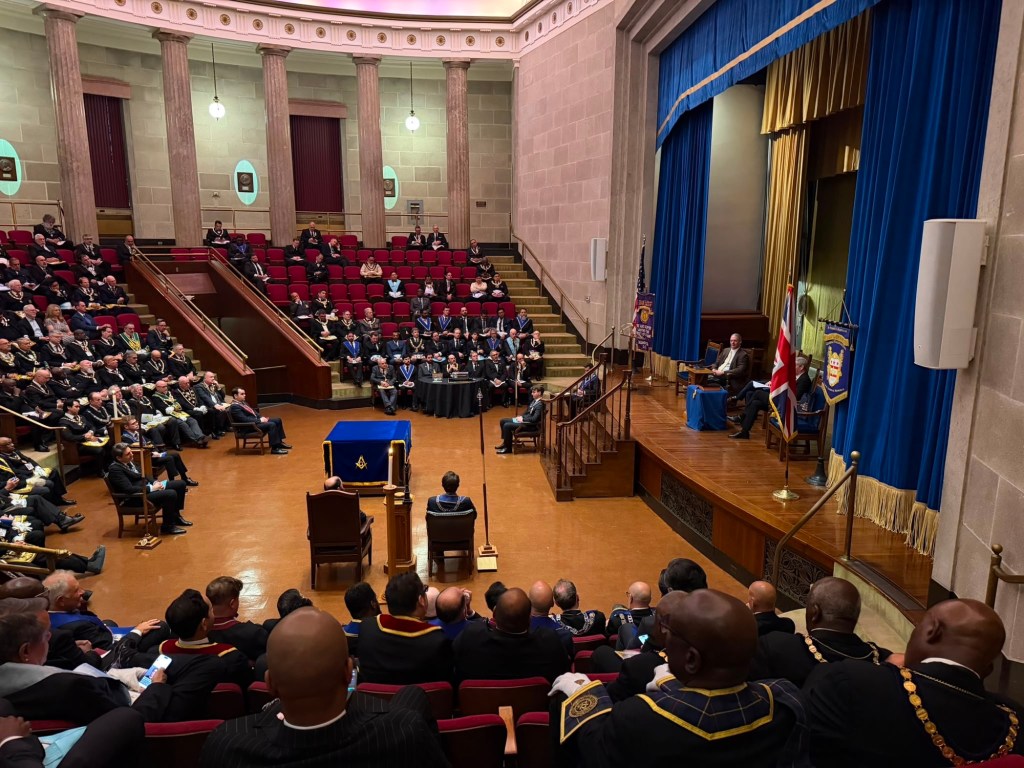
We called the lodge off and received three visitors who were not Masons: a panel of historians, who detailed the special relationship in front of us. Churchill and Truman, and back from there to the Revolution, which more than one of our party continued to call the rebellion, and forward again to this year.
We called the lodge back on. The Pro Grand Master read out a letter from our Grand Master, the Duke of Kent, hand signed, and presented it to the Grand Master of the District of Columbia. He continued with his own oration, which ended, without a flicker, God bless the United States of America and God save the King. In conclusion, he presented the Kent Medal, as a personal gift, not an institutional one.
The Grand Master replied by coming down off the dais and onto the floor of the lodge to speak, which is not nothing, and spoke about unity. Two marble bookends were presented in return, whose provenance I did not quite catch.
Then our own Master gave his address, and said the thing plainly. This was the first occasion in nearly two hundred years, since the English lodges closed their doors on American shores, that a lodge under the English constitution had met on American soil. And the first time in the history of this building that a lodge of any constitution but an American one had met in it, the Memorial opening its temple to very few.
When we closed, we sang the royal anthem. I call it that because that is what it is where I come from. The Island has its own national anthem, and God Save the King comes after it.
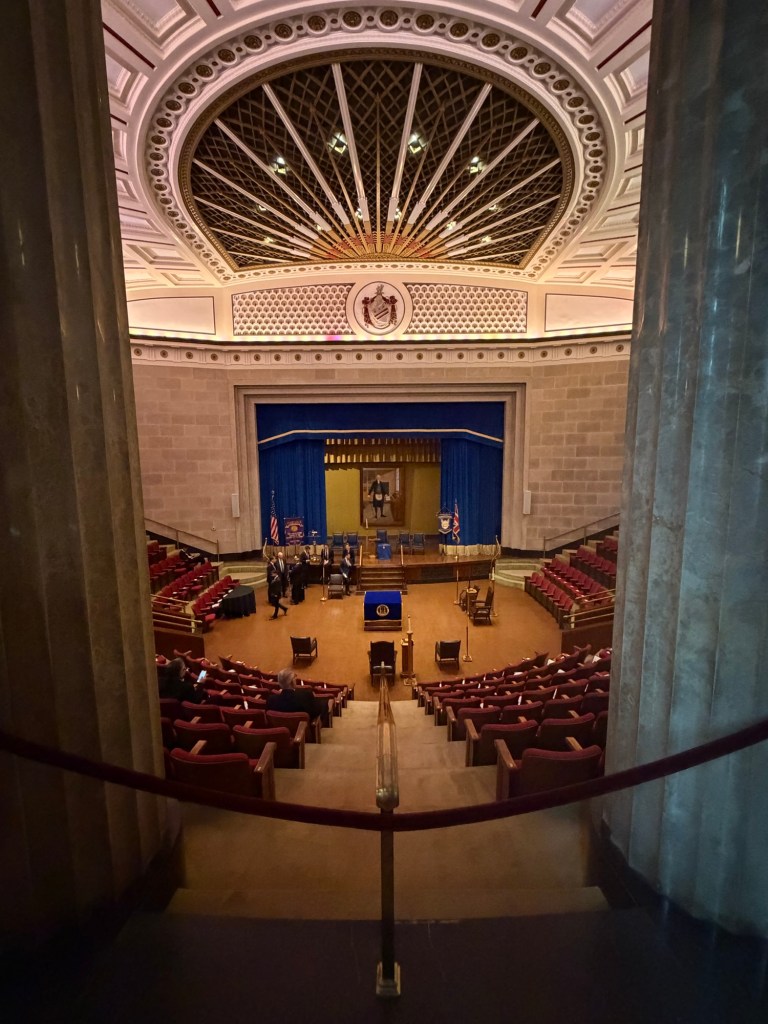
It was a strange moment and I do not believe I was alone in feeling it. A room full of Americans, standing for a king, in the year they are marking two hundred and fifty years of having done away with one. Nobody smirked. Given what the evening was for, there was no other way to end it.
And I was in it. Standing in as Junior Warden, one of the three principal officers, in a borrowed collar, because somebody was needed and I was there.
We left quickly afterwards to catch the coach. There was a private tour of the Capitol the following morning, and the bus was to depart at a quarter to eight. So a nightcap it was, and then early to bed.
I had thought that my Masonic high point was already behind me: the evening I sat as Senior Warden of Lodge Sine Nomine at the first Light Blues quarterly communication at Great Queen Street. That has taken second place since about half past seven on this day.

