Up at half past eight for an eleven o’clock coach, which by the standards of this week counts as an early start.
The others have gone off to climb a tower. I did not establish which tower, and by the time it occurred to me to ask they had gone. I used the morning to catch up on emails instead. There is a pattern here that I have stopped pretending not to notice.
I had brought beers for the journey and the driver raised no objection, this group having some days ago quietly reclassified beer as a soft drink. The ruling was well received and the coach beers were a considerable success.
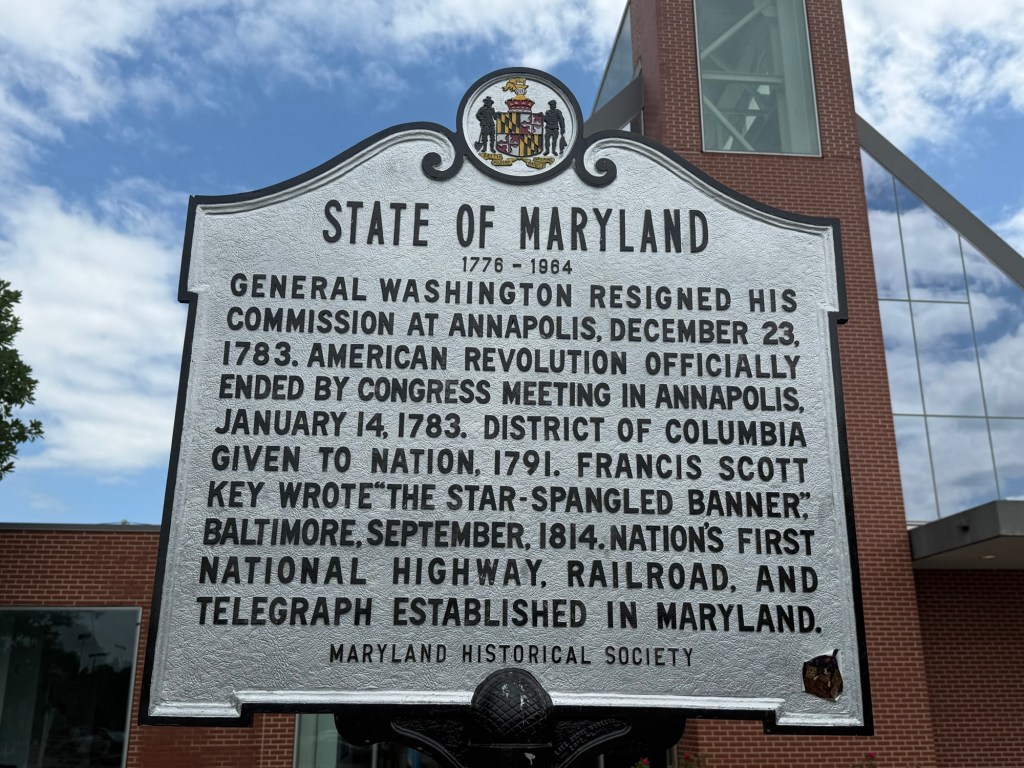
We stopped at a service station, where I had a Wendy’s, which was nice, and where I found a State of Maryland historical marker standing between the car park and the front door. It records that Washington resigned his commission at Annapolis in December 1783, that the District of Columbia was given to the nation in 1791, and that Francis Scott Key wrote the national anthem at Baltimore in 1814. That is the thing about this country. The history is so thick on the ground that some of it ends up next to a Wendy’s.
The marker also dates the formal end of the Revolution to January 1783. Congress ratified the treaty at Annapolis in January 1784. I mention it with some sympathy, being a man who has been corrected more than once this week himself.
Into Washington and checked in to the JW Marriott by three. From the window I can see the obelisk. Before dinner I went for a very long walk and took in more or less everything in one go.
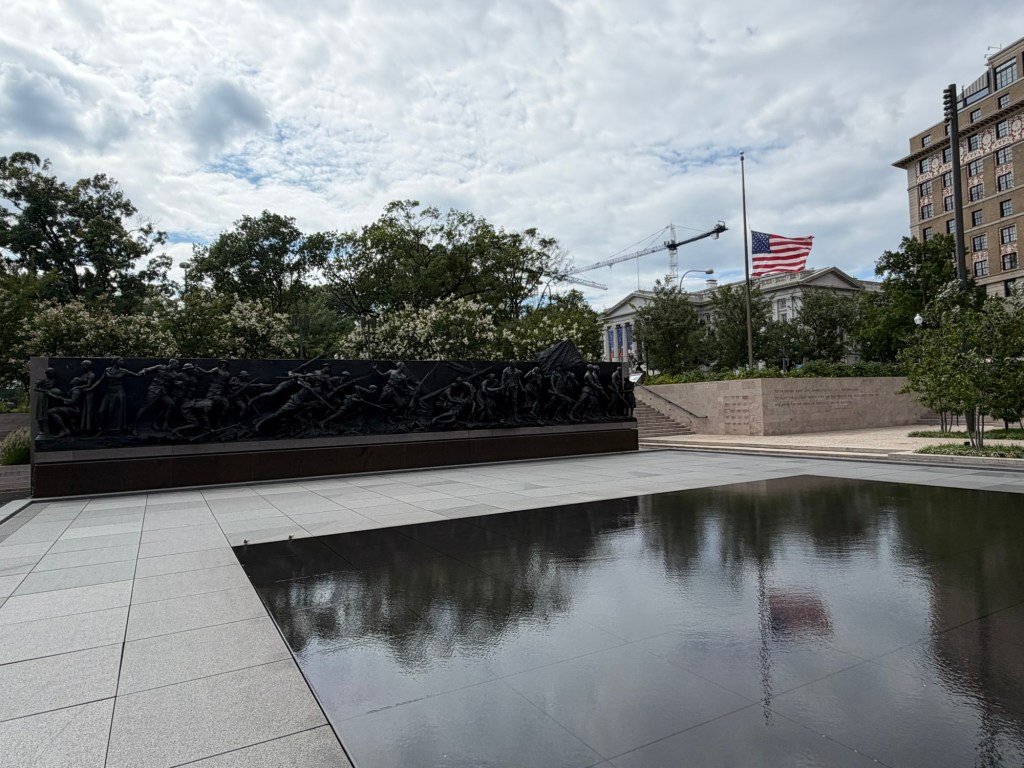
It began two hundred yards from the front door. Directly opposite the hotel is the National World War One Memorial: a long bronze relief of men moving forward into fire, with a still black pool set in front of it. I had not planned to start there and I stayed longer than I meant to.
Washington is lovely, and a very different proposition from Philadelphia. Philadelphia is worn in and working, and wears its history on the outside. Washington is swept, ordered and oddly quiet. Serene, even, which is not a word I had expected to need for a capital city.
The exception is the White House, where the security is frankly bonkers. A cordon of a size I have not seen anywhere, vehicles, police, layer upon layer of it, and at the end of all that you get the briefest glimpse of a white building through a gap.
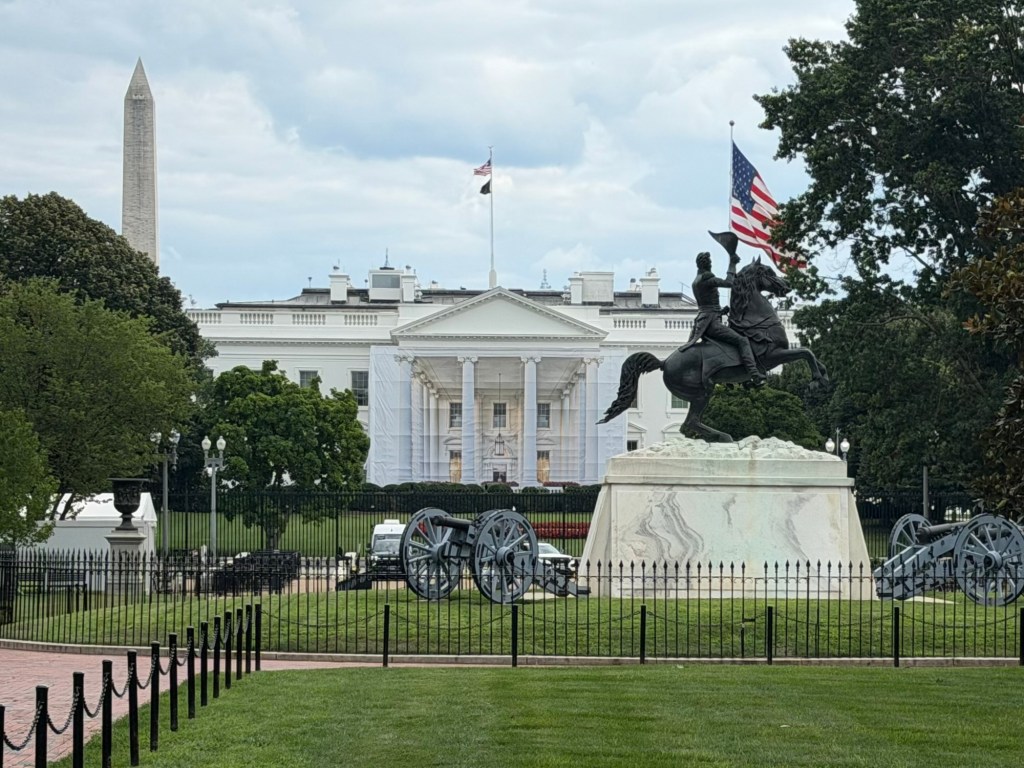
And not even the building. There is work going on at the front, and they have hung an enormous printed sheet across the portico, showing the portico. The most photographed house on earth is currently wearing a photograph of itself.
In front of it, on a rearing horse with his hat raised and cannon set about the base, is Andrew Jackson. I last saw him the previous afternoon in Philadelphia, the sole Democrat on the wall of a club founded by Republicans. Two days running.
I went up to the obelisk first, the Washington Monument. From a distance it orders the whole city. From directly underneath it is a very large piece of stone that gives you nothing whatever, ringed with flags and with a few hundred people photographing it from the one angle that cannot possibly work. I stayed long enough to be sure of that and moved on.
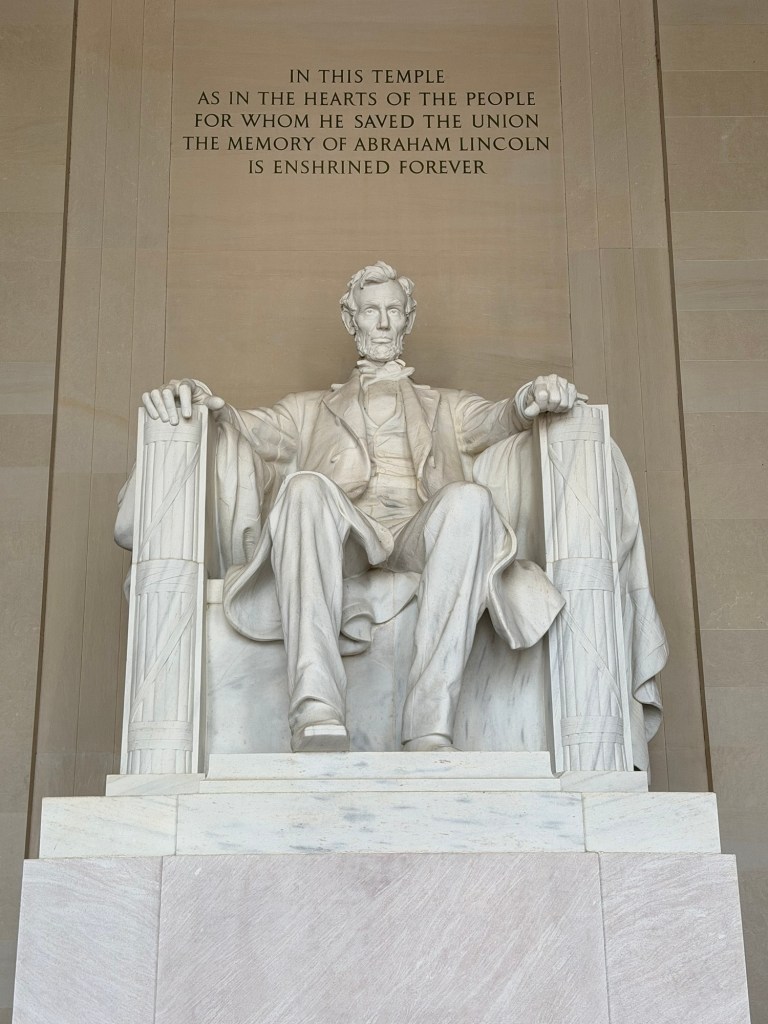
The Lincoln is the busiest place on the Mall and somehow survives it. You come up the steps into a chamber of enormous columns with him seated at the far end, and the crowd goes quiet in the way crowds generally do not. The Gettysburg Address is cut into the wall on one side and the Second Inaugural on the other, both at a size that takes a while to read. A plaque on the terrace explains which states were in the Union when he died, and notes with some care that Alaska and Hawaii came afterwards.
It was the Second Inaugural that stopped me. Not the part about malice toward none, which everybody knows, but the sentence before it, where he observes that both sides read the same Bible and prayed to the same God. That is an extraordinarily difficult thing to say five weeks before Appomattox, and there it is on the wall in letters a foot high.
Everything else is wide open. I walked down through Constitution Gardens and the World War Two Memorial and kept going. It is picturesque, immaculately kept and genuinely tranquil, while carrying about as much symbolic weight as any square mile anywhere. I had not expected to find it restful, and I did.
The wildlife is the part nobody mentions. Ducks, starlings and squirrels in great numbers, all of them so entirely unbothered by people that they come closer than anything wild on the Island would dream of. One starling stood near enough, and long enough, that I am prepared to say we had a conversation.
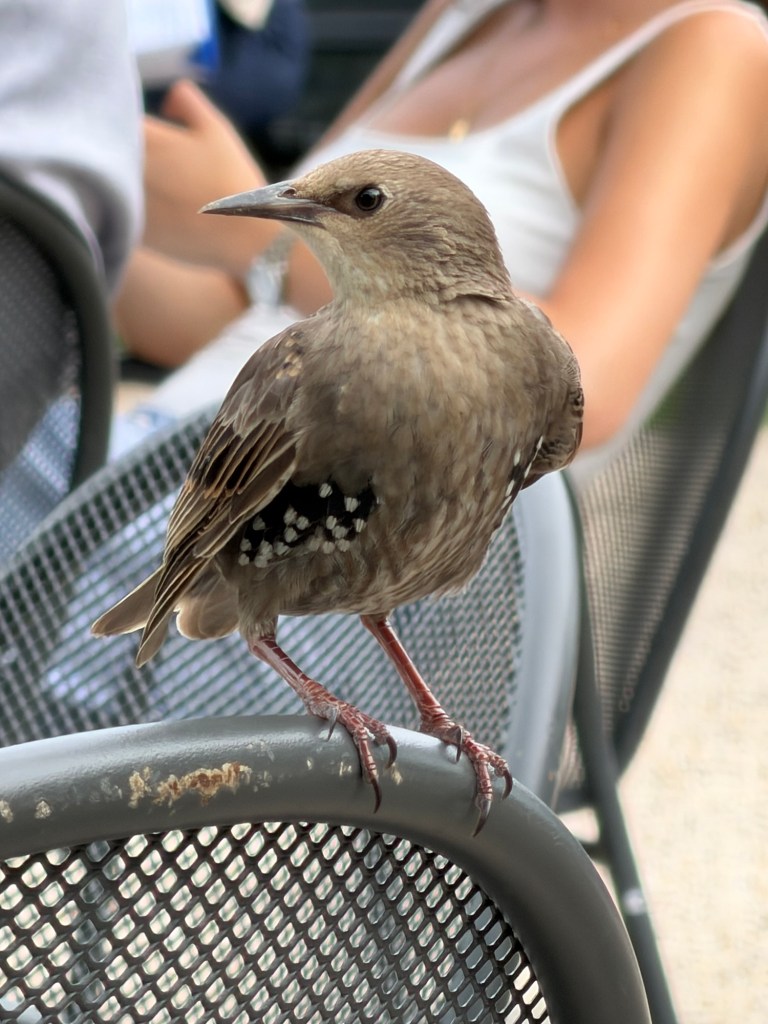
I looked her up afterwards. Every starling in North America, and there are something like two hundred million of them, descends from about a hundred birds released in Central Park in 1890 and 1891. Which makes her a late arrival. Manxmen had been leaving that small island in the Irish Sea for Ohio since the 1820s, in numbers, and by the time his ancestors were let out of a cage in New York there were Manx speaking communities around Cleveland two generations old. We were here first. I mention it because we so seldom get to say that about anything.
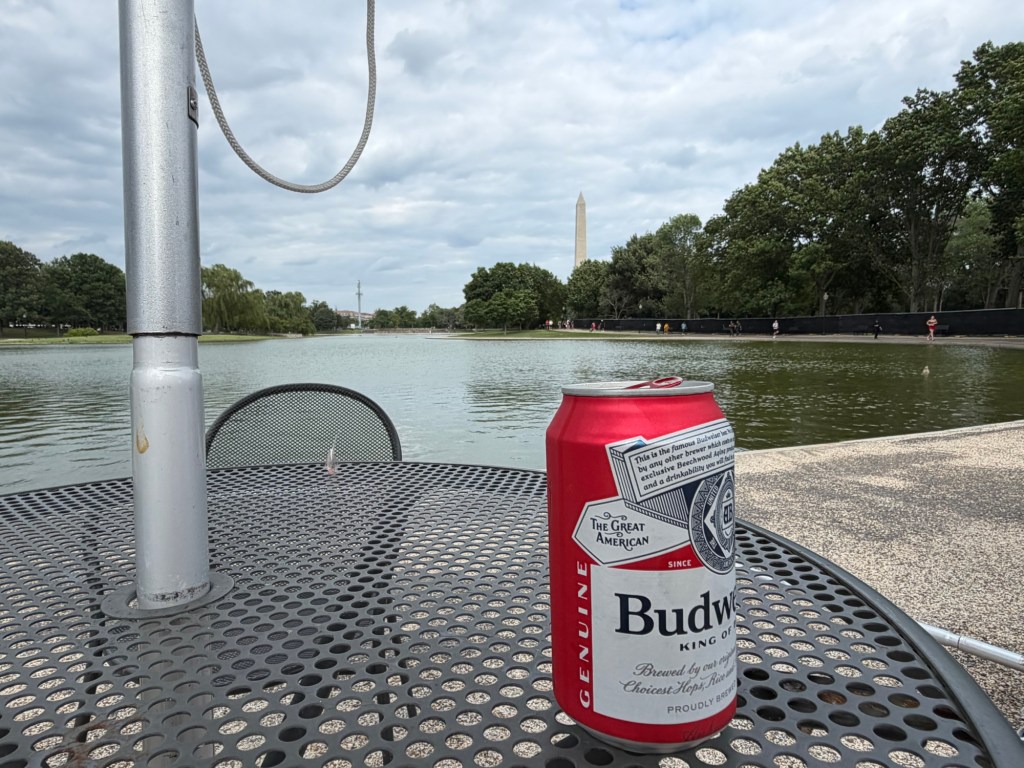
At the same table I had a can of Budweiser, and photographed it with the obelisk standing directly behind it. Beer in a lounge at Heathrow on Sunday morning, beer on a coach down the interstate, and now beer at the foot of the Washington Monument. There is a consistency running through this week.
Walking back along the other side I came to the Korean War Veterans Memorial, where a granite curb carries the names of the twenty two nations that sent combat units or medical support. I stopped at one of them. Luxembourg, where I was born and raised, and whose nationality I hold, cut into the stone between Italy and the Netherlands.
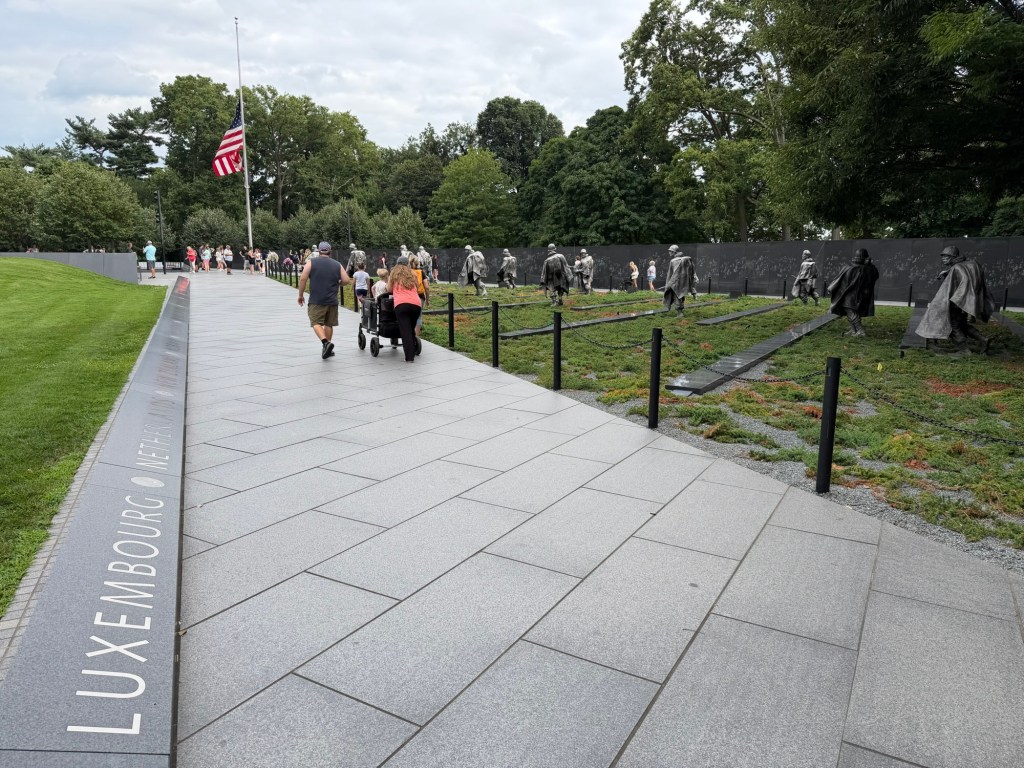
Luxembourg’s contribution was a single volunteer platoon attached to the Belgian battalion, fewer than a hundred men in all. They fought at the Imjin River alongside the Gloucestershire Regiment. Two were killed and seventeen wounded.
There is something in a country that size having its name in granite in Washington, on the same footing and in the same lettering as everybody else. I had not expected to be standing on the Mall thinking about it.
Round the Tidal Basin to the King memorial, where you walk between the two halves of a split mountain and find the third piece pushed out in front, with him carved standing in it and looking across the water. The line about a stone of hope cut out of a mountain of despair is the whole design, done in rock rather than words. It is the only one on the loop that uses the ground itself as the argument.
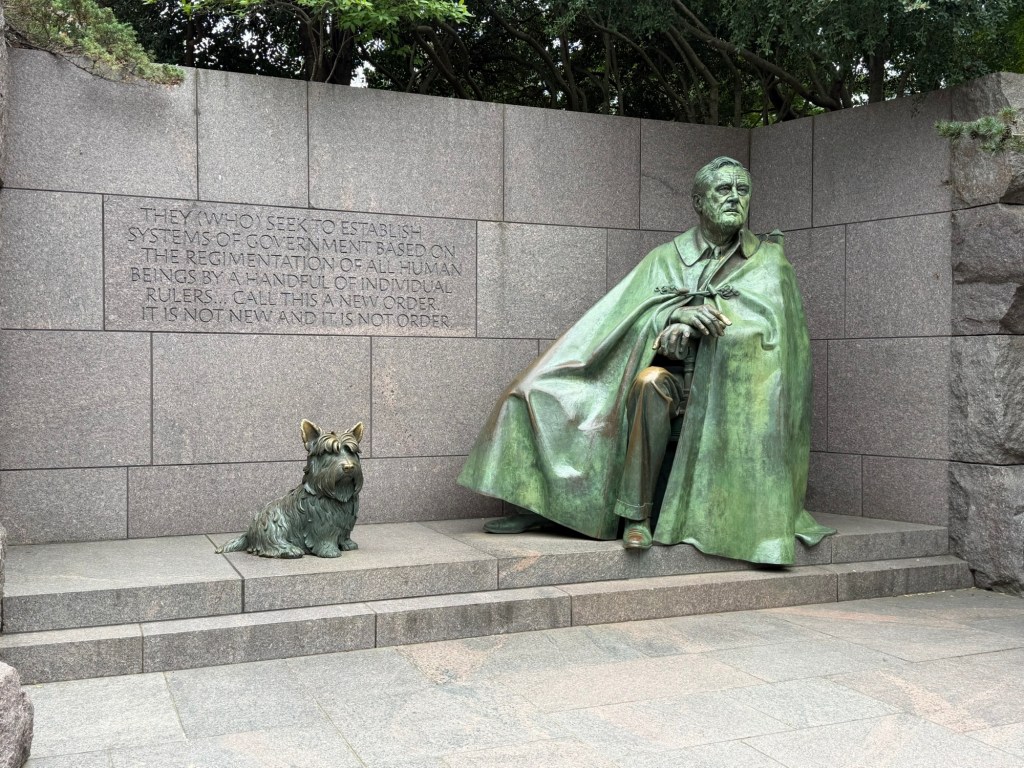
Then Roosevelt, which is not a building at all but a series of open rooms in granite with water running through every one of them. He is there in bronze in a long cloak with his dog sitting beside him. Eleanor is there too, in her own alcove beneath the emblem of the United Nations, which no other president’s wife has been given. And on one wall, beside a waterfall, an instruction to guard scrupulously the civil rights and civil liberties of all citizens, whatever their background, because any oppression or hatred is a wedge designed to attack civilisation. He said it in the 1940s. They cut it in stone in the 1990s. It reads today like a live argument rather than a memorial.
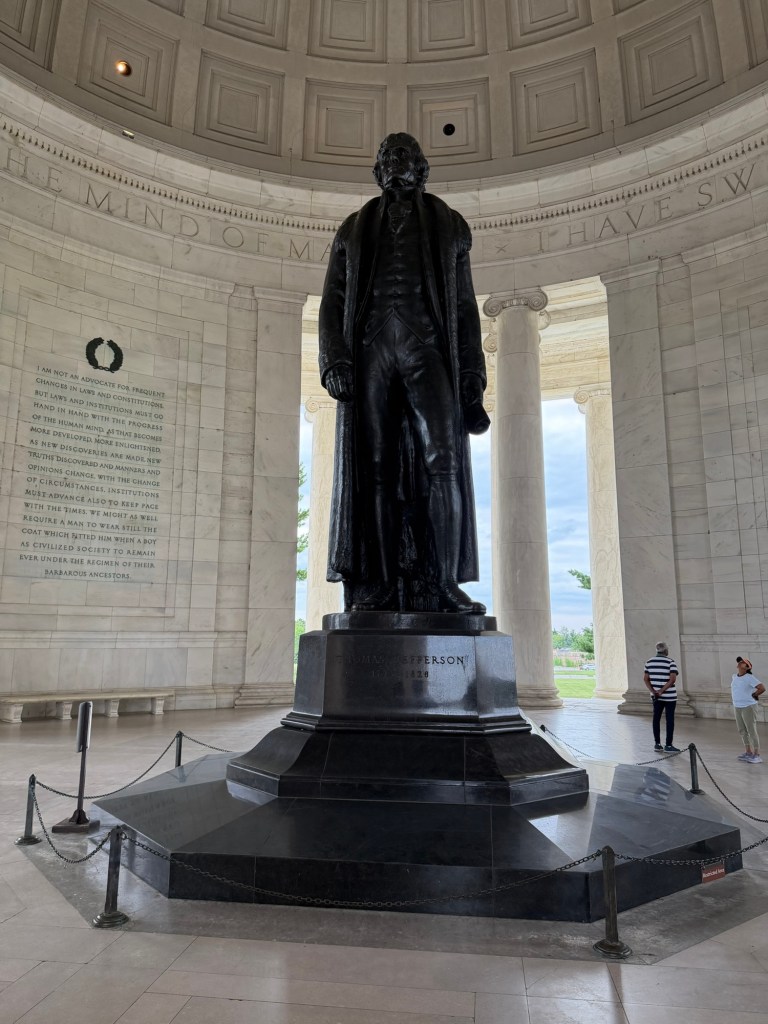
The Jefferson sits across the water under its dome, and its cornerstone was laid by Franklin Delano Roosevelt in 1939, so you arrive at Jefferson through Roosevelt twice over.
Inside there are four walls. The Declaration on the first. The Virginia Statute for Religious Freedom on the second, which is where the First Amendment I had been leaning on in Philadelphia actually comes from. And on the third, the hardest wall of the afternoon: his own words that commerce between master and slave is despotism, and that nothing is more certainly written in the book of fate than that these people are to be free. Written by a man who owned them. They have put it up in his own memorial, at his own eye level, and left it there. I am not at all confident that we would, on my island or on the neighbouring one.
Which brings me to how the place is laid out. In a single loop, on foot, without doubling back once, I took in the First World War, the Second, Korea, Lincoln, King, Roosevelt and Jefferson, and finished within sight of the Capitol. Most of them are not things you look at from behind a rope but things you walk into and straight out of the other side. Each one hands you on to the next. I assume that is deliberate. It certainly works.
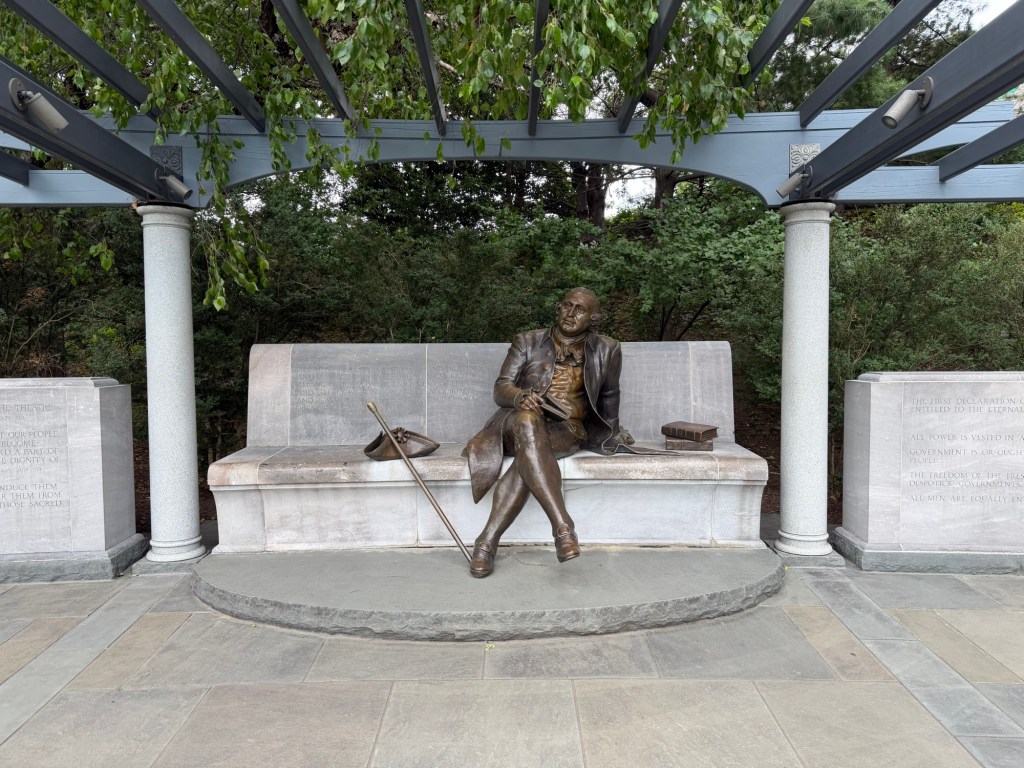
There was one more, and it was the smallest. In a garden off the Tidal Basin, with a fountain and almost nobody in it, there is a bronze of George Mason sitting on a bench with his hat off and his books put down beside him. The board in front of him calls him the Forgotten Founder. He wrote the Virginia Declaration of Rights, the ancestor of the Bill of Rights, and then refused to sign the Constitution because it did not contain one.
Everybody else on that loop has a temple. Mason has a bench, a fountain and an honest label. It was the best thing I saw all afternoon and I nearly walked straight past it.
The others had gathered in the hotel bar for drinks before dinner. I wandered and took it in all at once.
Dinner is at La Grande Boucherie. Today there is no official programme to be part of. We arranged the whole thing ourselves.
It is not a black tie evening. We are mostly in our lodge blazers, which are horrendous, as any club blazer is obliged to be.
Not everybody is coming. The restaurant runs a minimum spend of a hundred and fifty dollars a head, which has thinned the numbers noticeably. Which continues a theme, since every arrangement this week has shed people at the edges, and ours has now managed it over money, as most things eventually do. I have a good deal of sympathy with the abstainers. I am going anyway.
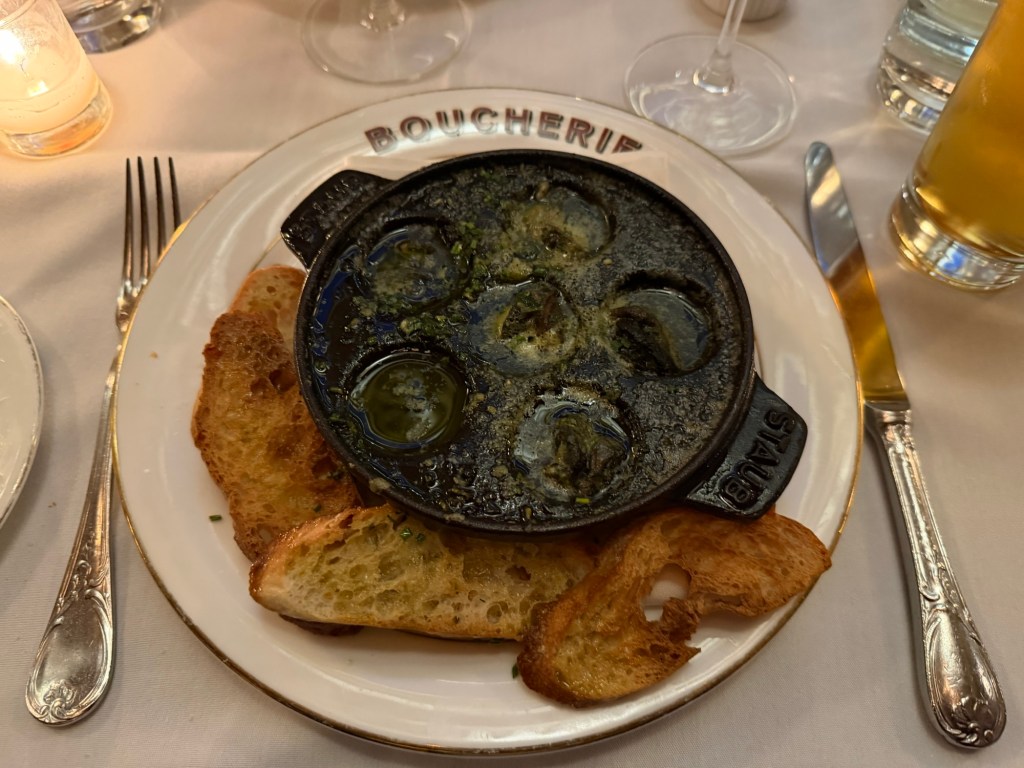
Escargots to start, which were very good indeed, and then the beef bourguignon, which was excellent. The service was perfectly fine without ever threatening to be memorable, which at a hundred and fifty dollars a head is the one thing you might reasonably expect it to be.
And then a turn I could not have arranged. The Pro Grand Master, Jonathan Spence, the Grand Secretary and several other senior figures came into the same restaurant. Not a complete coincidence, in one city, in one week, with one obvious place to eat. But not arranged either. They came across to say hello.
A little later the Pro Grand Master returned to our table carrying bottles of Le Petit Smith Haut Lafitte 2019, charged to the Grand Secretary’s account. A Pessac-Leognan, Cabernet led, and very good indeed. Not at all what one expects to be handed while wearing a lodge blazer.
Later still, the man who until recently was Grand Master of the District of Columbia, and who I gather now serves as its Grand Secretary, came over to talk to us. He explained that tomorrow’s visit to the National Archives is a considerably bigger undertaking than any of us had appreciated, and had required sign-off from the Secretary of State.
Which is why the bus leaves at seven o’clock sharp for a journey of roughly five minutes. Federal timekeeping does not appear to negotiate.
So the pattern held. Having in part spent this week declining the official programme, tonight, at a dinner we arranged ourselves precisely because there was no official programme to attend. The official programme walked in, said hello, and bought the wine.
I have called it a night, along with several others, and am having a beer sent up to the room. A few of the madder ones have gone to an Irish bar. That is (at least) the third Irish bar of the week, which is quietly becoming a tradition of its own.

