A second lie in, until ten. Various groups had already left for various activities, which by this stage of the week is less a schedule than a weather system.
My first engagement was lunch at the Union League of Philadelphia, at half past twelve. When I booked this trip I had completely forgotten that my membership of the East India Club carries reciprocal rights at clubs both here and in Washington. Fortunately one of my fellow brethren had not forgotten that his own club extends the same courtesy, and had booked lunch accordingly. After a few beers yesterday evening he extended me an invitation, which I accepted with every appearance of grace.
Then, not to be outdone, I wrote to the East India requesting a letter of introduction. It came back by return of email. So I would be lunching with my friend, but I would not be lunching as his guest. I would be attending as a reciprocal member in my own right. He was paying for the lunch. I was paying for the principle. I am entirely aware of how this reflects on me and I make no apology for it.
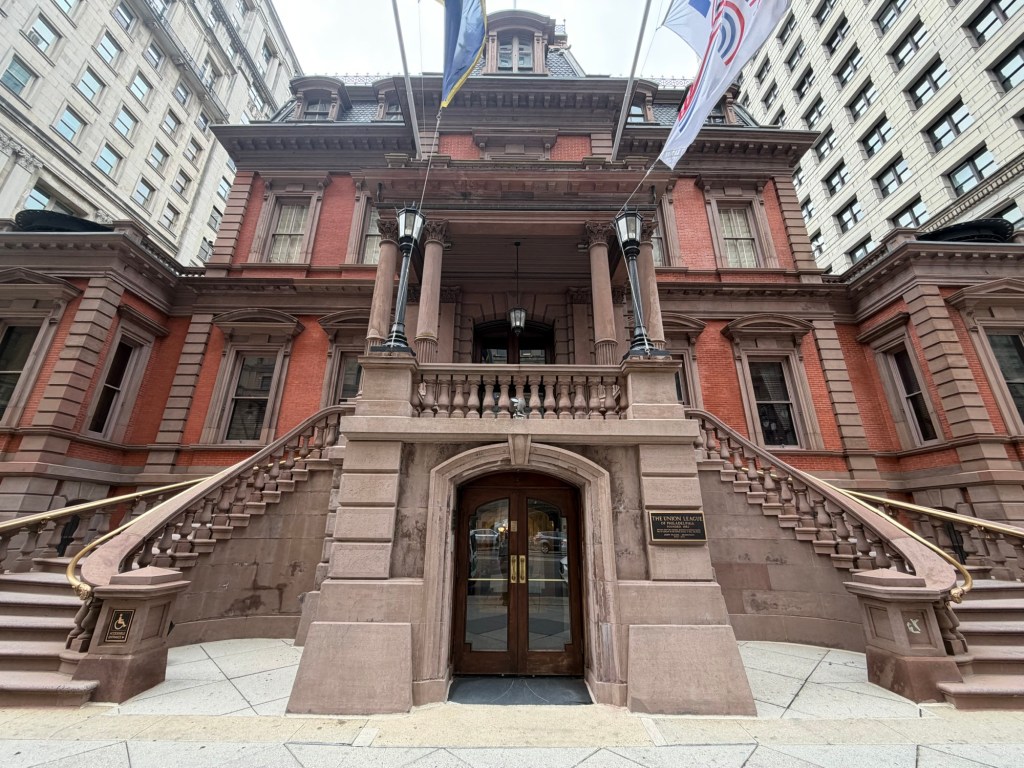
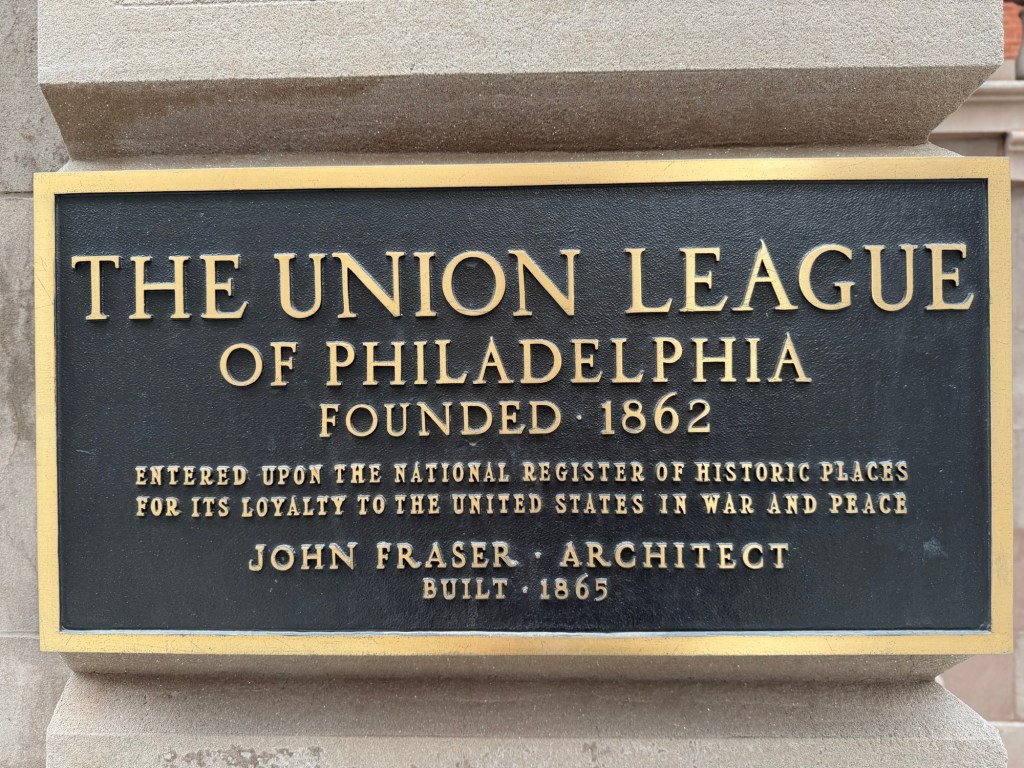
The Union League occupies a whole block of South Broad Street, a French Renaissance pile with twin curved staircases sweeping up to the door. It was founded in November 1862 as a patriotic society to support Lincoln and the Union, at a moment when Philadelphia was by no means uniformly persuaded of either.
What the front of the building does not begin to convey is the scale of the thing. From the street it is handsome. Inside it simply keeps going. We were joined after lunch by a gentleman of some standing in the club, who took us round properly.
Marble columns the size of trees. Battle banners from the Civil War, hanging where they were hung. And in the banquet room, portraits of every Whig and Republican president, with one Democrat among them. Andrew Jackson, in spectacles, hangs in a club founded to hold the Union together, which makes sense once you remember that he was the president who told South Carolina he would hang the first nullifier he could lay hands on.
From there the same gentleman walked us on to the Philadelphia Club, founded in 1834 and the oldest city club in the United States. Every bit as fine and entirely different in manner. Quieter. No dining room as such, no bustle, nothing announcing itself. More like a large private house that happens to have members, with a handful of characters drifting about inside it. We had a drink. The others took wine. I had a beer, as I have had all week.
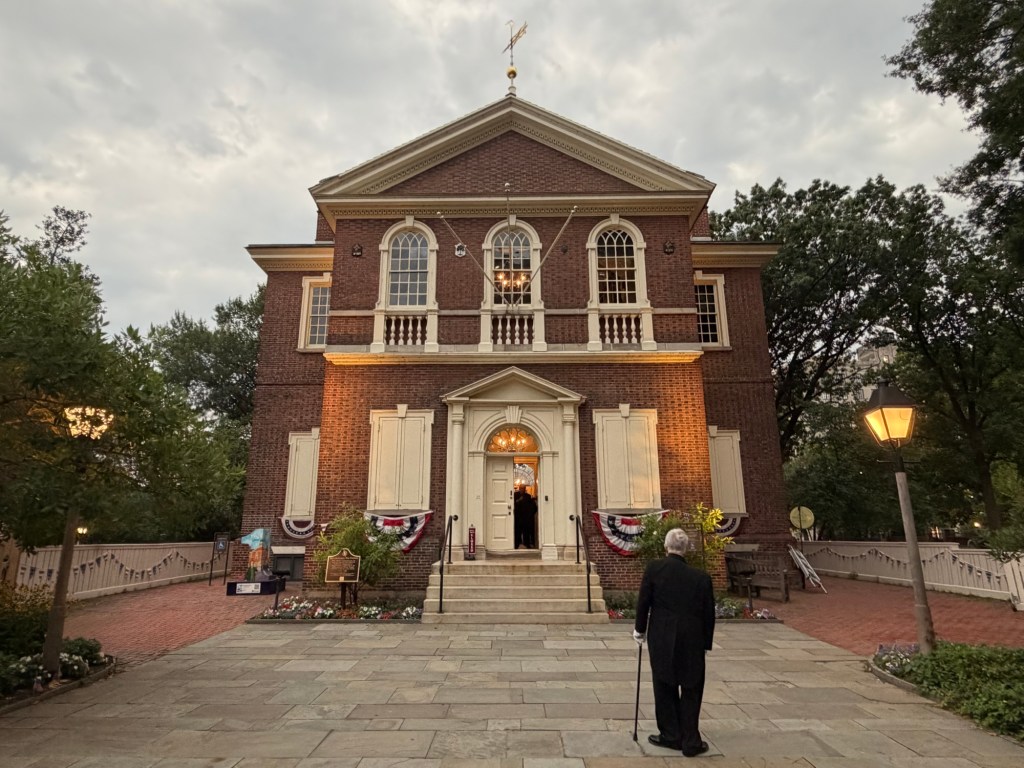
Now to meet the rebel group at half past four for one at the brewery, and then to Carpenters’ Hall at six.
The meeting lasted about an hour and was a great deal more relaxed than Grand Lodge meetings generally manage. Jovial, even. There were, inevitably, a good many references to the importance of the building, both to the United States and to Freemasonry, and for once the references were earned.
On the pedestal was the Mayflower Bible. Not a facsimile. Also on display was the sash Benjamin Franklin wore as Master of Les Neuf Soeurs in Paris, the lodge of the Nine Muses.
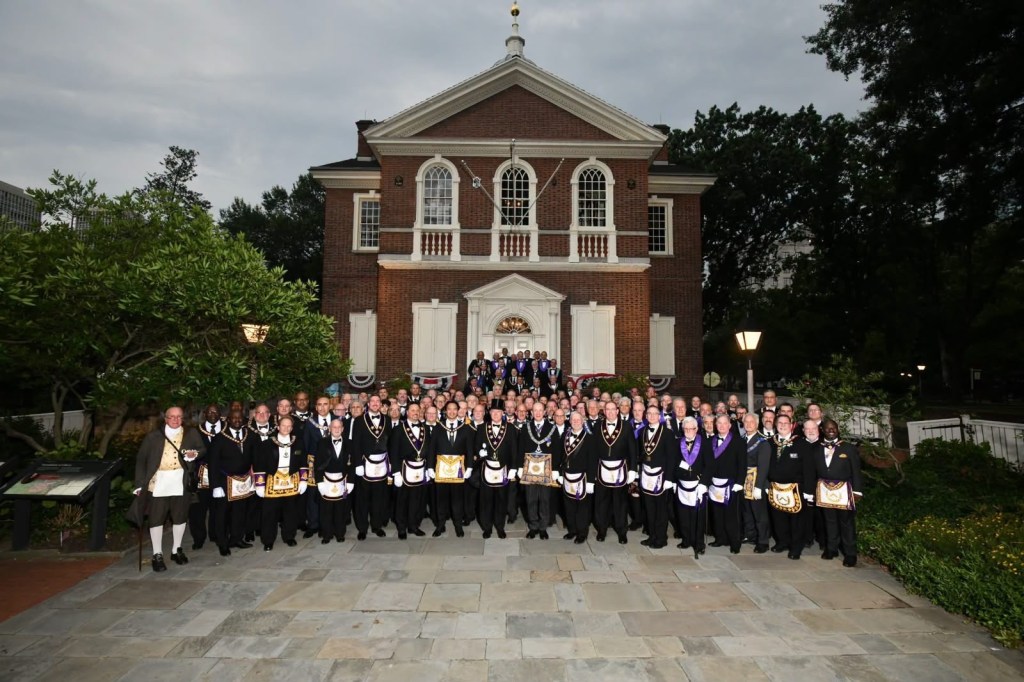
Gifts were exchanged between our Pro Grand Master and the Grand Master of Pennsylvania, and then between the Grand Master of Pennsylvania and the French Grand Master, who had come over for it. An Englishman, an American and a Frenchman, swapping presents in the room where the first two fell out and the third took a side. The jokes wrote themselves and were duly made.
I am very glad indeed that I did it. I should also report that it was stifling. The hall has stood on that spot since before the Revolution and has never, so far as I could establish, been introduced to air conditioning, and the effect of a room full of men in regalia in a Philadelphia July is that during every genuinely profound moment of the proceedings the dominant thought in one’s head is how soon one might decently get outside. I did get to see upstairs, on a trip to the lavatory, which I offer to future visitors as a strategy.
Something has come clear to me over these few days that I had not expected to be thinking about at all.
It is not that the founders were all Freemasons. They were not. Washington was, and Franklin was. Jefferson was not, nor Adams, nor Madison, and the number of signers who can actually be documented is a good deal smaller than the popular account would have you believe.
It is that the lodge was one of the very few places in the eighteenth century where men of different ranks and different denominations sat down as equals, governed themselves under a written constitution, elected their own officers, and drew the divine broadly enough that an Anglican, a dissenter and a deist could stay in the room together. That is a rehearsal for a republic. Nobody had to be a Mason for those habits to be in the air, and the men who met at Carpenters’ Hall in 1774 had been breathing them for thirty years.
So not that Freemasonry made America. That it had already made the shape of the room in which America was declared.
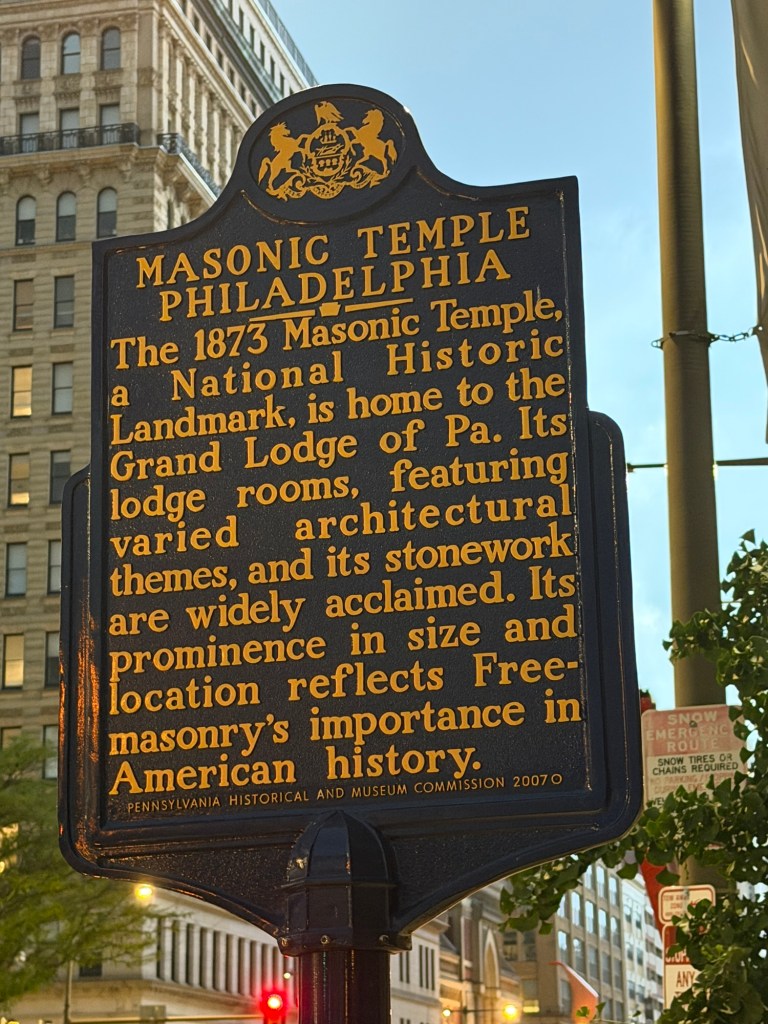
Then back to the Temple for dinner, more formal than the night before and held in the basement, which was blessedly cool. Still stand up, walk over and fetch your own drink. The wine came in plastic cups, which I had not expected, although the cups had gold glitter in them, so somebody had plainly given the matter thought.
The thunderstorm came back over during the evening and put paid to any notion of going out afterwards. Everybody went home. I left towards the end of the formalities and walked to the liquor store.
I am from the Isle of Man. What had emptied the streets of Philadelphia registered with me as a small shower, and I found I rather enjoyed the walk. The city at night, in the rain, with almost nobody else out in it. Refreshing is the word.
I came back with twenty four cans of Corona for what has by now become known as the frat house. An early night. The coach to Washington leaves at eleven.

