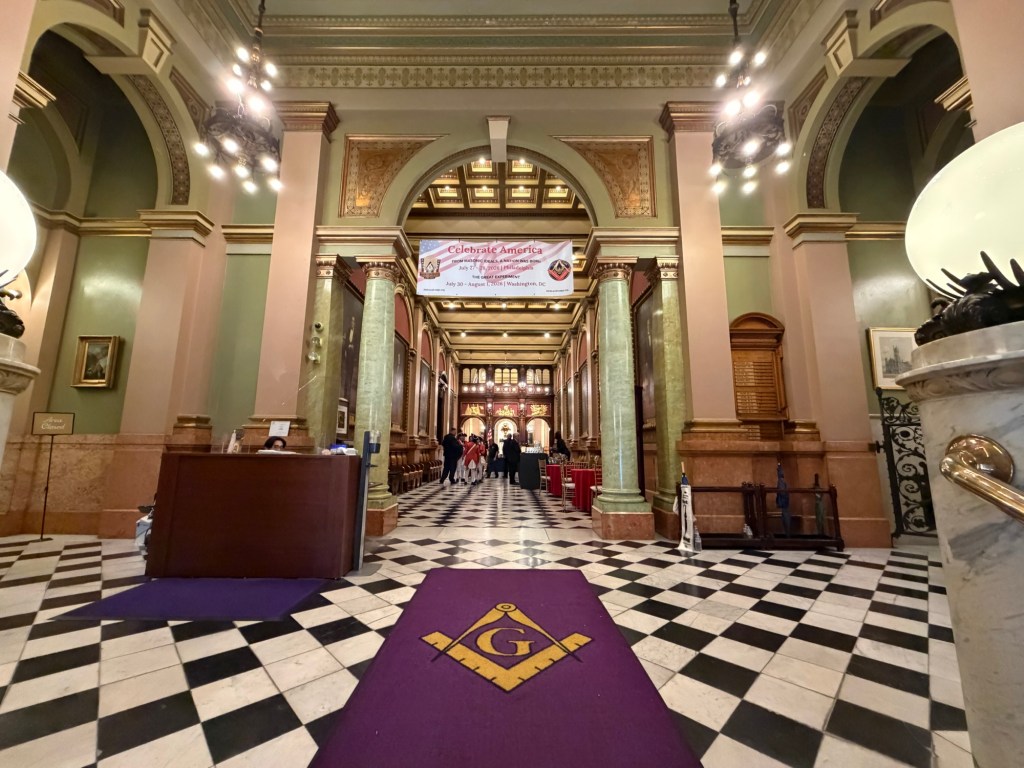
The building
The Grand Lodge of Pennsylvania opened its America 250 commemoration, Celebrate America, at the Masonic Temple on North Broad Street, with the second half of the programme, The Great Experiment, following in Washington DC from 30 July. Lodge Sine Nomine No. 10,000 was represented throughout, and the Pro Grand Master was among those present.
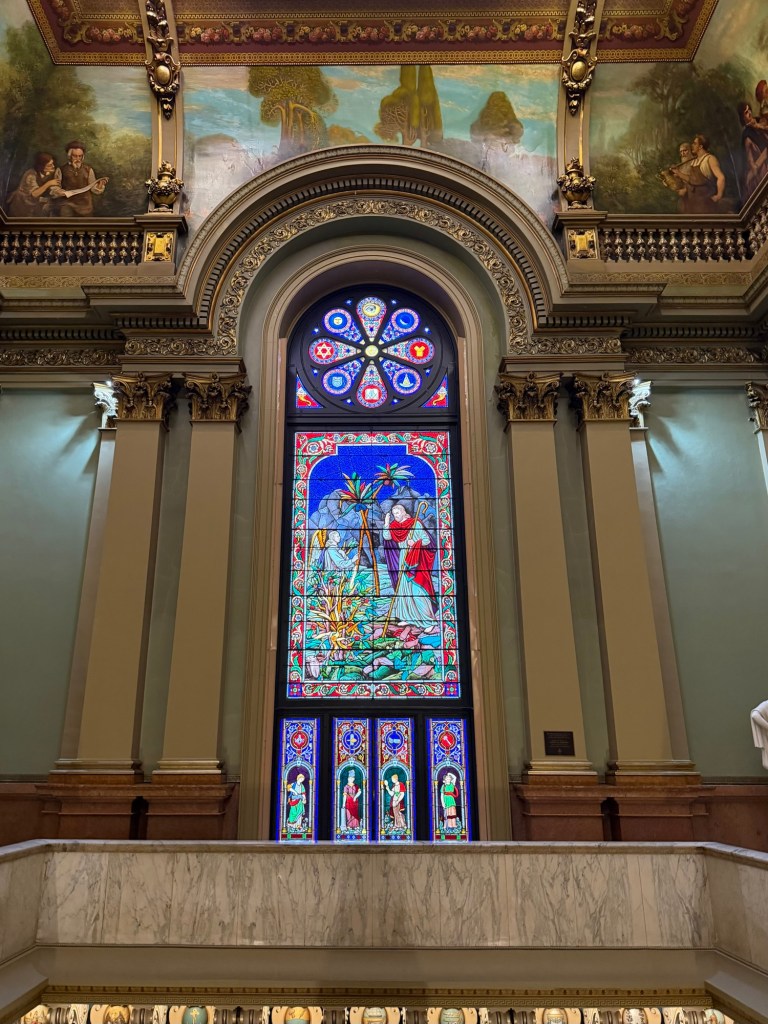
The Temple deserves a section of its own, because it is the part of the trip that will interest readers who are not Freemasons at all. The cornerstone was laid in 1868 and the building was dedicated in September 1873, to a design by James Windrim, who had won the competition at the age of twenty seven. The interiors were carried out from 1887 onwards by the decorator George Herzog, who also worked on Philadelphia City Hall across the road, and who spent some fifteen years on the job.
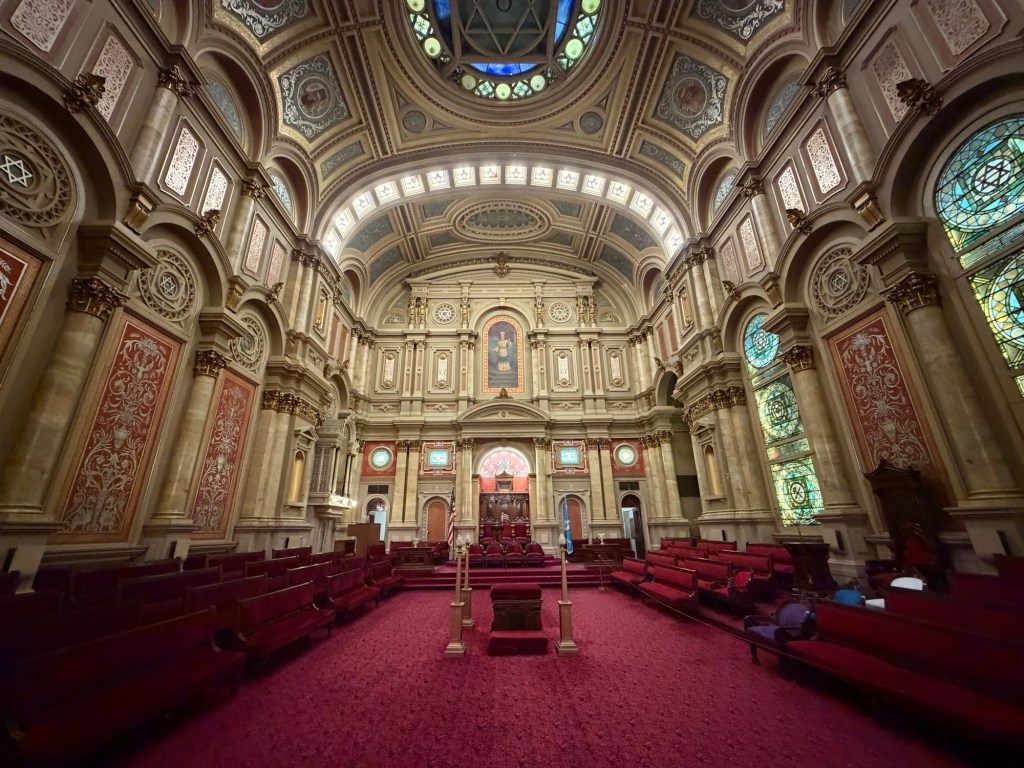
It contains seven lodge rooms, each worked in a different architectural style, so that a single circuit of the building takes you from a Norman chapel to an Egyptian temple by way of a Corinthian hall the size of a small church. Before you reach any of them there is the grand staircase, which is worth stopping on.
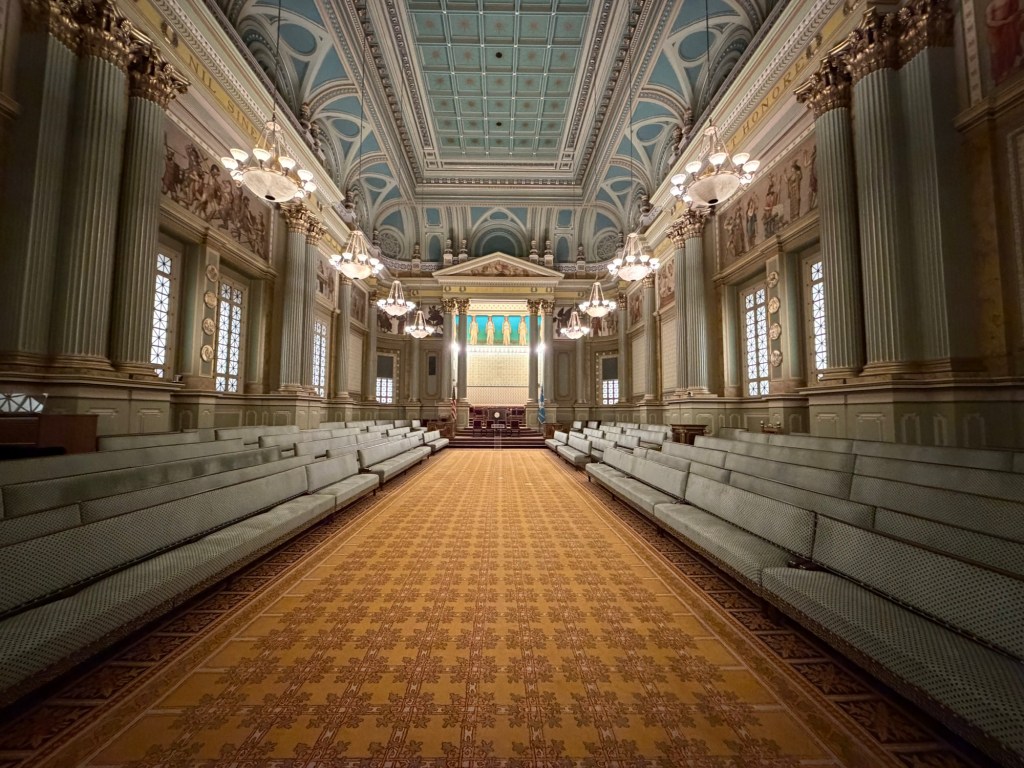
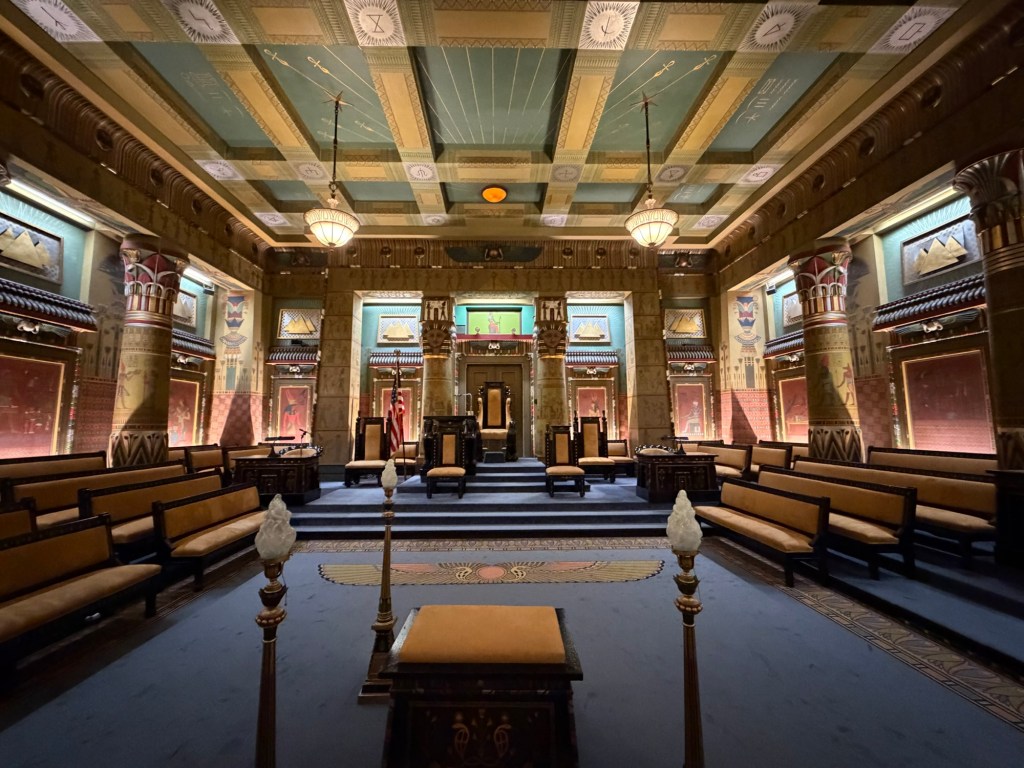
Corinthian Hall is the largest of the seven. The ceiling is coffered in pale blue, painted friezes of classical processions run along the entablature above the columns, and the mottoes are picked out in gold, NIL SINE NUMINE along one side. It seats a great many more brethren than anything on the Island and still manages not to feel like a barn.
Egyptian Hall is the one that stops visitors in the doorway. It was modelled on the temples at Luxor, the walls are covered in hieroglyphs and lotus columns, and the ceiling carries masons’ marks, the personal signatures that stoneworkers cut into finished work. It was decorated in 1889, at the height of the Victorian enthusiasm for Egyptology, and it commits to the theme without the least embarrassment.
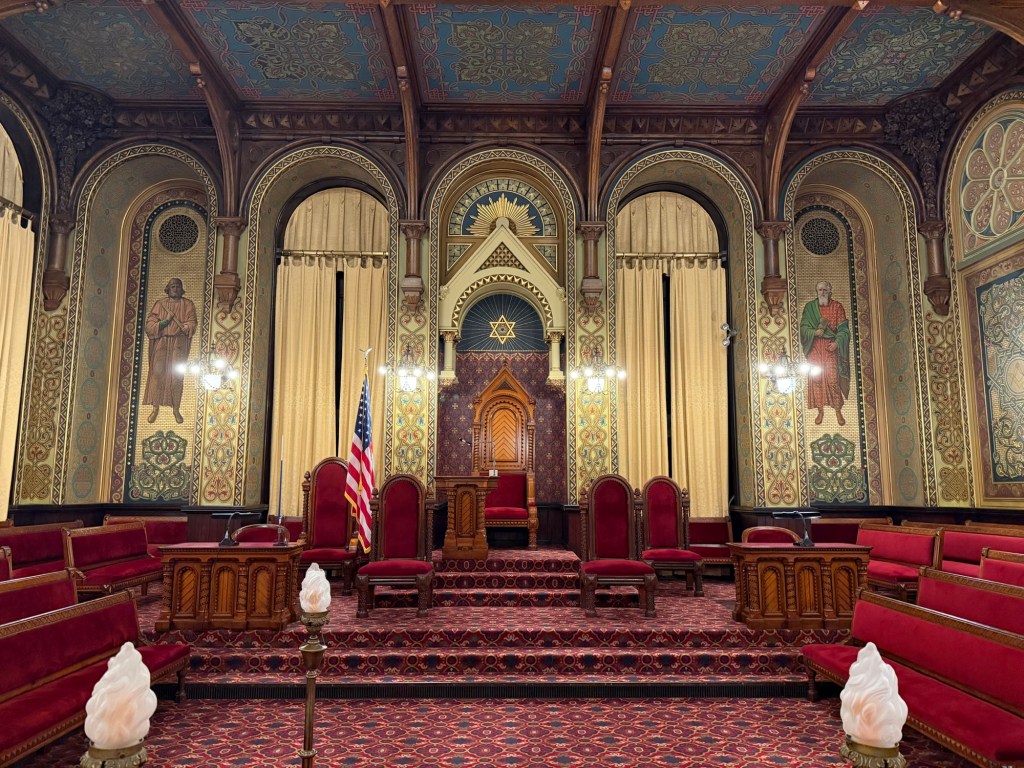
Norman Hall is the closest of the seven to the character of the building as a whole, round arches, interlace and carved oak, with the Master’s chair set under a canopy beneath a blazing sun. Except that the oak is not oak. A guide put us right on this: the woodwork is plaster, grained by hand with feathers to imitate timber. It is the sort of thing you cannot unsee once you have been told, and it makes rather a good key to the whole building, which is a tour of the world’s architecture assembled in a single block on North Broad Street and committed to entirely. Renaissance Hall, decorated in 1906, is the warmest of them, the Master’s chair against red beneath a clock and a domed ceiling. The rest run through Oriental, borrowed from the Alhambra, along with Ionic and Gothic.
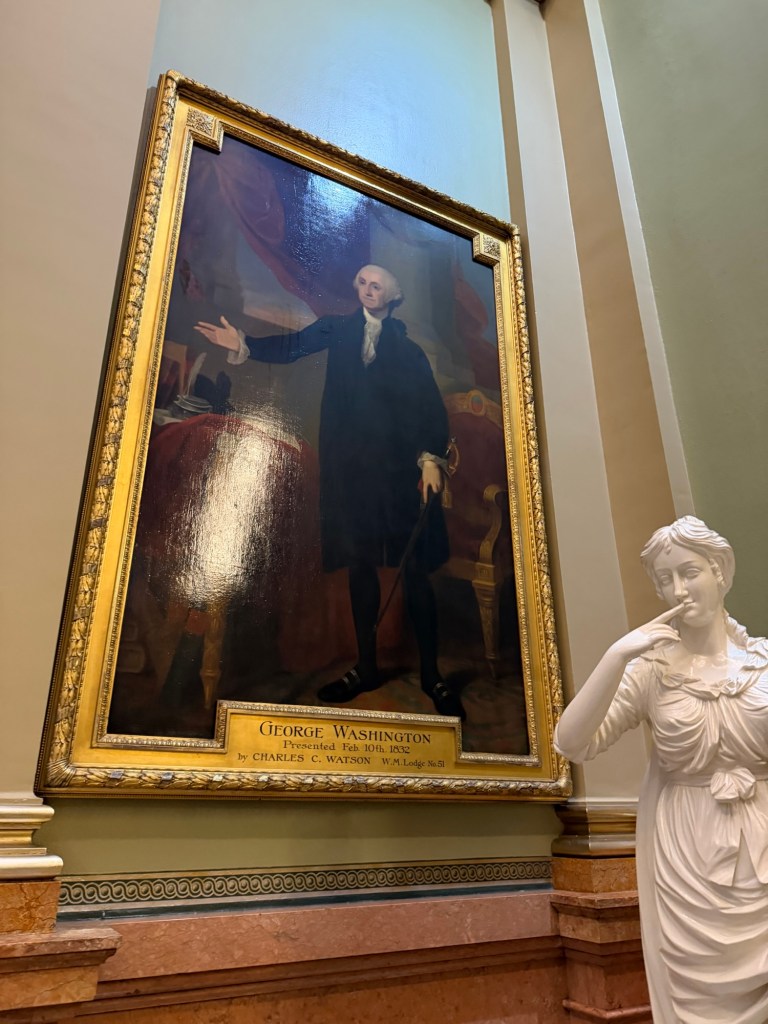
Portraits hang throughout, and not only of Grand Masters. The Washington in the stairwell was presented to the Grand Lodge in February 1832 by Charles C. Watson, then Worshipful Master of Lodge No. 51, and there is a Franklin nearby. The Temple also holds a substantial museum and a library said to run to more than seventy thousand volumes.
The America 250 Celebration Dinner
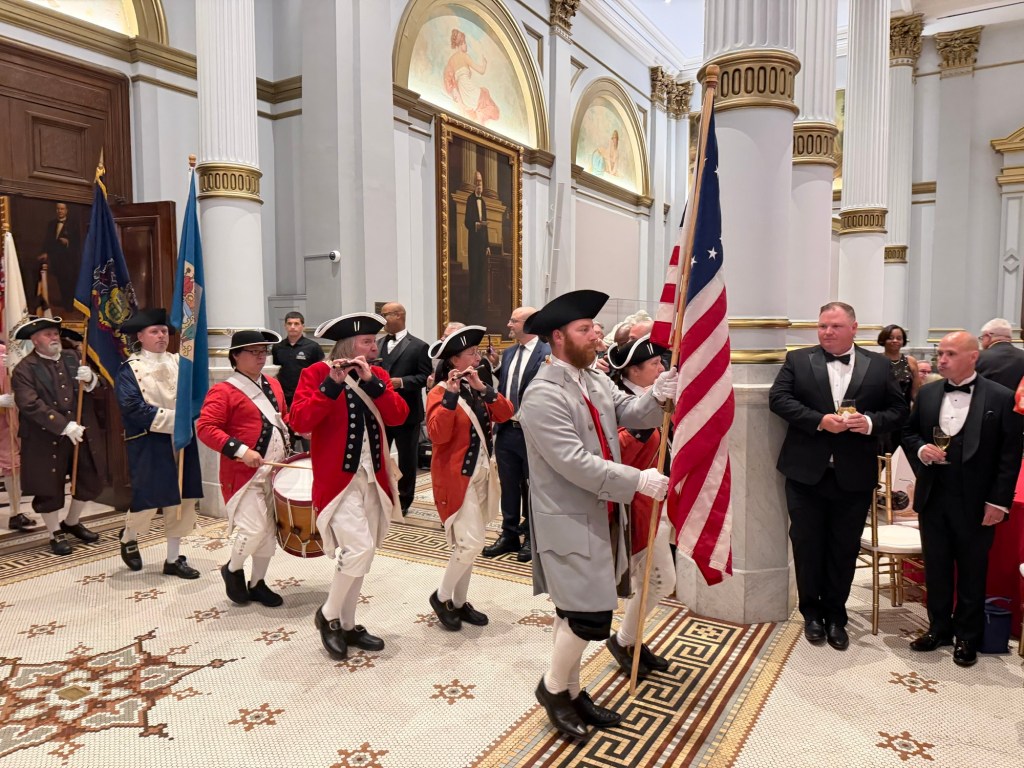
The evening opened in a manner no Manx festive board has yet attempted. A fife and drum party in Revolutionary period dress processed into the hall playing marching tunes, followed by a colour party bearing the national and state colours, while the assembled brethren and their guests stood in black tie on either side. It was theatrical, precisely drilled, and thoroughly enjoyed by everybody in the room.
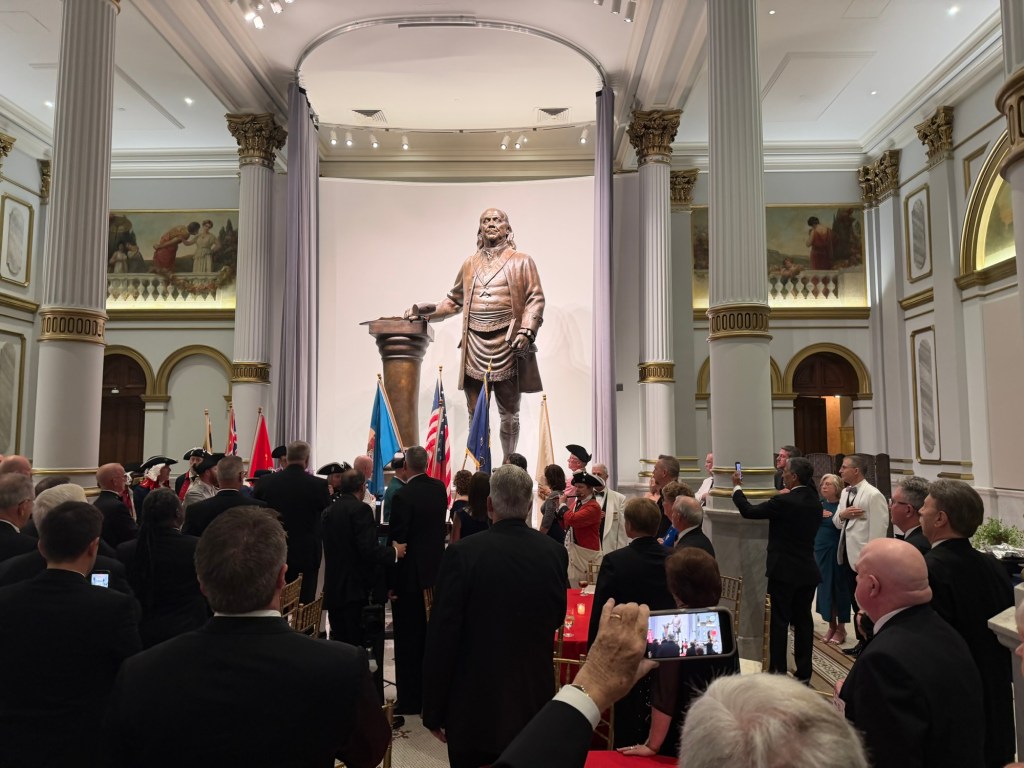
The formal proceedings took place beneath the bronze of Brother Benjamin Franklin. There were speeches, a prayer, and a poem that took the colours of the flag in turn, the red for the blood spilt for it, and closed by drawing the whole room together. Anyone arriving from an English constitution will find the register unfamiliar, since the civic and the ceremonial are woven together far more openly than we are used to at home, but the sincerity of it is not in doubt and the effect in that room was considerable.
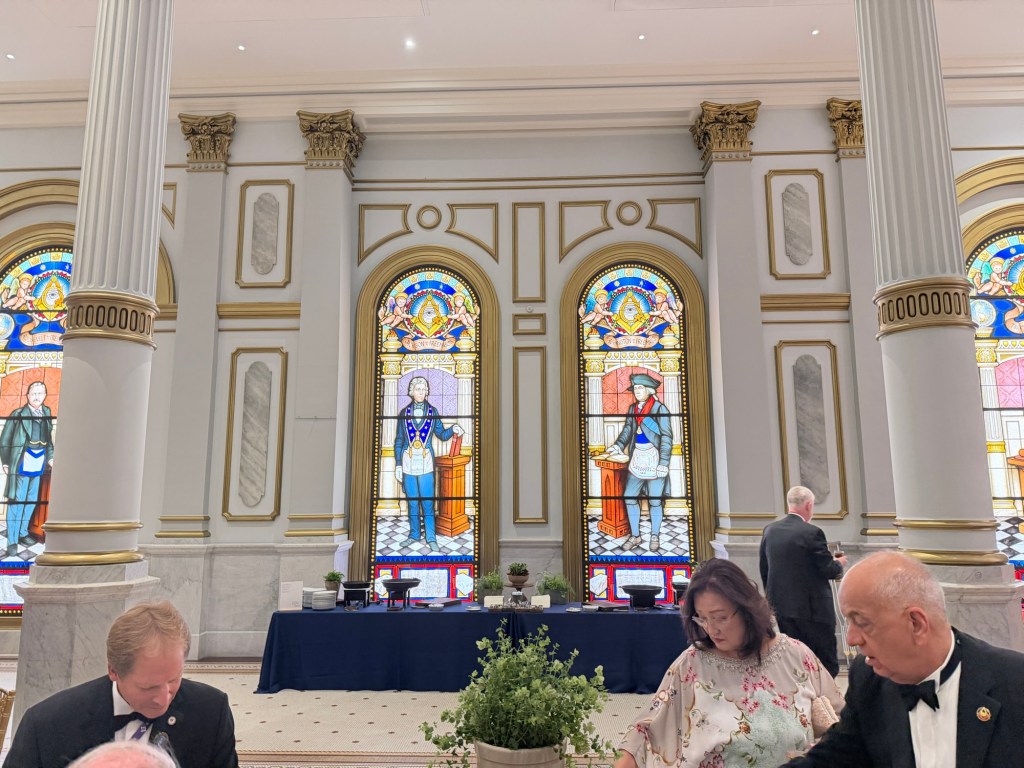
Dinner began in the banqueting hall, where the stained glass depicts Presidents of the United States who were also Freemasons, Washington among them, each shown at the pedestal in full Craft regalia. Little of it is subtle and none of it is apologetic, which is rather the point.
Food and drink stations were spread through the building rather than confined to one room, which had the sensible effect of sending everybody wandering. I ate a great deal of brisket, drank a fair amount of beer, and saw considerably more of the Temple than a guided tour would have allowed.
Two details
The first is that the reception desk operated a firearms deposit alongside the usual cloakroom arrangements, which is not a line item familiar from any summons I have seen.
The second is that a fellow guest, on hearing where I was from, asked whether I knew a senior Manx member of the Honourable Fraternity of Ancient Freemasons (HFAF), the women’s Order founded in 1913 and now also known as Freemasonry for Women, which is organised by women for women. As it happens I do. The Order has lodges across the United Kingdom and overseas, and since 2019 has had America Lodge No. 57 in Washington DC, so the transatlantic traffic runs in both directions. The two of them had met when she was over in May, and a photograph was duly taken at the dinner and sent on to her. The Craft remains a small world, even at four thousand miles.
I met a great many kind people, and left with a goody bag. Not the standard goody bag either, but the better one held back for the top brass, which I am choosing to attribute to charm. The likelier explanation is that Americans are extremely nice and I was standing in the right place.
Then back to the house to change out of the dinner jacket, and across town to an Irish pub, where the rebel programme was assembling for a pub quiz. Shorts at lunchtime, black tie at eight, a pub quiz by eleven. I have had less varied days.

