St James’s
Back in London, and back at the Royal Over-Seas League, where we arrived the evening before and settled in. Saturday was the reason for the trip.
Lunch first, a quick one at Maison François. Charcuterie and a gin and tonic, which by now will surprise nobody who reads this.
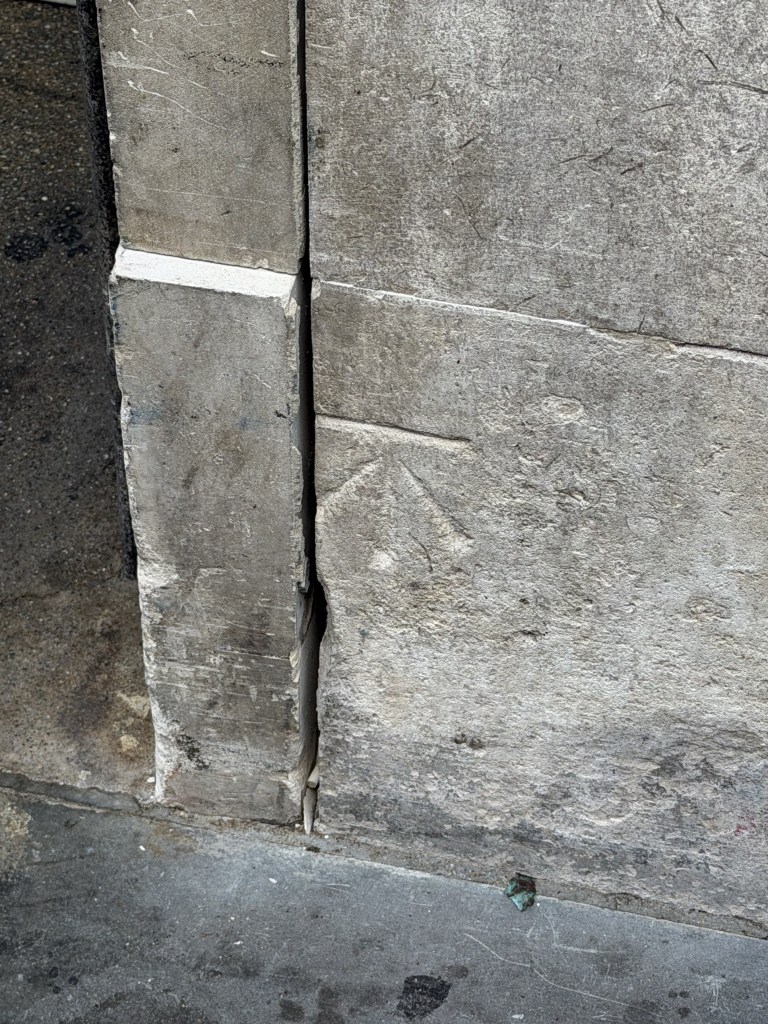
Then along Jermyn Street, where my girlfriend, being the star she is, spotted the bench mark at the back of Fortnum’s. We knew it was there. Every other time we had walked past, there had been bins in front of it.
Further along, on St James’s Street, outside Brooks’s, whose bench mark has already appeared here, stand a pair of lead planters full of geraniums. Cast into the side of one is a date: 1776. I thought the planter looked rather large and out of place.
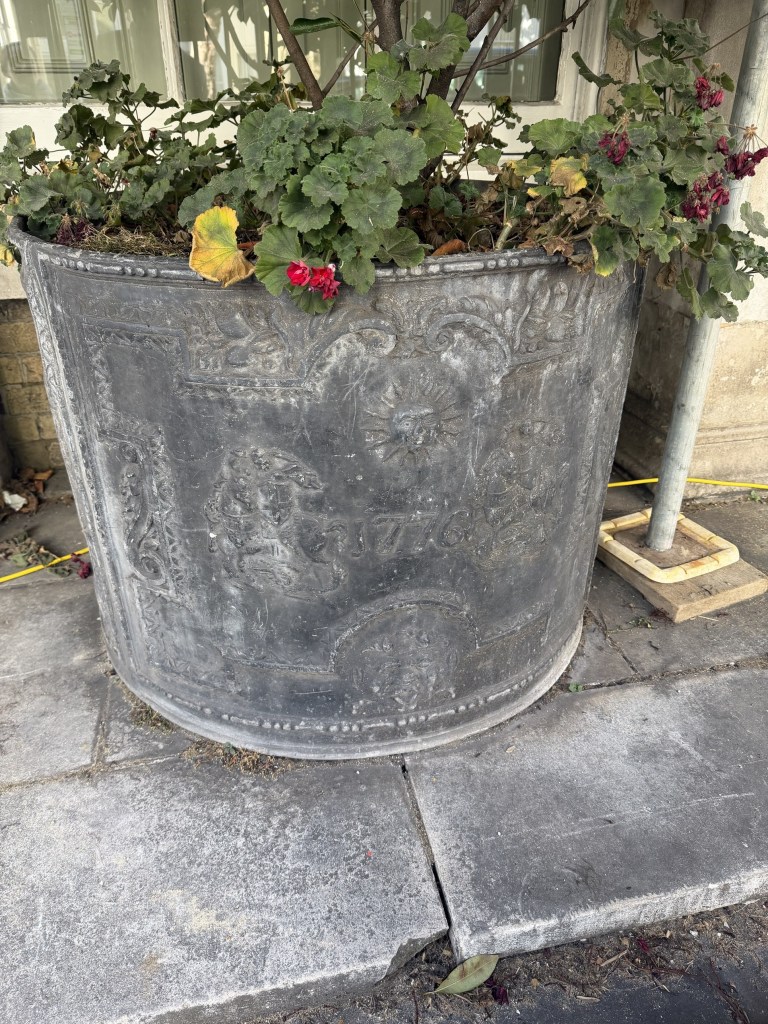
I spent the end of July in Philadelphia and Washington with a great many Freemasons marking two hundred and fifty years since that year. Brooks’s was the great Whig club, and Charles James Fox, one of the American colonists’ best-known friends in Parliament, was a member, so a planter cast in 1776 standing outside it would be a lovely thing. It would also be older than the clubhouse, which was not finished until October 1778, though a planter can always have come from somewhere else. The firmer reason for caution is that at least one architectural salvage dealer has sold a lead cistern made around 1930, decorated with horsemen and sun faces, which it describes plainly as spuriously dated 1776. This one has a sun face. That proves nothing about this pair, but if they are later pieces, they are cousins of the Declaration of Independence in Washington, where the original has faded almost to nothing and the version everyone pictures is an engraved copy of the 1820s. That copy, at least, never pretended to be anything else.
At which point I abandoned her for the rest of the day.
Mark Masons’ Hall
I met some friends from the Island at the Golden Lion on King Street, and from there we walked round to Mark Masons’ Hall on St James’s Street for the installation meeting of Alexandra Palace Lodge, at which I was to be declared Worshipful Master for a second year.
Before any of that there was work to do. Two brethren from other lodges were to be passed to the second degree, at the request of their own lodges, and we took them through together. The meeting was held in the Grand Temple and was well attended, by grand officers and junior brethren alike, and our visiting officer got stuck into the ceremony.
One of the two friends I had met at the Golden Lion has recently joined the lodge, which already had another Manx member, the one who introduced me. That made four Manxmen in the temple, three of them members of a lodge named after a building in north London.
The sword
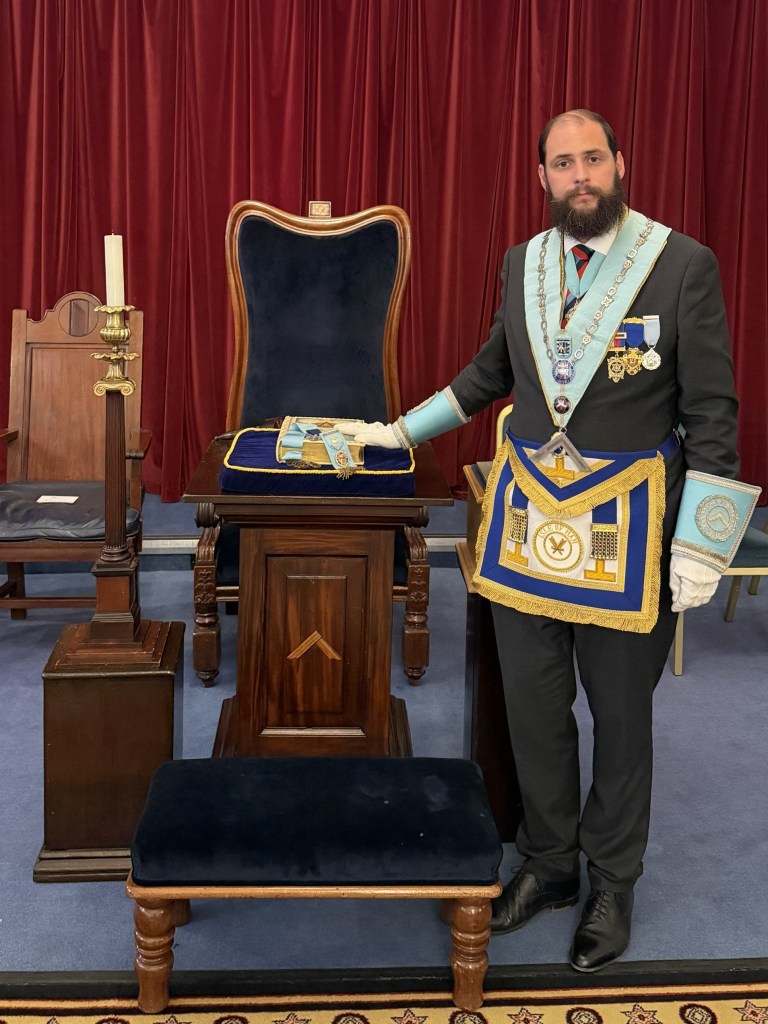
Readers who were here in August know the story: a surrender sword handed, as the lodge’s history has it, to Major General Snelling in Burma in 1945, and a blade that is never to be cleaned, because it is stained with the blood of British soldiers. What I have not described is what the Master does with it.
The Tyler comes in, hands over his collar and surrenders the sword. The Master invests him, shows him the sword, and then turns and holds it out level to the brethren while the story is told. Then comes the part that gets me. The sword is raised to the forehead, lowered to the lips, and lowered again to the chest, while the Master explains that it teaches us to set a watch at the entrance of our thoughts, a guard at the door of our lips, and a sentinel at the avenue of our actions. It is held out over the Volume of the Sacred Law towards the brethren, then turned towards the Tyler, and handed back to him, and he goes out to take up his post on the other side of the door.
That is the second time I have had the opportunity to do it, and both times I have had to hold back tears.
The Golden Lion
Afterwards, a quick pint back at the Golden Lion. It is a remarkable little building, tall, narrow and ornate, still standing between much larger and more modern neighbours. I had always understood it to have been part of an old theatre, and I remember an old Ordnance Survey map labelling it as one. Then I spotted the plaque.
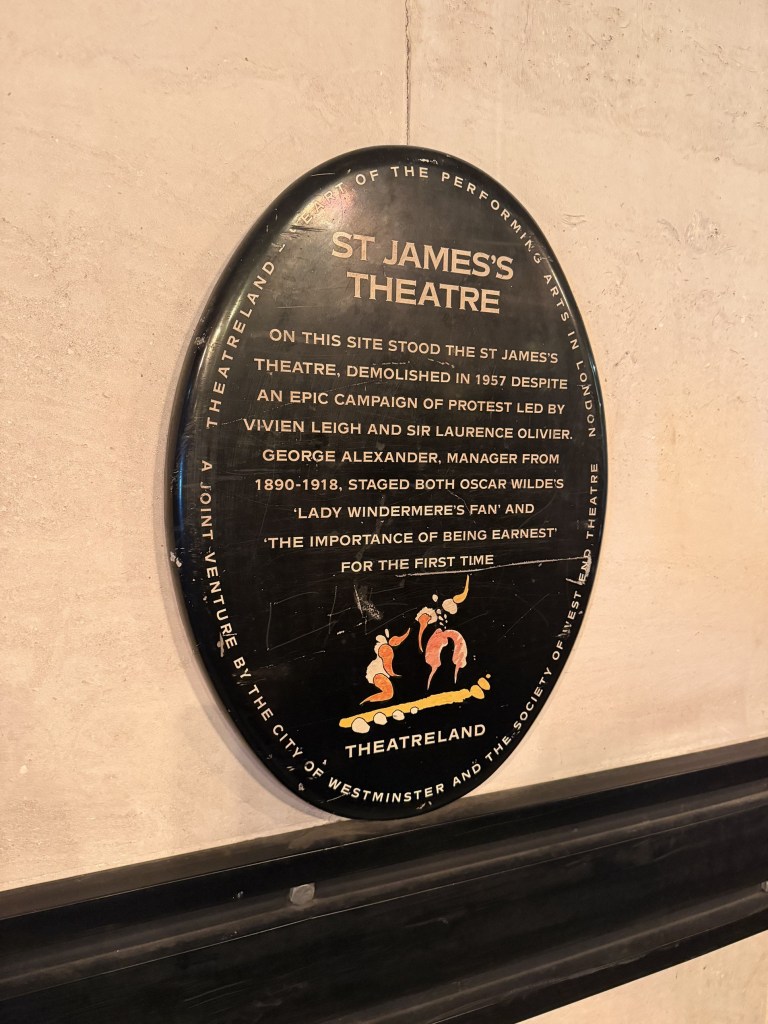
It records that the St James’s Theatre stood on this site and was demolished in 1957, despite a campaign of protest led by Vivien Leigh and Sir Laurence Olivier, and that George Alexander, its manager from 1890 to 1918, staged both Lady Windermere’s Fan and The Importance of Being Earnest there for the first time.
So the pub was never the theatre. It was the theatre’s neighbour, and as an establishment the older of the two. There has been a Golden Lion on this site since at least 1732. The St James’s was built next door in 1835 for the tenor John Braham, and stood for a hundred and twenty years. Its last performance was in July 1957, the campaign went as far as the House of Lords, and it came down anyway.
The building, though, is younger than it looks. The one I drank in went up in 1897 and 1898, in what the Survey of London calls a grotesque imitation of the Jacobean Baroque. The Importance of Being Earnest had its first night next door in February 1895. Within a few months Wilde was in prison, and when he was released in May 1897 he left for France and never came back. Building work on the new pub was due to start that summer. Whatever Golden Lion Wilde may have known, it was not this one.
Earlier that afternoon I had handed a sword back to a Tyler and watched him go out to keep the door. The Golden Lion has been keeping one on King Street since at least 1732. It stood beside the St James’s for the whole of its hundred and twenty years, outlasted it without anybody campaigning on its behalf, and has since outlasted the office block that replaced it as well. Still pouring, next to a theatre that is no longer there. We had our quick pint and left it on watch.

